
Near East (369–358 BCE): Revolt of the …
Years: 369BCE - 358BCE
Near East (369–358 BCE): Revolt of the Satraps and Persian Restoration
Between 369 and 358 BCE, the Near East is significantly shaped by internal turmoil within the Persian Empire, prominently featuring the Revolt of the Satraps. This widespread insurrection represents the greatest challenge to Persian authority since the earlier revolt led by Cyrus the Younger.
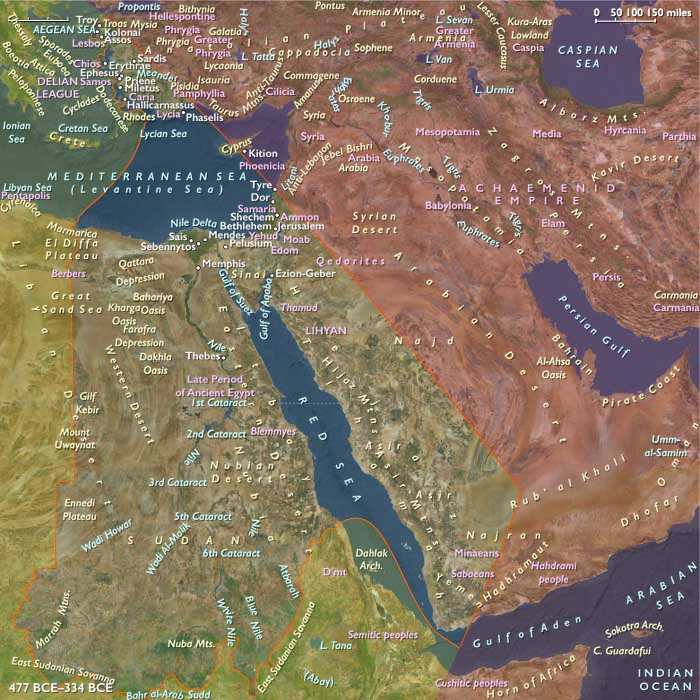
Key figures in this revolt include Orontes, traditionally identified as the satrap of Mysia but possibly of Armenia, indicating an even broader geographical scope of rebellion. Joining Orontes are notable regional rulers such as Mausolus of Caria (briefly), Autophradates of Lydia, and the distinguished military commander Datames, satrap of Cappadocia. Datames, respected for his skill, had inherited his position around 384 BCE but rebelled in 372 BCE due to deteriorating relations with the Persian court. Despite efforts by neighboring satraps Autophradates and Artumpara of Lycia to suppress his rebellion, Datames successfully withstands their attacks.
Further complicating matters, Ariobarzanes, satrap of Phrygia and initially a temporary appointee in Hellespontine Phrygia, refuses to yield his authority to the legitimate heir, Artabazos, and joins the revolt around 366 BCE. He receives crucial support from King Agesilaus II of Sparta, enabling him temporarily to withstand a siege by Persian-aligned satraps, including Mausolus and Autophradates. Nevertheless, Ariobarzanes is ultimately betrayed and killed in 363 BCE by his son Mithradates.
Orontes emerges as the leader of the insurgent satraps due to his noble status, but internal distrust among the rebels undermines the revolt. Seeking compromise, Orontes eventually betrays his fellow satraps, leading to the swift collapse of the rebellion. Datames, betrayed by his son-in-law Mitrobarzanes, is assassinated, and Persian authority is systematically restored through a series of treacheries.
By the time of King Artaxerxes II's death in 359 BCE, the revolt is effectively quelled, less by decisive Persian military action than by internal rivalries among the insurgents themselves. This era underscores the persistent challenges to Persian dominance and highlights the complex interplay of local ambition and imperial control shaping the Near Eastern geopolitical landscape.
People
- Agesilaus II
- Ariobarzanes of Phrygia
- Artabazus II of Phrygia
- Artaxerxes II Mnemon
- Artumpara
- Autophradates of Lydia
- Datames
- Mausolus
- Mithridates of Cius
- Orontes I
Groups
Topics
Subjects
Regions
Subregions
Years: 369BCE - 358BCE
People
- Agesilaus II
- Ariobarzanes of Phrygia
- Artabazus II of Phrygia
- Artaxerxes II Mnemon
- Artumpara
- Autophradates of Lydia
- Datames
- Mausolus
- Mithridates of Cius
- Orontes I
Groups
Topics
Subjects
Regions
Subregions