
Near East (765–622 BCE): Rise, Reform, and …
Years: 765BCE - 622BCE
Near East (765–622 BCE): Rise, Reform, and Regional Shifts
Egypt and the Nubian Dynasty
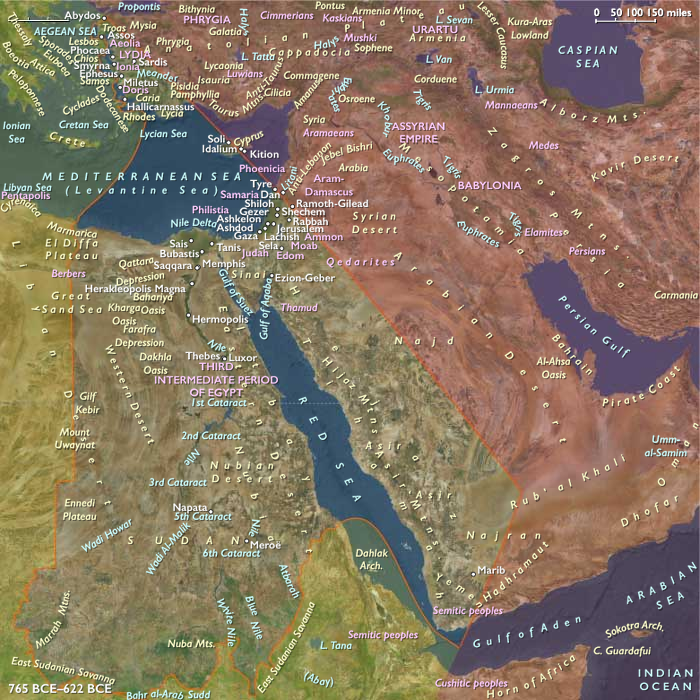
During this era, Egypt is characterized by the rule of both native Egyptians and foreign Nubian kings, notably from the Twenty-fourth and Twenty-fifth Dynasties. Nubian influence peaks with the reign of Kashta (ca. 750–740 BCE), who takes control of Upper Egypt and Thebes, laying the groundwork for the Twenty-fifth Dynasty. His successor, Piye, successfully reunifies Egypt, extending Nubian dominance from Nubia to the Nile Delta.
The Nubian dynasty, ardent worshippers of Amun, views Egyptian traditions reverently, revitalizing temples and religious practices. However, their expansion into Syria-Palestine provokes conflict with Assyria. The Assyrian king Esarhaddon ultimately invades Egypt in 671 BCE, displacing the Nubian rulers and reinstating local rulers at Sais. The Nubians retreat to Napata, from where they continue to govern Kush.
Judah: Religious Revival and Reformation
Following Israel’s collapse to Assyria in 722 BCE, the Kingdom of Judah emerges as the sole representative of Hebrew sovereignty, preserving its independence as an Assyrian vassal state. Judah experiences considerable prosperity and religious shifts under kings like Uzziah and Hezekiah. However, true transformation comes under King Josiah (641–609 BCE), whose reforms dramatically reshape Judah’s religious identity.
Josiah's campaign, beginning around 626 BCE, is bolstered by the discovery of an early form of Deuteronomy in 622 BCE. Josiah centralizes worship in Jerusalem, eliminating pagan altars and foreign deities, including the cult of Asherah, and renews the covenant between Yahweh and the nation. This religious reform, supported by prophets such as Zephaniah, lays foundational elements of monotheistic Judaism, profoundly influencing Judah’s future cultural and spiritual trajectory.
Assyrian Dominance and Decline
The powerful Assyrian Empire dominates much of the Near East through military conquest and political pressure, successfully subduing kingdoms like Israel and city-states across Phoenicia and Philistia. Yet, after the death of Ashurbanipal in 627 BCE, Assyria’s power wanes rapidly, plunging the region into uncertainty and allowing former vassal states like Judah to assert greater autonomy.
Philistia, Phoenicia, and Regional Instability
Philistine and Phoenician cities, including Tyre and Ashkelon, become Assyrian vassals but repeatedly rebel against their overlords. These revolts are brutally suppressed, notably by Sargon II and Sennacherib, leaving these coastal kingdoms weakened yet culturally resilient. By the late seventh century BCE, Egypt under Psamtik I exerts significant influence over Philistia, notably besieging Ashdod and making it a vassal state.
Emergence of Greek Influence: Ionia and Cyprus
Greek settlement intensifies in the coastal regions of Asia Minor and the island of Cyprus, where Ionian cities such as Miletus and Ephesus and Cypriot kingdoms flourish culturally and commercially. Assyrian dominance briefly extends over Cyprus around 708 BCE, but local autonomy largely persists, allowing continued Greek cultural and economic prosperity.
Edom, Moab, and the Kingdom of Kush
In Edom, settlement and economic activity intensify in the late eighth century BCE, as indicated by archaeological records. Moab, linguistically and culturally close to Judah, nonetheless becomes an Assyrian tributary state. Meanwhile, the Nubian Kingdom of Kush, having retreated from Egypt, maintains an influential presence, ruling from Napata and then moving its capital to Meroe, strategically situated along vital trade routes.
Legacy of the Age
The period from 765 to 622 BCE is a transformative era marked by significant political shifts, religious reforms, and regional reconfigurations. Judah’s move toward religious centralization under Josiah shapes the future of Hebrew religious identity, laying critical groundwork for monotheistic Judaism. Simultaneously, the weakening of Assyria creates a power vacuum filled by emergent regional powers such as Egypt, Lydia, and the reassertion of local autonomy throughout the Near East. These transformations set the stage for profound historical developments in subsequent centuries.
People
- Ashurbanipal
- Esarhaddon
- Hezekiah of Judah
- Josiah of Judah
- Kashta
- Piye
- Psamtik I
- Sarduri II
- Sennacherib
- Uzziah of Judah
- Zephaniah
Groups
- Egyptians
- Nubians
- Phoenicians
- Tyre, Kingdom of (Phoenicia)
- Edomites, Kingdom of the
- Moabites, Kingdom of the
- Ionians
- Philistines
- Lydia, Kingdom of
- Kush, Kingdom of
- Egypt (Ancient), Third Intermediate Period of
- Miletus (Ionian Greek) city-state of
- Judah, Kingdom of
- Israel (Northern Kingdom of)
- Cyprus, Classical
- Ephesus (Ionian Greek) city-state of
- Greeks, Classical
- Egypt (Ancient), Late Period of
Subjects
Regions
Subregions
Years: 765BCE - 622BCE
People
- Ashurbanipal
- Esarhaddon
- Hezekiah of Judah
- Josiah of Judah
- Kashta
- Piye
- Psamtik I
- Sarduri II
- Sennacherib
- Uzziah of Judah
- Zephaniah
Groups
- Egyptians
- Nubians
- Phoenicians
- Tyre, Kingdom of (Phoenicia)
- Edomites, Kingdom of the
- Moabites, Kingdom of the
- Ionians
- Philistines
- Lydia, Kingdom of
- Kush, Kingdom of
- Egypt (Ancient), Third Intermediate Period of
- Miletus (Ionian Greek) city-state of
- Judah, Kingdom of
- Israel (Northern Kingdom of)
- Cyprus, Classical
- Ephesus (Ionian Greek) city-state of
- Greeks, Classical
- Egypt (Ancient), Late Period of
Subjects
Regions
Subregions