
Near East (633–622 BCE): Religious Reformation and …
Years: 633BCE - 622BCE
Near East (633–622 BCE): Religious Reformation and Regional Turmoil
Judah’s Religious Revival under Josiah
The decline and eventual death of the Assyrian king Ashurbanipal in 627 BCE weakens Assyrian dominance, allowing Judah significant autonomy for the first time in over a century. King Josiah of Judah, guided by a regency council of influential priests and landowners, embarks upon a vigorous campaign of national independence and religious renewal.
In 623–622 BCE, Josiah orders the High Priest Hilkiah to use accumulated tax revenue for the extensive renovation of the Jerusalem Temple. During these renovations, Hilkiah reportedly discovers a scroll containing the "Book of the Law," widely recognized by scholars as an early edition of Deuteronomy. This influential text, traditionally ascribed to Moses but likely compiled during Josiah's reign from earlier Israelite traditions, emphasizes monotheistic devotion to Yahweh, the rejection of foreign gods, and centralized worship.
Josiah’s reforms profoundly reshape Judah’s religious landscape. He systematically removes foreign altars, desecrates local sanctuaries, and centralizes sacrificial practices exclusively in Jerusalem. The Passover celebration, newly centralized in the Temple, achieves unprecedented prominence, as Josiah positions Jerusalem as the singular spiritual and political heart of the nation. His religious purge extends to the violent eradication of pagan practices, notably the destruction of the cult of Asherah, previously worshiped alongside Yahweh as his consort.
To cement this spiritual renewal, Josiah convenes a public assembly to formally ratify a covenant based on the newly discovered Torah, setting a definitive precedent for state enforcement of religious adherence and significantly advancing the canonization of sacred Hebrew scriptures.
Prophetic Advocacy by Zephaniah
The religious reforms gain vocal support from prophets such as Zephaniah, who around 630 BCE vigorously condemns foreign religious practices, idolatry, and those skeptical of divine judgment. His preaching aligns closely with Josiah's aggressive campaign against polytheism and social injustice, reinforcing the ideological foundations of the king's reform.
Lydia’s Struggles and the Decline of the Cimmerians
In Asia Minor, Ardys II of Lydia faces renewed conflicts. He successfully recaptures Miletus and conquers Priene, yet Sardis, Lydia’s capital, experiences a second devastating sack—this time by the Treres, a Thracian tribe allied with the Cimmerians. The Assyrians eventually defeat the Cimmerians in Cilicia between 637 and 626 BCE, bringing an end to their dominance in western Asia. Following their defeat, the Cimmerians fade from historical records, possibly settling in Cappadocia, suggested by its Armenian name "Gamir."
Scythian Invasions and Egyptian Response
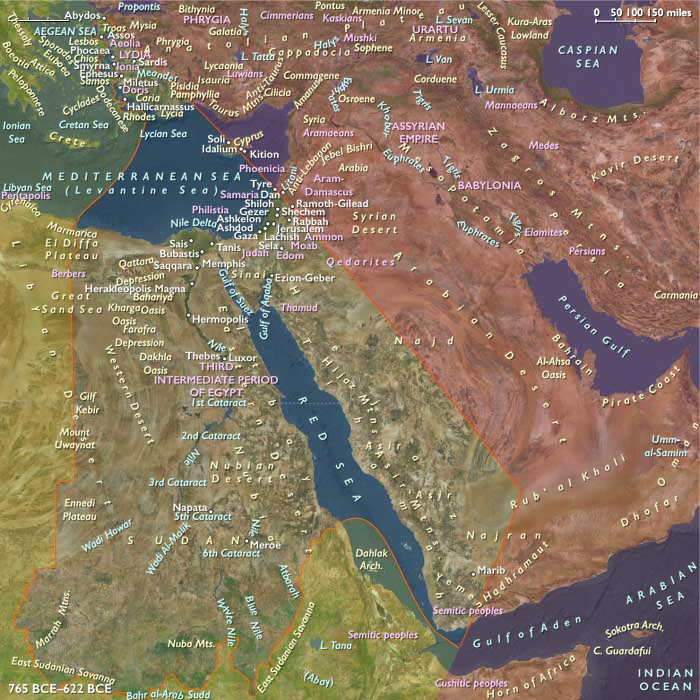
Further regional instability arises in 626 BCE when Scythians under King Madyes exploit Assyria’s diminished military strength, freely ravaging Syria and Palestine. According to Herodotus, these Scythian incursions reach as far as Egypt, prompting Pharaoh Psamtik I to pay substantial tribute to avoid invasion. Despite this payment, the Scythians sack Ashkelon and its ancient temple, underscoring the vulnerability of regional powers in the face of nomadic threats.
Egypt’s Consolidation under Psamtik I
In Egypt, Pharaoh Psamtik I, founder of the Twenty-Sixth Dynasty, continues his methodical consolidation of authority. With local rulers initially secured through diplomacy, Psamtik systematically replaces them with loyal royal officials. Psamtik notably besieges Ashdod for twenty-nine years, as recorded by Herodotus, ultimately bringing this Philistine city—and indeed the entire Philistine region—firmly under Egyptian vassalage by the end of his reign.
Legacy of the Era
The era from 633 to 622 BCE is defined by critical shifts in religious and political landscapes across the Near East. Josiah’s religious reforms fundamentally alter the cultural and spiritual identity of Judah, laying essential foundations for monotheistic Judaism. Meanwhile, the decline of external powers, including the Cimmerians and Assyrians, coupled with the persistent threat of Scythian raids, fosters an environment of heightened political uncertainty and shifting alliances, reshaping the geopolitical fabric of the region for decades to come.
People
Groups
- Aeolians
- Lydia, Kingdom of
- Kush, Kingdom of
- Priene, Greek City-State of
- Miletus (Ionian Greek) city-state of
- Cimmerians
- Judah, Kingdom of
- Greeks, Classical
- Treres
- Egypt (Ancient), Late Period of
Subjects
Regions
Subregions
Years: 633BCE - 622BCE
People
Groups
- Aeolians
- Lydia, Kingdom of
- Kush, Kingdom of
- Priene, Greek City-State of
- Miletus (Ionian Greek) city-state of
- Cimmerians
- Judah, Kingdom of
- Greeks, Classical
- Treres
- Egypt (Ancient), Late Period of
Subjects
Regions
Subregions