
Near East (681–670 BCE): Assyrian Conquest of …
Years: 681BCE - 670BCE
Near East (681–670 BCE): Assyrian Conquest of Egypt and Apostasy in Judah
Esarhaddon's Egyptian Campaign
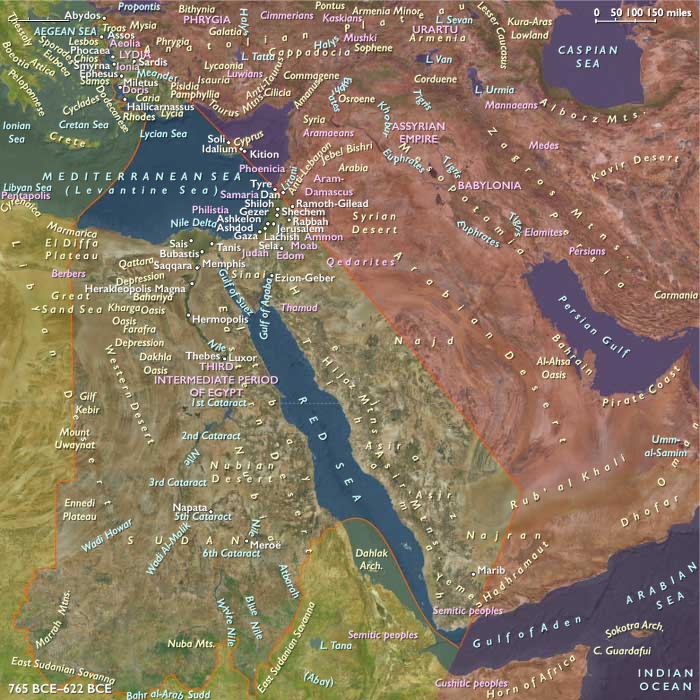
The Assyrian king Esarhaddon, driven by Egypt's persistent resistance to Assyrian dominance in Syria-Palestine, initially mounts an unsuccessful invasion in 675 BCE. Undeterred, he mobilizes again in 671 BCE, targeting the powerful Nubian Pharaoh Taharqa, ruler of the Kushite Twenty-fifth Dynasty. While a portion of Esarhaddon's forces remains in the Levant to quell rebellions in strategic cities such as Tyre and possibly Ashkelon, the main Assyrian army crosses the treacherous Sinai desert—infamous for its hostile wildlife—and penetrates deep into Egypt.
Capture of Memphis and Its Aftermath
In the summer of 671 BCE, Esarhaddon successfully captures Memphis, the ancient capital, compelling Taharqa to retreat to Upper Egypt. Victorious, Esarhaddon proclaims himself "King of Egypt, Patros, and Kush," marking a significant extension of Assyrian power. To commemorate his triumph, he erects a victory stele depicting Prince Ushankhuru, Taharqa's young son, bound as a captive. Nevertheless, Egyptian resistance quickly resurfaces once Esarhaddon departs, prompting him to dispatch his general, Sha-Nabu-shu, to forcibly restore Assyrian authority along the Nile.
Judah’s Religious Reversal under Manasseh
Meanwhile, in Judah, Manasseh—Hezekiah's son and successor since 687 BCE—abruptly reverses his father's religious reforms. In sharp contrast to Hezekiah’s strict adherence to Yahweh, Manasseh openly embraces apostasy, reinstating previously banned Canaanite religious practices. According to the Hebrew Bible, he reintroduces soothsaying, augury, sorcery, and necromancy, even allegedly offering his own son as a human sacrifice. The reign of Manasseh is described by the Deuteronomic historians as one marked by widespread bloodshed, religious regression, and moral decline.
Legacy of the Era
The era from 681–670 BCE is defined by stark contrasts—while Assyria expands its empire aggressively into Egypt, signaling a peak of imperial power, Judah undergoes internal turmoil through Manasseh’s controversial reign. Esarhaddon's conquest demonstrates Assyria’s reach and resourcefulness, yet Egyptian resistance underscores the enduring difficulties of imperial control. Manasseh’s rule, meanwhile, signals deepening internal divisions in Judah, setting the stage for future religious and political upheaval.
People
Groups
- Philistines
- Egypt (Ancient), Third Intermediate Period of
- Greeks, Classical
- Assyria, (New) Kingdom of (Neo-Assyrian Empire)
Topics
Commodoties
Subjects
Regions
Subregions
Years: 681BCE - 670BCE
People
Groups
- Philistines
- Egypt (Ancient), Third Intermediate Period of
- Greeks, Classical
- Assyria, (New) Kingdom of (Neo-Assyrian Empire)
Topics
Commodoties
Subjects
Regions
Subregions