Emperor Nero, touring Greece in 67, unsuccessfully …
Years: 67 - 67
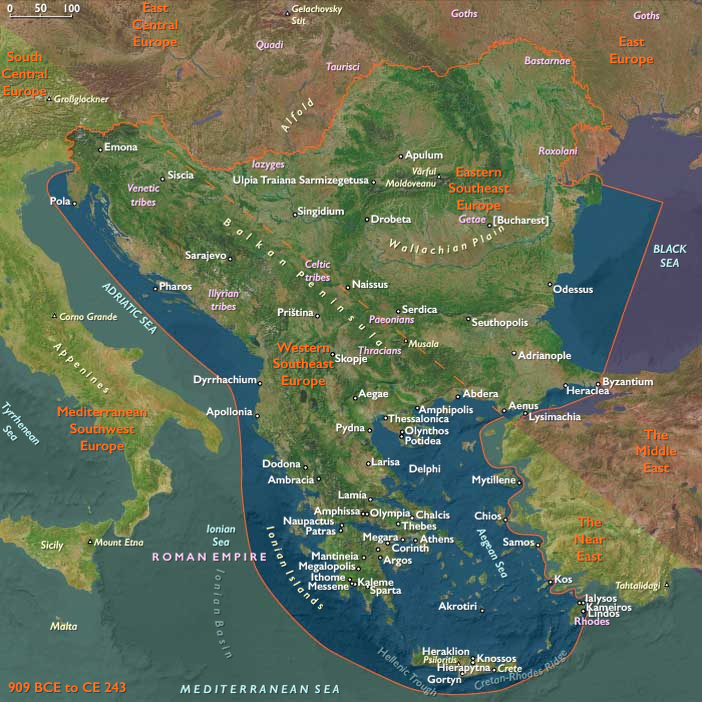
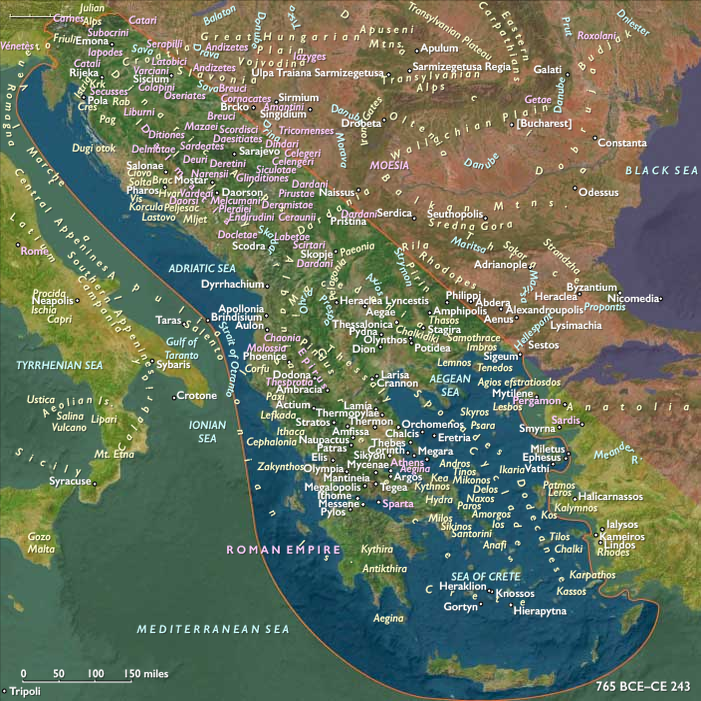
Emperor Nero, touring Greece in 67, unsuccessfully attempts construction of a canal across the Isthmus of Corinth, a narrow strip of land connecting central Greece to the Peloponnesus, in a bid to shorten the journey from the Adriatic Sea to Piraeus.
Ancient historians state that this projects and others exacerbated the drain on the State's budget, already stressed by consequences of the Great Fire of Rome in 64.
After two failed plots in 62 by noblemen and senators, including Lucius Annius Vinicianus, to overthrow Nero, the emperor has become suspicious of Vinicianus’ father-in-law Corbulo, governor of the province of Asia, and his support among the Roman masses.
When disturbances break out in Judaea in 67, Nero, ordering Vespasian to take command of the Roman forces, summons Corbulo, as well as two brothers who are the governors of Upper and Lower Germany, to Greece.
On his arrival at Cenchreae, the port of Corinth, messengers from Nero meet Corbulo, and order him to commit suicide, which he loyally obeys by falling on his own sword.
Locations
People
Groups
Topics
Commodoties
Subjects
Regions
Subregions
Related Events
Filter results
Showing 10 events out of 61644 total
Emperor Ming is known for his generosity and affection for his brothers early in his reign.
This, however, apparently has caused some of them to engage in behavior that is considered taboo at the time and, ironically, causes them to be severely punished by Emperor Ming, leading also to two major mass executions that blot Emperor Ming's record.
The first of these incidents occurs in 66-67 and is relatively bloodless.
The ambitious Prince Jing of Guanglin wants to be emperor, and plots with people under him to rebel.
When he is informed upon, he confesses, and Emperor Ming initially spares him and permits him to remain the Prince of Guanglin but strips from him his political powers.
However, Prince Jing later hires warlocks to curse Emperor Ming.
After this is discovered, Emperor Ming initially takes no action, but in 67 forces Prince Jing to commit suicide.
Emperor Nero had promoted an expedition to discover the sources of the Nile River between 62 and 67, According to Pliny the Elder and Seneca,
Nero's expedition up the Nile, the first exploration of equatorial Africa from Europe in history, fails because water plants had clogged the river, denying Nero's vessels access to the Sudd of Nubia, a vast swamp formed by the White Nile in present South Sudan.
The shock of the defeat at the Battle of Beth-Horon has persuaded the Romans of the need to fully commit to crushing the rebellion regardless of the effort it will require.
Soon after his return, Gallus had died and been succeeded in the governorship of Syria by Licinius Mucianus.
Mucianus, who had been sent by Claudius to Armenia with Gnaeus Domitius Corbulo, is recorded around 65 as suffect consul under Nero.
After he, too, fails to put down the Jewish revolt, Nero and the senate, greatly annoyed by the revolt and Gallus’ loss of six thousand men, gives Titus Flavius Sabina Vespasianus (Vespasian), who has held many political and military offices, the command against the rebels.
Vespasian lands at Ptolemais in April 67 with two legions, with eight cavalry squadrons and ten auxiliary cohorts.
Here he is joined by his elder son Titus, who arrives from Alexandria at the head of Legio XV Apollinaris, as well as by the armies of various local allies including that of king Agrippa II.
Vespasian, fielding more than sixty thousand soldiers, begins operations by subjugating Galilee.
Many towns give up without a fight, although others have to be taken by force.
The Romans quickly break the Jewish resistance in the north.
The Jews have failed to establish an effective field army and Vespasian's campaign is therefore dominated by sieges.
Josephus after a failed attempt to confront the Roman army at Sepphoris had retired to Tiberias but soon establishes himself at Yodfat (Jotapata), drawing the Roman legions to the town.
Yodfat, however, suffers from a lack of any local natural source of water.
Excavations have revealed the existence of an extensive system of cisterns, both public and private, that were used to collect rain water.
While a large quantity of corn had been stored away, Yodfat's dependence on a limited and diminishable supply of water will prove problematic during the Roman siege.
Josephus puts the population of Yodfat on the eve of the siege at over forty thousand people, including refugees, although this number is undoubtedly inflated.
On the forty-seventh day of the siege, the day when the ramp surpasses the walls, a deserter goes over to the Romans and discloses the dire situation within Yodfat.
Few defenders have remained, and these, worn out by their perpetual fighting and vigilance, usually sleep during the last watch of the night.
At dawn on the very next day (July 20, 67), a band of Romans reportedly led by Titus himself stealthily scales the walls, cuts the throats of the watch and opens the gates, letting in the entire Roman army.
The Jews, taken by surprise, are furthermore confounded by a thick mist, and the Romans quickly take hold of the summit, pursuing the inhabitants down the eastern slope.
According to Josephus, forty thousand are slain or commit suicide and twelve hundred women and infants are taken into slavery, while the Romans suffer but a single fatality.
Vespasian orders the town demolished and its walls torn down.
The Romans prohibit burial of the fallen and it is only a year or more later when Jews are allowed to return to bury the remains in caves and cisterns.
Yosef Ben-Matityahu had hidden in one of the caves that litter the site, along with forty other prominent citizens of Yodfat.
Although Ben-Matityahu is in favor of surrendering to the Romans, the majority of his comrades opt to kill themselves rather than fall into Roman hands.
As suicide is considered sinful, they decide to draw lots to kill each other.
Ben-Matityahu and another man, however, are the last to survive, and both resolve to give themselves up.
Taken in chains to see the Roman general, Ben-Matityahu, assuming the role of a prophet, foretells that Vespasian will one day become emperor.
Vespasian subsequently spares the rebel leader, who begins collaborating with the Romans.
At first a slave, he will later be freed and be granted Roman citizenship as Flavius Josephus.
Josephus' role as leader of the defenders of Yodfat, his subsequent collaboration with the Romans and his servitude to the Flavians have all made his account of the siege of Yodfat suspect.
As the sole account of the battle, as well as of many events of the Great Revolt, the credibility of Josephus has been a central subject of historical inquiry.
Although evidence from excavations indicate that hundreds, possibly thousands, of people were clearly killed during the battle, the archaeology of Yodfat also reveals that the fortification of Yodfat cannot be credited to Josephus' effort alone.
Furthermore, archaeology is unable to provide insight into many of the details he provides, particularly events surrounding the final fall of Yodfat and his surrender to Vespasian.
The figure he provides for the population of Yodfat, and the large number of casualties are clearly inflated.
A more realistic figure would place the population of the town on the eve of the siege, including refugees and fighting men, at seven thousand people.

Vespasian repeatedly attempts to parley for peace with the rebels, who will have none of it.
He is forced to battle the rebels at Tiberias and …
…Giscala, the last town in Galilee not yet conquered.
Outside the walls of the city, Titus calls on the defenders to surrender.
John of Giscala prevails upon Titus not to enter the city that day, as it was Sabbath, "not so much out of regard to the seventh day as to his own preservation."
John flees to Jerusalem that night.
The fortress of Gamala, situated at the southern part of the Golan, overlooking the Sea of Galilee, had been built on a steep hill shaped like a camel's hump, from which it derives its name (Gamla meaning 'camel' in Aramaic).
The city appears to have been founded as a Seleucid fort during the Syrian Wars (third century BCE) which later became a civilian settlement.
Jews have inhabited it from the last quarter of the second century BCE, and it had been annexed to the Hasmonean state under king Alexander Jannaeus in about 81 BCE.
Josephus, who had in 66 CE fortified Gamla as his main stronghold on the Golan, gives a very detailed topographical description of the city and the steep ravines which precluded the need to build a wall around it.
Only along the northern saddle, at the town's eastern extremity, was a three hundred and fifty meter-long wall built, constructed by blocking gaps between existing houses and destroying houses that lay in its way.
Initially loyal to the Romans, Gamla had turned rebellious under the influence of refugees from other locations.
It is one of only five cities in the Galilee and Golan who stand against Vespasian's legions, reflecting the cooperation between the local population and the rebels.
At the time of the revolt, the town mints its own coins, probably more as a means of propaganda than as currency.
Bearing the inscription "For the redemption of Jerusalem the H(oly)" in a mixture of paleo-Hebrew (biblical) and Aramaic, only six of these coins have ever been found.
Josephus also provides a detailed description of the Roman siege and conquest of Gamla in 67 CE by components of legions X Fretensis, XV Apollinaris and V Macedonica.
The Romans first attempt to take the city by means of a siege ramp, but are repulsed by the defenders.
Only on the second attempt do the Romans succeed in breaching the walls at three different locations and invading the city.
They then engage the Jewish defenders in hand-to-hand combat up the steep hill.
Fighting in the cramped streets from an inferior position, the Roman soldiers attempt to defend themselves from the roofs.
These subsequently collapse under the heavy weight, killing many soldiers and forcing a Roman retreat.
The legionnaires reenter the town a few days later, eventually beating Jewish resistance and completing the capture of Gamla.
According to Josephus, some four thousand inhabitants were slaughtered, while five thousand, trying to escape down the steep northern slope, were either trampled to death, fell or perhaps threw themselves down a ravine.
These appear to be exaggerated and the number of inhabitants on the eve of the revolt has been estimated at three thousand to four thousand.
The notion that these inhabitants committed mass suicide has also been questioned, as the account appears to force an analogy with the story of the end of the siege of Masada, also recounted by Josephus.
The Greek word Josephus used implies a hasty, clumsy flight while suicide is forbidden under most circumstances by Jewish law.
Eleazar ben Simon, following his victory against Cestius' forces, was deposed from power in Jerusalem by the High Priest Ananus ben Ananus.
Although he had proven his devotion and leadership at Beit-Horon, Eleazar ben Simon had been given no office "because of his tyrannical temperament" (Josephus, The Jewish War, 2.564).
Contrary to the radical anti-Roman agenda of the Zealots, Ananus and the other moderate leaders of Jerusalem wish to stabilize the conflict and reach equilibrium with Rome.
They fear that appointing a Zealot to power would provoke Rome to attack and would diminish their own power.
Eleazar despite his rejection from power remains in Jerusalem promoting the Zealot cause from his headquarters at the Temple.
During the summer of 67, Eleazar and his Zealots attempt to dismantle the moderate government of Ananus by imprisoning officials who remain from the procurator period before the revolt and spreading the fear that the moderate Temple aristocracy will undermine the Jewish nationalist cause.
As Vespasian's armies terrorize the countryside of Judea and Galilee, thousands of Jewish refugees join Eleazar's ranks in hopes of intensifying Roman resistance, having witnessed their terror tactics.
With growing support, Eleazar successfully appoints a puppet High Priest in Jerusalem to usurp power from Ananus and seizes control of the Temple.
Nero, whose great passion is art, has scandalized Roman society by continuous public displays of his talents as a chariot driver, singer, and musician.
The emperor immerses himself in artistic pursuits, allowing the reins of power to slip from his hands.
Nero is persuaded to participate in the Olympic Games of 67 in order to improve relations with Greece and display Roman dominance.
As a competitor, Nero races a ten-horse chariot and nearly dies after being thrown from it.
He also performs as an actor and a singer.
Though Nero falters in his racing (in one case, dropping out entirely before the end) and acting competitions, he wins these crowns nevertheless and parades them when he returned to Rome.
The victories are attributed to Nero bribing the judges and his status as emperor.
The author of the Epistle to the Colossians (possibly written by Paul during one of his incarcerations after 60, or by a later follower of Paul who further develops some of his ideas) confronts a form of gnosticism that teaches that angelic powers rule the cosmos and that various ascetic and ritual practices are required of Christians.
In arguing against these teachings, the author posits that since Christ is lord of the whole cosmos and has saved believers, neither fear nor extreme practices are appropriate.
Colossians, like the earlier Ephesians, describes the church as a body, with Christ as its head.
The letter is supposed (or intended) to be written by Paul at Rome during his first imprisonment.
(Acts 28:16, 28:30) If the letter is not considered to be an authentic part of the Pauline corpus it might be dated during the late first century, possibly as late as the 80s.
The Epistle to the Hebrews, probably written between 60 and 90 to a general audience, features a symbolic style and sustained argument that identify it as a Hellenistic work based on the Jewish tradition.
(The only New Testament letter not introduced by the name of its author, Hebrews has traditionally, it has been ascribed to Paul, but modern scholars suggest that it, like Colossians, may have been written by another author, perhaps a disciple of Paul.)
The epistle’s first part describes Jesus Christ as superior to Moses; viewing him as the high priest who replaces the Levitical priesthood and who establishes a new covenant to be accepted by faith.
The second part offers counsel on persevering faithfully in the new covenant, urging Christians to uphold the exemplary ideal of Old Testament heroes of faith.
The use of tabernacle terminology in Hebrews has been used to date the epistle before the destruction of the temple, the idea being that knowing about the destruction of both Jerusalem and the temple would have influenced the development of his overall argument to include such evidence.
Therefore, the most probable date for its composition is the second half of the year 63 or the beginning of 64, according to the Catholic Encyclopedia.
Another argument in favor of an early dating is that the author seems unfamiliar with the Eucharist ritual (had the author been familiar, it would have served as a great example).
Peter (about whom the New Testament is silent after his meeting in 51 with James and Paul) is the possible author of the first of two Epistles of Peter.
Possibly written from Rome ("Babylon", as the author calls it) to strengthen Christians suffering persecution in Anatolia just before 64, Peter explains the suffering as a test of faith and directs the persecuted Christians to their living hope founded on God, who raised Jesus from the grave.
2 Peter, probably written for the same Anatolian audience as was 1 Peter, cautions against false teachers in the community and gives affirmative assurance that Christ will return.
(Scholars question the authorship of 2 Peter; no mention of the letter occurs until about the third century.)