
The most significant achievements of the Classical …
Years: 532 - 675
The most significant achievements of the Classical period in India, however, have been in religion, education, mathematics, art, and Sanskrit literature and drama.
The religion that later develops into modern Hinduism witnesses a crystallization of its components: major sectarian deities, image worship, devotionalism, and the importance of the temple.
Education includes grammar, composition, logic, metaphysics, mathematics, medicine, and astronomy.
These subjects become highly specialized and reach an advanced level.
The Indian numeral system—sometimes erroneously attributed to the Arabs, who will take it from India to Europe where it will replace the Roman system—and the decimal system are Indian inventions of this period.
Aryabhatta's expositions on astronomy in 499, moreover, gave calculations of the solar year and the shape and movement of astral bodies with remarkable accuracy.
In medicine, Charaka and Sushruta wrote about a fully evolved system, resembling those of Hippocrates and Galen in Greece.
Although progress in physiology and biology is hindered by religious injunctions against contact with dead bodies, which discourages dissection and anatomy, Indian physicians excel in pharmacopoeia, caesarean section, bone setting, and skin grafting.
Locations
People
Groups
- Hinduism
- Indian people
- Gupta Empire
- Huna people
- Hephthalite Empire
- Harsha (Harsavardhana), Empire of (Thaneswar)
Topics
Subjects
Regions
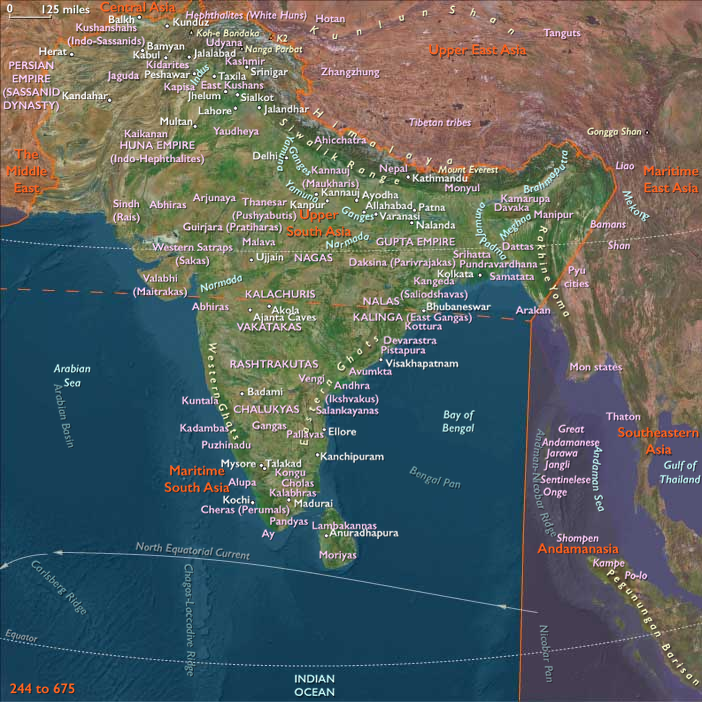
Subregions
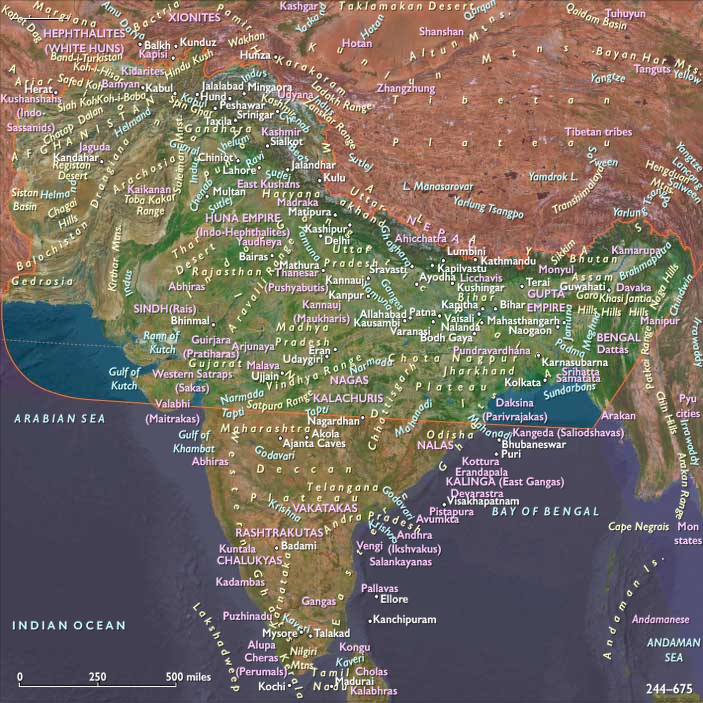
Related Events
Showing 10 events out of 14 total
Years: 532 - 675
Locations
People
Groups
- Hinduism
- Indian people
- Gupta Empire
- Huna people
- Hephthalite Empire
- Harsha (Harsavardhana), Empire of (Thaneswar)
Topics
Subjects
Regions
Subregions