
Upper South Asia (1840–1851 CE): Wars, Annexations, …
Years: 1840 - 1851
Upper South Asia (1840–1851 CE): Wars, Annexations, and Internal Transformations
British Expansion and Annexation
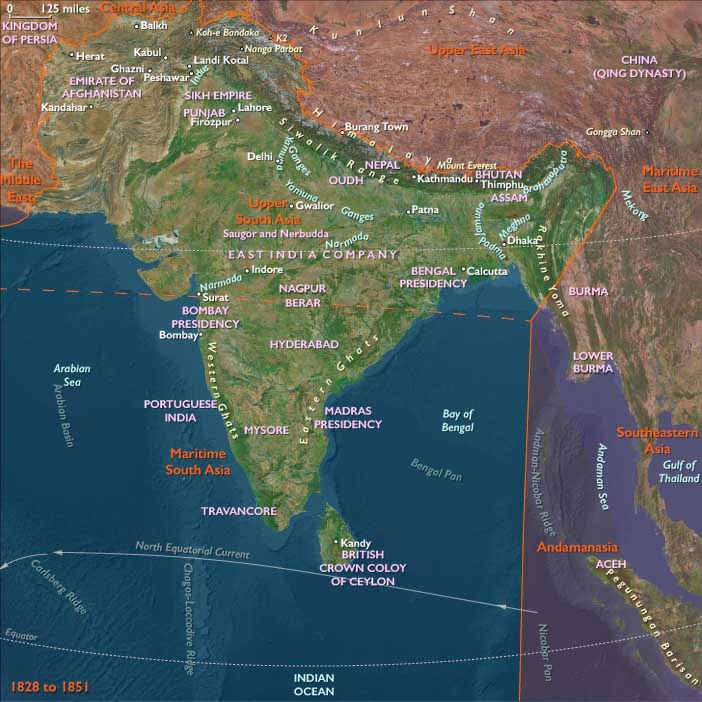
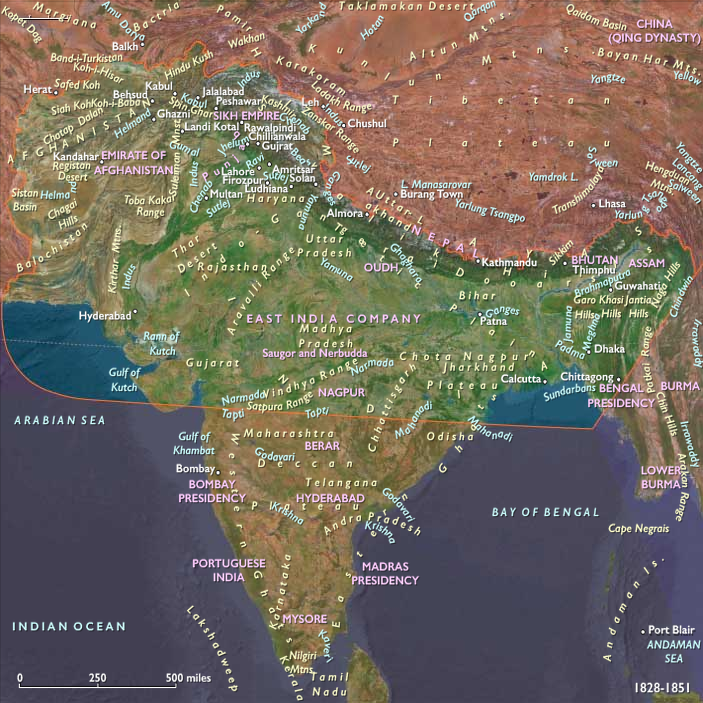
Between 1840 and 1851, the British East India Company aggressively expanded its territories, notably annexing Sindh in 1843 after defeating the local Talpur Mirs, and securing control of Punjab following two intense conflicts with the Sikh Empire. The decisive Second Anglo-Sikh War (1848–1849) resulted in the full annexation of Punjab, including present-day Khyber Pakhtunkhwa, extending British rule to the borders of Afghanistan.
The Aftermath of Anglo-Afghan Conflict
Following the catastrophic First Anglo-Afghan War (1839–1842), British ambitions in Afghanistan were dramatically scaled back. The British retreat from Kabul in January 1842 ended in tragedy, with nearly the entire army perishing in the snowbound mountain passes. In retaliation, Britain launched a punitive expedition to Kabul but ultimately restored Dost Mohammad Khan as Emir, withdrawing thereafter and temporarily relinquishing direct control.
Kashmir and the Treaty of Amritsar
In 1846, the British signed the Treaty of Amritsar, transferring control of Kashmir to the Hindu Dogra Dynasty under Maharaja Gulab Singh, creating a princely state that would remain under British paramountcy until 1947. This decision shaped Kashmir’s distinct socio-political trajectory, laying the groundwork for future tensions.
Internal Power Shifts in Nepal
This period was pivotal for Nepal, marked by political turmoil and violent shifts in power. The dramatic Kot Massacre of 1846, orchestrated by Jang Bahadur Kunwar (later known as Jung Bahadur Rana), effectively annihilated rival aristocratic factions, consolidating his absolute authority. He established the hereditary rule of the Rana dynasty, sidelining the monarchy and dominating Nepalese politics for more than a century.
Bhutanese Territorial Adjustments
In Bhutan, increasing British influence led to territorial adjustments. In 1841, Britain annexed the formerly Bhutanese-controlled Assam Duars, paying annual compensation. Bhutan further relinquished portions of the Bengal Duars to British administration in 1842, setting the stage for ongoing boundary disputes.
Socioeconomic Changes and Military Reforms in Punjab
The annexed Punjab was efficiently administered by British officials, who respected local customs and introduced substantial administrative and economic reforms. These policies, alongside significant infrastructure investments, later facilitated the region’s transformation into the "granary of India." The Punjabi Sikhs and Muslims became crucial recruits for the British Indian Army, reinforcing Punjab’s central role in subsequent colonial conflicts.
Cultural and Religious Adaptations
Throughout Northern South Asia, the era saw significant religious and cultural adaptations. In regions like Afghanistan and Punjab, traditional structures began adapting to British colonial demands, leading to an interplay of cooperation and resistance. Indigenous groups, such as the Pashtuns, increasingly navigated pressures from both internal rulers and external colonial forces.
Legacy of the Era
The period from 1840 to 1851 set critical precedents for colonial governance, notably in the forms of direct annexation and indirect rule through princely states. Dramatic political events, such as Nepal’s Rana coup and British military campaigns, left profound legacies shaping the future socio-political and cultural landscape of Northern South Asia.
People
Groups
- Sindhi people
- Hinduism
- Pashtun people (Pushtuns, Pakhtuns, or Pathans)
- Baloch people
- Durrani (Pashtun tribal confederacy)
- Islam
- Muslims, Sunni
- Muslims, Shi'a
- Ghilzai (Pashtun tribal confederacy)
- Sikhs
- East India Company, British (The Company of Merchants of London Trading into the East Indies)
- Bhutan, Kingdom of
- Mughal Empire (Delhi)
- Sindh, Kingdom of
- India, East India Company rule in
- Bengal Presidency
- Nepal, Shah Kingdom of
- Talpur dynasty
- Sikh Empire
- Britain (United Kingdom of Great Britain and Ireland)
- Jammu, Dogra Kingdom of the
Topics
- Anglo-Afghan War, First
- British Annexation of Sindh
- Anglo-Sikh War, First
- Kot Massacre in Nepal
- Anglo-Sikh War, Second
Subjects
Regions
Subregions
Years: 1840 - 1851
People
Groups
- Sindhi people
- Hinduism
- Pashtun people (Pushtuns, Pakhtuns, or Pathans)
- Baloch people
- Durrani (Pashtun tribal confederacy)
- Islam
- Muslims, Sunni
- Muslims, Shi'a
- Ghilzai (Pashtun tribal confederacy)
- Sikhs
- East India Company, British (The Company of Merchants of London Trading into the East Indies)
- Bhutan, Kingdom of
- Mughal Empire (Delhi)
- Sindh, Kingdom of
- India, East India Company rule in
- Bengal Presidency
- Nepal, Shah Kingdom of
- Talpur dynasty
- Sikh Empire
- Britain (United Kingdom of Great Britain and Ireland)
- Jammu, Dogra Kingdom of the
Topics
- Anglo-Afghan War, First
- British Annexation of Sindh
- Anglo-Sikh War, First
- Kot Massacre in Nepal
- Anglo-Sikh War, Second
Subjects
Regions
Subregions