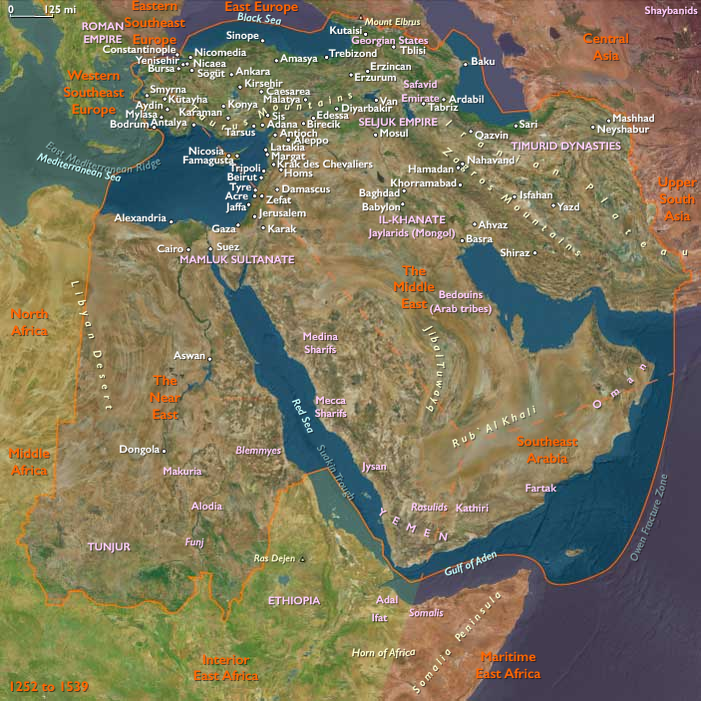
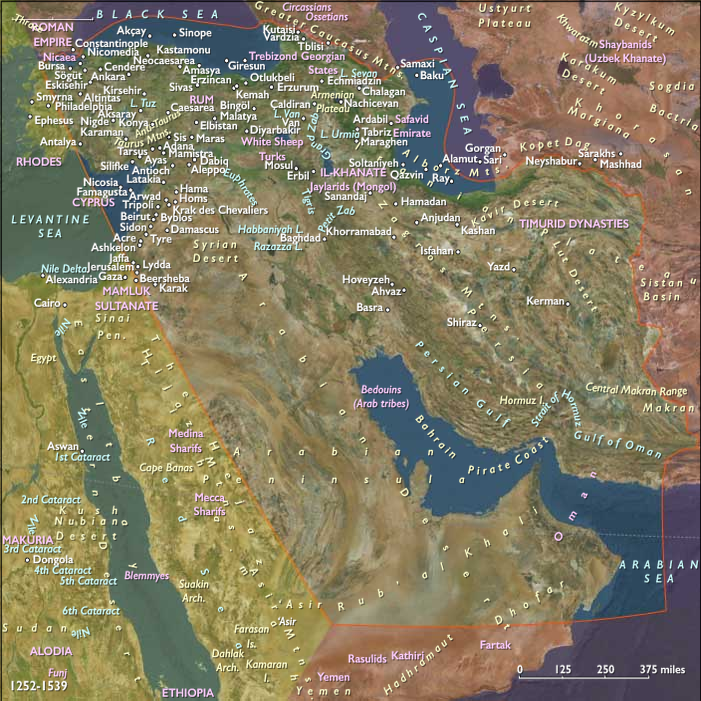
Öljaitü’s magnificent mausoleum of at Soltaniyeh, constructed …
Years: 1310 - 1310
Öljaitü’s magnificent mausoleum of at Soltaniyeh, constructed sometime before the Mongol ruler’s death in 1316, has an interior span of about eighty-five feet (twenty-six meters).
It remains the best known monument of Ilkhanid Persia.
Locations
People
Groups
Subjects
Regions
Subregions
Related Events
Filter results
Showing 10 events out of 16 total
England’s King John I had in 1200 reaffirmed the rights and privileges awarded by Richard II to the city of Portsmouth, which had rapidly eclipsed the older settlement of Portchester, with its Roman and medieval castle, as the sea receded from that site.
King John's desire to invade Normandy resulted in the establishment of Portsmouth as a permanent naval base.
Shortly afterwards, construction had begun on the first docks, and the Hospital of St Nicholas, which performed its duties as an almshouse and hospice.
During the thirteenth century Portsmouth, was commonly used by Henry III and Edward I as a base for attacks against France.
By the fourteenth century, commercial interests had grown considerably.
Common imports include wool, grain, wheat, woad, wax and iron; however the port's largest trade is in wine from Bayonne and Bordeaux.
A French fleet led by Nicholas Béhuchet had raided Portsmouth in 1338, destroying much of the town, with only the local church and hospital surviving.
Edward III had given the town exemption from national taxes to aid reconstruction.
Only ten years later, the town had been struck by the Black Death.
To prevent the regrowth of Portsmouth as a threat, the French had again sacked the town in 1369, 1377 and 1380.
Henry V, who built the first permanent fortifications of Portsmouth, had in 1418 ordered a wooden Round Tower be built at the mouth of the harbor, which was completed in 1426.
Henry VII has rebuilt the fortifications with stone, raised a square tower, and assisted Robert Brygandine and Sir Reginald Bray in the construction of the world's first dry dock.
Although King Alfred may have used Portsmouth to build ships as early as the ninth century, the first warship recorded as constructed in the town is the Sweepstake, built in 1497 in the dry dock.

England following the defeat of Buckingham in October 1627 attempts to send two fleets to relieve La Rochelle.
The first one, led by William Feilding, Earl of Denbigh, a veteran of the Expedition to Cadiz three years earlier, leaves on April 1628, but returns without a fight to Portsmouth, as Denbigh "said that he had no commission to hazard the king's ship in a fight and returned shamefully to Portsmouth".
Buckingham's failure to protect the Huguenots—indeed, his attempt to capture Saint-Martin-de-Ré spurs Louis XIII's attack on the Huguenot fortress of La Rochelle—furthers Parliament's detestation of the Duke—“the grievance of grievances,”—and the king's close proximity to this eminence grise.
Buckingham, trying meanwhile to organize a second campaign to relieve the Siege of La Rochelle, is stabbed and killed at Portsmouth on August 23, 1628 by John Felton, a disaffected army officer who had been wounded in the earlier military adventure and believes he had been passed over for promotion by Buckingham.
Felton will be hanged in November; Buckingham is buried in Westminster Abbey, his tomb bearing a Latin inscription translated as: "The Enigma of the World."
Buckingham’s infant son, also named George Villiers, becomes the 2nd duke of Buckingham.
On December 6, 1785, Orders in Council are issued in London for the establishment of a penal colony in New South Wales, on land claimed for Britain by explorer James Cook in his first voyage to the Pacific in 1770.
The Fleet consists of two Royal Navy vessels, three store ships and six convict transports, carrying between one thousand and fifteen hundred convicts, marines, seamen, civil officers and free people (accounts differ on the numbers), and a vast quantity of stores.
Here they are transferred to the guardship HMS Hector to await trial.
The prisoners include the three detained loyalists—Coleman, McIntosh and Norman—to whom Bligh had promised justice, the blind fiddler Michael Byrne (or "Byrn"), Heywood, Morrison, and four active mutineers: Thomas Burkett, John Millward, Thomas Ellison and William Muspratt.
Bligh, who has been given command of HMS Providence for a second breadfruit expedition, had left England in August 1791, and thus will be absent from the pending court martial proceedings.
Heywood's family secures him competent legal advisers; of the other defendants, only Muspratt employs legal counsel.
The survivors of Bligh's open-boat journey give evidence against their former comrades—the testimonies from Thomas Hayward and John Hallett are particularly damaging to Heywood and Morrison, who each maintain their innocence of any mutinous intention and had surrendered voluntarily to Pandora.
The court does not challenge the statements of Coleman, McIntosh, Norman and Byrne, all of whom are acquitted.
On September 18, the six remaining defendants are found guilty of mutiny and are sentenced to death by hanging, with recommendations of mercy for Heywood and Morrison "in consideration of various circumstances".
The warship HMS Lion, commanded by Captain Sir Erasmus Gower, leads the mission.
The Hindostan, belonging to the East India Company (and later purchased by the Royal Navy as HMS Hindostan), is commanded by Captain William Mackintosh.
These two vessels are accompanied by a brig, the Jackall.
Muspratt, through his lawyer, wins a stay of execution by filing a petition protesting that court martial rules had prevented his calling Norman and Byrne as witnesses in his defense.
He is still awaiting the outcome when Burkett, Ellison and Millward are hanged from the yardarm of HMS Brunswick in Portsmouth dock on October 28.
Some accounts claim that the condemned trio continued to protest their innocence until the last moment, while others speak of their "manly firmness that ... was the admiration of all".
There is some unease expressed in the press—a suspicion that "money had bought the lives of some, and others fell sacrifice to their poverty."