
Francis II gives up his title of …
Years: 1806 - 1806
August
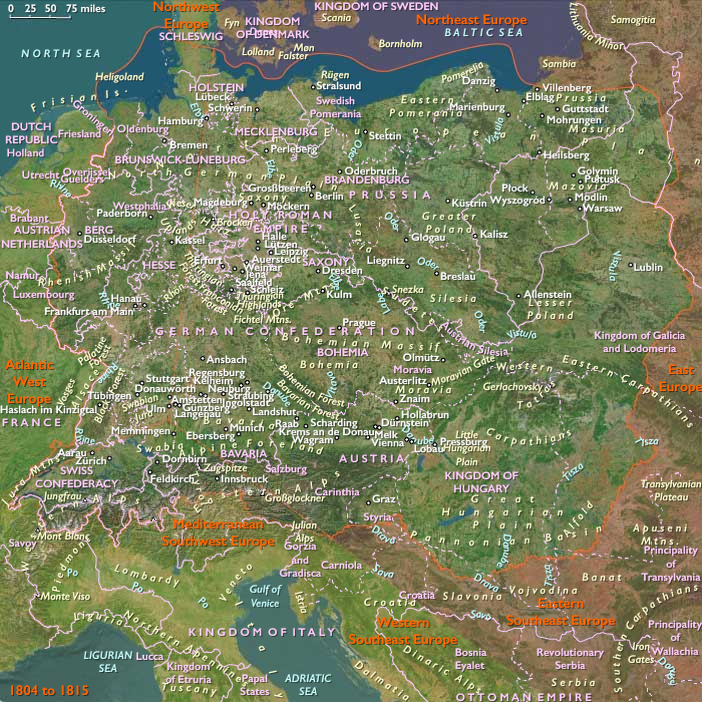
Francis II gives up his title of Emperor and declares the Holy Roman Empire dissolved on August 6, following an ultimatum by Napoleon.
In the years that follow, twenty-three more German states will join the Confederation; Francis's Habsburg dynasty will rule the remainder of the empire as Austria.
Only Austria, Prussia, Danish Holstein, and Swedish Pomerania stay outside, not counting the west bank of the Rhine and Principality of Erfurt, which will be annexed by the French empire after the defeat of Prussia in the Battle of Jena and Auerstedt in October, while the surrounding Thuringian states join the Confederation.
According to the treaty, the confederation is to be run by common constitutional bodies, but the individual states (in particular the larger ones) want unlimited sovereignty.
Instead of a monarchical head of state, as the Holy Roman Emperor had been, its highest office is held by Karl Theodor von Dalberg, the former Arch Chancellor, who now bears the title of a Prince-Primate of the confederation.
As such, he is President of the College of Kings and presides over the Diet of the Confederation, designed to be a parliament-like body though it never actually assembles.
The President of the Council of the Princes is the Prince of Nassau-Usingen.
The Confederation is above all a military alliance: the members have to supply France with large numbers of military personnel.
In return for their cooperation, some state rulers are given higher statuses: Baden, Hesse, Cleves, and Berg are made into grand duchies, and Württemberg and Bavaria become kingdoms.
States are also made larger by incorporating the many smaller Kleinstaaten, or small former imperial member states.
Locations
People
Groups
- Austria, Archduchy of
- Holstein, Duchy of
- Hesse-Darmstadt, Landgraviate of
- Bavaria, Electorate of
- Hesse-Philippsthal, Landgraviate of
- Prussia, Kingdom of
- Pomerania, Swedish
- Baden, Electorate and Margravate of
- Württemberg, Electorate of
- Hesse (-Kassel), Electorate of
- Austrian Empire
- Baden, Grand Duchy of
- Hesse (-Darmstadt) and the Rhine, Grand Duchy of
- Rhine, Confederation of the (Rhine Confederation)
- Bavaria, Kingdom of
- Erfurt, Principality of
- Württemberg, Kingdom of
Subjects
Regions
Subregions

Related Events
Showing 10 events out of 22089 total
Years: 1806 - 1806
August
Locations
People
Groups
- Austria, Archduchy of
- Holstein, Duchy of
- Hesse-Darmstadt, Landgraviate of
- Bavaria, Electorate of
- Hesse-Philippsthal, Landgraviate of
- Prussia, Kingdom of
- Pomerania, Swedish
- Baden, Electorate and Margravate of
- Württemberg, Electorate of
- Hesse (-Kassel), Electorate of
- Austrian Empire
- Baden, Grand Duchy of
- Hesse (-Darmstadt) and the Rhine, Grand Duchy of
- Rhine, Confederation of the (Rhine Confederation)
- Bavaria, Kingdom of
- Erfurt, Principality of
- Württemberg, Kingdom of
Subjects
Regions
Subregions