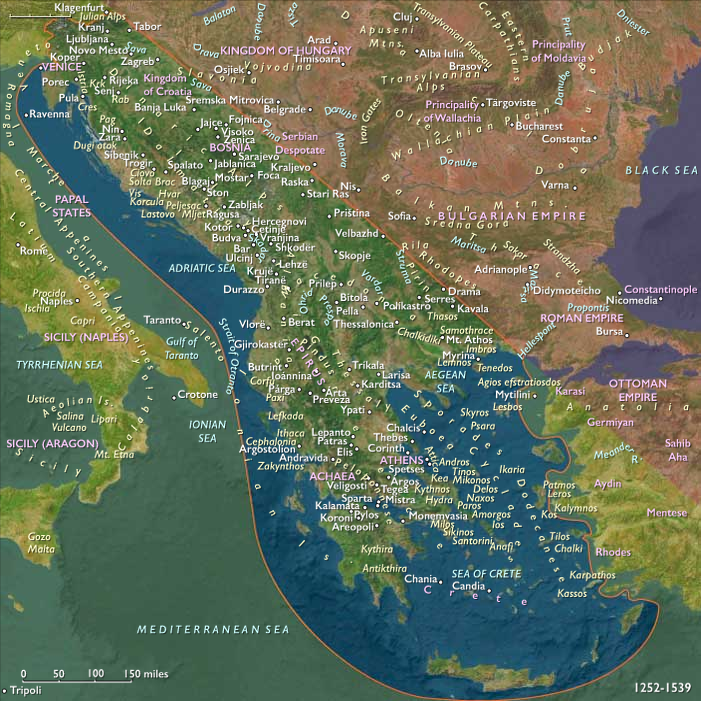
Dushan on his own conquers a greater …
Years: 1343 - 1343
Dushan on his own conquers a greater part of Macedonia and …
Locations
People
Groups
Topics
Commodoties
Subjects
Regions
Subregions
Related Events
Filter results
Showing 10 events out of 44425 total
Estonia had been completely subjugated by the Northern Crusaders from Germany and Denmark with the conquest of Ösel (Saaremaa) by the Livonian Order in 1261.
The new rulers had imposed taxes and duties even as the indigenous population retained individual rights, such as the right to bear arms.
Oppression had hardened as the new ruling class started to build manor-houses all over the country.
The weight of duties to the lay masters is redoubled by religious repression and economic demands imposed by the church.
The area is also politically unstable.
The Estonian provinces of Harria (Harju) and Vironia (Viru) had been conquered by Denmark but by the fourteenth century the kingdom's power has weakened.
The province in Estonia has become split between a pro-Danish party led by bishop Olaf of Reval and the pro-German party led by captain Marquard Breide.
Eighty percent of the Danish vassals in the Duchy of Estonia are Germans from Westphalia, eighteen percent are Danes and two percent Estonians.
The Estonian peasantry, despite guarantees of certain rights and freedoms under peace treaties with the Danish and German nobles (who have, four six score years, held much land in Estonia as fiefs), suffer abuse from their feudal overlords and respond with sporadic violence against them.
A major revolt had broken out on April 23, 1343,Saint George’s Day.
Beginning in Harjumaa county, the rebellion has spread to surrounding areas, including the island of Oesel.
The rebellious peasants kill more than eighteen hundred nobles, who lay siege to Tallin and request help from Swedish forts in Finland.
The Teutonic Knights, responding to the beleaguered nobles’ call for support, enter the fray, arrange a peace conference, and murder the rebel peasant leaders at the meeting.
The Knights then battle the peasant rebels near Tallinn, routing them before Swedish help can arrive.

Poland’s King Casimir III manages to stop the war with the Teutonic Knights and reach a territorial settlement in 1343.
By the Treaty of Kalisz, Poland recovers the territory of Kuyavia and the Dobrzyn area in exchange for leaving Pomerelia under the Knights’ control.
Casimir now works to extends Polish influence eastward into Lithuania and Russia.
Dushan aids the Greek pretender, but their alliance breaks up in 1343, and they become bitter enemies.
…Albania in the same year.
The Serbian empire, its territory having doubled in little more than a decade, now includes all of Albania ...
...except Durrës.
The presence of secular and monastic schools of law in Pisa is first reliably dated from the eleventh and the second half of the twelfth century, a time when Pisa had already achieved a remarkable economic development.
Early thirteenth century documents indicate the presence of doctors of medicine and surgery.
The earliest evidence of a Pisan Studium dates to 1338, when the renowned jurist Ranieri Arsendi transferred to Pisa from Bologna.
He, along with Bartolo da Sassoferrato, a lecturer in Civil Law, were paid by the Municipality to teach public lessons.
The papal bull In supremae dignitatis, granted by Pope Clement VI on September 3, 1343, recognizes the Studium of Pisa as a Studium Generale; an institution of further education founded or confirmed by a universal authority, the Papacy, or Empire.
Pisa is one of the first European universities that can boast this papal attestation, which guarantees the universal, legal value of its educational qualifications.
The first subjects taught are theology, civil law, canon law and medicine.
The kingdom of Majorca and its Balearic Island dependencies, independent since 1276, return to Aragonese control in 1343.
The oppressive taxation and cruel policies of the Florentines’ signore (elected lord), Walter of Brienne, have by 1343 engendered three conspiracies to depose him.
Walter, with outside aid from Bologna and Tuscany, rounds up three hundred leading Florentine citizens whom he suspects of subversion and prepares to execute half of them.
The various conspirators unite their efforts to lead a revolt that prevents the executions, besieging the signore in his palace until most of the foreign troops desert him.
Walter finally grants the Florentine bishop authority to enact reforms, but the Florentine rebels, their fury uncontrolled, massacre most of the signore’s supporters.
Walter withdraws from Florence, and a democratic and commercial republic soon replaces his tyranny.
he Truce of Malestroit (January 1343): A Temporary Pause in the Breton War of Succession
In January 1343, Pope Clement VI, newly elected in 1342, sought to mediate peace in the ongoing War of the Breton Succession, which had now fully intertwined with the Hundred Years’ War. His envoys intervened as intermediaries, negotiating a temporary ceasefire between the warring factions.
The Truce of Malestroit: A Papal-Backed Settlement
- The Truce of Malestroit, signed in January 1343, temporarily halted hostilities between:
- Edward III of England and John of Montfort, supported by the English.
- Philip VI of France and Charles of Blois, backed by the French.
- The key terms of the truce included:
- A general cessation of fighting before any major engagements could take place.
- The city of Vannes, then under siege, was placed under papal custody, effectively neutralizing it as a contested territory.
- An exchange of prisoners, including John of Montfort, who had been imprisoned in Paris since 1341.
Significance and Limitations
- While the truce paused the conflict, it did not resolve the succession dispute, as neither side renounced its claims to Brittany.
- Both England and France used the truce as an opportunity to regroup, replenish forces, and prepare for renewed hostilities.
- The truce was short-lived, as Edward III and Philip VI resumed military actions within two years, culminating in the Battle of Crécy (1346) and the renewed Anglo-French war effort in Brittany.
Impact on the Breton War of Succession
- Although Vannes was temporarily removed from the conflict, the truce failed to create a lasting peace.
- The underlying tensions between the Montfortist and Blois factions persisted, ensuring that Brittany would remain a contested battleground for years to come.
The Truce of Malestroit (1343) was a diplomatic effort by Pope Clement VI to mediate peace, but its temporary and inconclusive nature ensured that the Breton War of Succession and the Hundred Years' War would soon resume with full intensity.
The Truce of Malestroit and the Fragmentation of the Montfortist Cause (1343–1346)
Although the Truce of Malestroit (January 1343) was intended to pause hostilities between England and France until September 29, 1346, it made little difference in Brittany, where Charles of Blois refused to recognize the agreement, claiming that he was fighting his own war rather than one directed by Philip VI of France. This allowed the French-backed forces to continue their attacks, ensuring that brutal small-scale warfare persisted despite the truce.
The Montfortist Cause in Crisis
With John of Montfort still imprisoned in Paris, his faction was in disarray:
- Montfortist-controlled areas were effectively administered from London, as neither Montfort nor his family could provide leadership.
- His wife, Joanna of Flanders, who had successfully resisted French forces in 1342, had recently gone mad, further destabilizing the movement.
- His son, John IV of Brittany, was still an infant, leaving the faction without a strong native leader.
- The Montfortist stronghold at Brest remained secure, backed by a large permanent English garrison, but outside the English-controlled coastal cities, Montfortist power was fading.
John of Montfort’s Release from Prison (September 1, 1343)
- On September 1, 1343, Montfort was released from prison in Paris after posting a massive bond and swearing to remain confined to his estates in eastern France.
- Though technically free, he was politically neutralized, unable to take direct action in Brittany without violating the terms of his release.
The Continuing Struggle in Brittany
- The English garrisons along the coast held firm, particularly at Brest, but elsewhere, the Montfortist movement was disintegrating.
- The Montfortists had some isolated successes, such as expelling the papal custodians from Vannes, but without a unifying leader, they were mostly reduced to begging for troops and money from London.
- Meanwhile, Charles of Blois, unrestrained by the truce, continued his offensives, further weakening the Montfortist position.
Conclusion: A Movement in Decline
Although the Truce of Malestroit was meant to stabilize the conflict, it had little impact in Brittany, where Charles of Blois refused to stop fighting. The Montfortist cause, deprived of leadership, crumbled, leaving only English-controlled garrisons as a bulwark against total defeat.
With John of Montfort neutralized in France, his faction was entirely dependent on English support, making Brittany a key proxy battleground in the ongoing Hundred Years’ War.