The younger son of Susthita Varman succeeds …
Years: 600 - 600
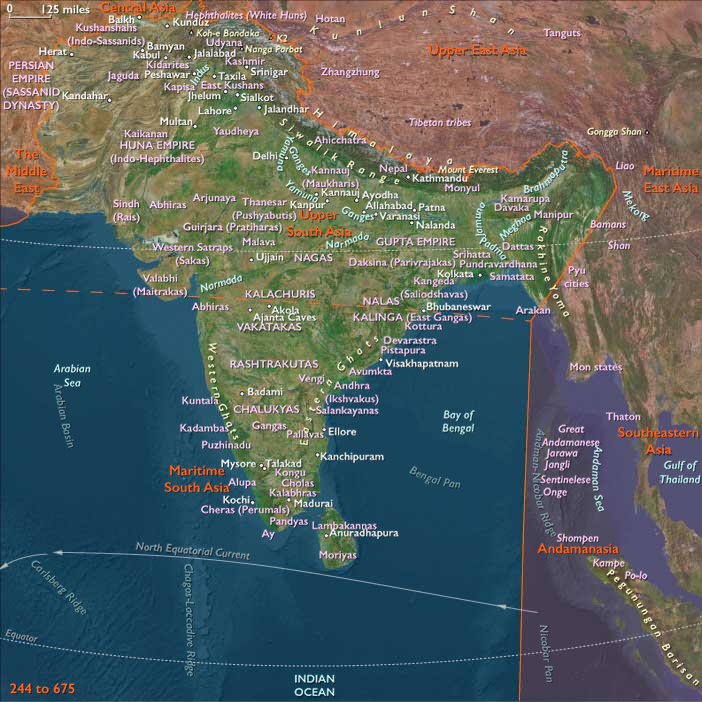
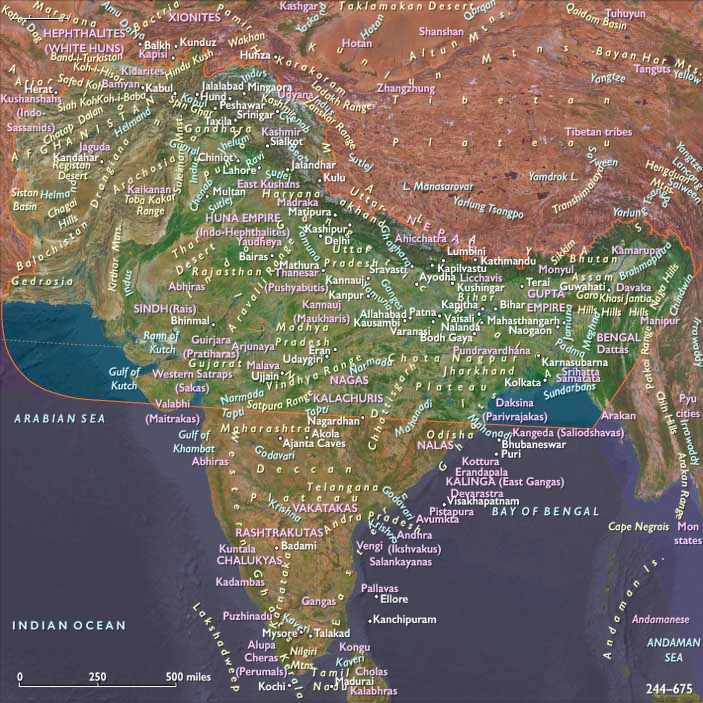
The younger son of Susthita Varman succeeds him in 600 as King Bhaskar Varman of Kamarupa, faced with the task of rebuilding the ravaged kingdom.
Locations
Groups
Topics
Subjects
Regions
Subregions
Related Events
Filter results
Showing 10 events out of 57116 total
The Japanese use large quantities of manufactured clay pipe as early as 600.
Isidore of Seville, a Spanish churchman and encyclopedist, succeeds his older brother, Leander, as archbishop of Seville in 600.
The information for the rest of Reccared's reign is scanty.
John of Biclaro, Reccared's contemporary, ends his account with the Third Council of Toledo.
Isidore of Seville praises his peaceful government, clemency, and generosity: standard encomia.
He had returned various properties, even some privates ones, that had been confiscated by his father, and has founded many churches and monasteries.
Pope Gregory, writing to Reccared in August 599, extols him for embracing the true faith and inducing his people to do so, and notably for refusing the bribes offered by Jews to procure the repeal of a law against them.
He sends Reccared a piece of the True Cross, some fragments of the chains of St. Peter, and some hairs of St. John the Baptist.
Gregory is convinced that Reccared has refused bribes from the Jewish community, which is large, well-connected throughout the Mediterranean and powerful.
Reccared's laws provide that the offspring of a Christian and a Jew be baptized, which is of little moment to the Jewish community, as whether it is not born of a Jewish mother or is born of a Jewish woman outside her community, the child is not considered a Jew anyway.
Reccared eliminates the death penalty for Jews convicted of proselytizing among Christians and ignores Gregory's request that the trade in Christian slaves at Narbonne be forbidden to Jews.
Reccared dies a natural death at Toledo in 601.
Liuva II had, at eighteen, succeeded his father Reccared as Visigothic King of Hispania, Septimania and Galicia.
The Goth Witteric, one of the conspirators with Bishop Sunna de Mérida to reestablish Arianism in 589, had in 602 been given command of the army to repulse the imperial forces.
From his position of power at the head of the army, he has surrounded himself with people in his confidence.
When it comes time to expel the imperial forces, Witteric instead uses his troops in the spring of 603 to strike at the young king .
Invading the royal palace, and deposing the young king, he counts on the support of a faction of nobles in opposition to the dynasty of Leovigild.
Witteric cuts off the king's right hand and in the summer has him condemned and executed.
The Battle of Dormelles (c. 600 CE): Chlothar II’s Defeat by Theudebert II and Theuderic II
Around 600 CE, Chlothar II of Neustria, still a young ruler, launches a military campaign against his cousins, Theudebert II of Austrasia and Theuderic II of Burgundy. This campaign results in a disastrous defeat at Dormelles, forcing Chlothar to flee the battlefield and marking a significant setback in the Frankish civil wars.
1. The War Between Neustria and Austrasia-Burgundy
- Following the death of Fredegund in 597, Chlothar II, then a teenager, is left to rule Neustria alone.
- His cousins, Theudebert II (Austrasia) and Theuderic II (Burgundy), both grandsons of Brunhilda, remain under her strong influence and seek to eliminate Chlothar as a rival.
- The tensions between Neustria and the Austrasian-Burgundian alliance escalate into open warfare, culminating in the Battle of Dormelles.
2. The Battle of Dormelles (c. 600 CE)
- Dormelles, located near Sens in modern France, becomes the site of a decisive confrontation between the forces of Chlothar II and the combined armies of Theudebert II and Theuderic II.
- Theudebert and Theuderic’s forces overwhelm Chlothar’s army, inflicting a crushing defeat on Neustria.
- Chlothar is forced to flee the battlefield, avoiding capture but suffering a major loss of territory and prestige.
3. The Aftermath: Neustria in Crisis
- Following the battle, Chlothar II loses significant territory, as Austrasia and Burgundy extend their control into Neustria.
- The victory strengthens the power of Brunhilda, as her grandsons tighten their grip over the Frankish kingdom.
- Chlothar is left weakened and on the defensive, struggling to maintain his authority.
4. Long-Term Consequences and the Road to Revenge
- Though defeated in 600, Chlothar II survives the political turmoil and bides his time.
- In 610 CE, the rivalry between Theudebert II and Theuderic II escalates into a fratricidal war, weakening their alliance.
- Eventually, in 613 CE, Chlothar II seizes his chance, defeating his cousins and capturing and executing Brunhilda, bringing an end to the civil war and reunifying the Frankish kingdom under his rule.
Conclusion: A Temporary Defeat in a Long Struggle
The Battle of Dormelles (c. 600 CE) is a major defeat for Chlothar II, forcing him into temporary retreat and submission. However, the civil war among his cousins will later allow him to turn the tide, culminating in his ultimate victory in 613 CE, when he becomes the sole ruler of the Frankish kingdom.
The Germanic invaders of Britain, all initially called Saxons, come to be known as Angles.
Pope Gregory refers to the recently converted King Æthelbert of Kent (a kingdom founded by Jutes) as rex Anglorum ("king of the Angles").
Augustine, an Italian monk, had served as prior of a monastery in Rome until June of 595, when Pope Gregory dispatched him and thirty other monks to convert the Anglo-Saxons.
He carries letters of commendation to bishops and is accompanied by Frankish interpreters.
Æthelbert, who had married a Christian Frankish princess, allows them to enter his realm, to preach, and to establish a church at Canterbury; Augustine baptizes Æthelbert into Christianity the following year.
Freely adapting local customs to Christianity in accord with Gregory's instructions, Augustine pursues a policy of preserving pagan temples and destroying only the idols, transforming pagan rites and customs into Christian practices whenever possible.
Augustine founds an abbey in Canterbury and becomes the first archbishop here.
The West Germanic language of the invader-colonizers of Britain, whether spoken by Angles, Saxons, or Jutes (and perhaps some Frisians), is apparently always referred to as English.
The Anglo-Saxons begin using the Latin alphabet: King Æthelbert’s code of law, circa 600, is the oldest surviving document in Old English.
The code is concerned with preserving social order, through compensation and punishment for personal injury.
When Christian monks attempt to write the Germanic languages in Latin characters, they encounter many difficulties because Latin and Germanic sounds do not very closely resemble one another.
Y Gododdin is a Welsh poem consisting of a series of elegies to the men of the Brittonic kingdom of Gododdin and its allies who, according to the conventional interpretation, died in about 600 fighting the Angles of Deira and Bernicia at a place named Catraeth.
It is traditionally ascribed to the bard Aneirin and survives only in one manuscript, the Book of Aneirin.
The Book of Aneirin manuscript is from the later thirteenth century, but Y Gododdin has been dated to anywhere between the seventh and the early eleventh centuries.
The text is partly written in Middle Welsh orthography and partly in Old Welsh.
The early date would place its oral composition soon after the battle, presumably in the Hen Ogledd ("Old North"); as such it would have been written in the Cumbric dialect of Common Brittonic.
Others consider it the work of a poet from Wales in the ninth, tenth or eleventh century.
Even a ninth-century date would make it one of the oldest surviving Welsh works of poetry.
The Gododdin, known in Roman times as the Votadini, held territories in what is now southeast Scotland and Northumberland, part of the Hen Ogledd (Old North).
The poem tells how a force of three hundred (or three hundred and sixty-three) picked warriors were assembled, some from as far afield as Pictland and Gwynedd.
After a year of feasting at Din Eidyn, now Edinburgh, they attacked Catraeth, which is usually identified with Catterick, North Yorkshire.
After several days of fighting against overwhelming odds, nearly all the warriors are killed.
The poem is similar in ethos to heroic poetry, with the emphasis on the heroes fighting primarily for glory, but is not a narrative.
The manuscript contains several stanzas which have no connection with the Gododdin and are considered to be interpolations.
One stanza in particular has received attention because it mentions King Arthur, which, if not an interpolation, would be the earliest known reference to that character, as outside this poem, Welsh Arthurian legend is known to develop only from about the early twelfth century.

The first few years of the administration of Callinicus had been marked by relatively good fortune.
In 598, an armistice between Constantinople and the Lombards had been concluded in which the Lombards had been acknowledged as sovereign rulers of the lands in their possession, and which has been observed by both parties over the following years.
However, around 601, Callinicus takes advantage of a rebellion by the duces of Tridentum and Forum Julii and breaks the peace by kidnapping the Lombard king Agilulf's daughter and her husband from Parma.
In response, …
…Agilulf invades the Exarchate, destroying Patavium, …
…pillaging Istria, then …
…defeating Callinicus outside the walls of Ravenna.
The war continues.