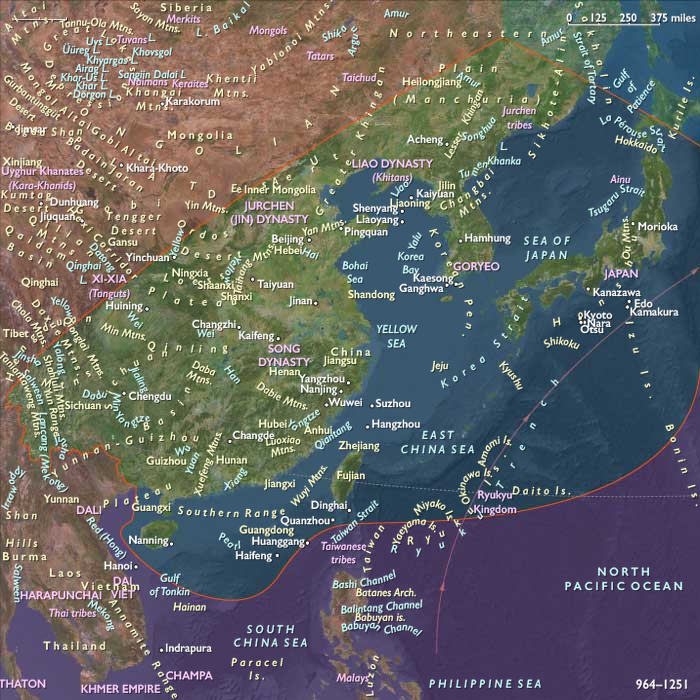
Government buildings in Hangzhou are extended and …
Years: 1133 - 1133
Government buildings in Hangzhou are extended and renovated once the prospect of the Song dynasty’s retaking northern China has diminished, to better befit its status as an imperial capital and not just a temporary one.
The imperial palace in Hangzhou, modest in size, is expanded in 1133 with new roofed alleyways.
Locations
Groups
- Chinese (Han) people
- Jurchens
- Jin Dynasty (Chin Empire), Jurchen
- Chinese Empire, Nan (Southern) Song Dynasty
Topics
Commodoties
Subjects
Regions
Subregions
Related Events
Filter results
Showing 10 events out of 49159 total
Suryavarman II begins construction on the great temple complex of Angkor Wat in about 1133.
Vsevolod, the eldest son of Mstislav the Great and Christina Ingesdotter of Sweden, was born in Novgorod during his father's reign as prince there (1088–1093, 1095–1117) and given the baptismal name Gabriel, or Gavriil.
His maternal grandfather was King Inge the Elder of Sweden.
The date of his birth is unknown, although the idea has been advanced that the event was commemorated by the Annunciation Church in the Marketplace, founded by Mstislav in 1103.
Enthroned as Prince of Novgorod after his father Mstislav Vladimirovich became Grand Prince of Kiev in 1117, he will rule Novgorod, with some interruption, until he is ousted by the Novgorodians in 1136.
He had wed a Chernigovian princess in Novgorod in 1123 and his son, Ivan, was born there (he died in 1128).
In 1123, Vsevolod led the Novgorodians against the Proto-Estonians, called Chuds in Old East Slavic chronicles.
These campaigns had continued in 1130 and will extend over the next several years.
Aside from Vladimir Yaroslavich, Vsevolod is the first Novgorodian prince known to have been in conflict with Finns (in 1123).
In addition to leading Novgorodian armies on several campaigns, Vsevolod has built a number of churches in and around the city: the Church of St. John on Opoki (1127–1130), the Church of St. George in the Market (1133), the Church of The Assumption in the Market (1133; built with Archbishop Nifont), and the Church of St. George in the Yuriev Monastery.
It is Vsevolod who grants the charter to Ivan's Hundred, the first Russian merchant guild.
In addition, the Cathedral of St. Nicholas in Yaroslav's Court, while often attributed to his father Mstislav, is mostly built during Vsevolod's tenure in Novgorod.
Following his father's death in 1132, support for Vsevolod begins to erode in Novgorod.
This same year, he is sent by his uncle, Grand Prince Yaropolk, to Pereslavl, to reign there.
When he tries to return to Novgorod later that year, the Novgorodians refuse to accept him back because they consider his move to Pereslavl as a betrayal (He had sworn an oath to die in Novgorod).
That being said, the chronicles indicate that he was back leading a Novgorodian army in 1133.
It is during this campaign that Vsevolod captures the city of Yuryev (modern Tartu, Estonia).

Baarin, a village in northern Syria, serves in the early twelfth century as a fortress of the Crusaders, who refer to it as "Mons Ferrandus" or "Montferrand."
In 1133, Pons of Tripoli escapes to Baarin for refuge where, according to chronicler William of Tyre, he is shortly besieged by the Muslim army of Aleppo led by Zengi before being rescued by King Fulk of Jerusalem.
Leo, protected in his rear by an alliance with the Danishmend emir, had descended into the plain soon after the death of Bohemond II; after a brief unsuccessful siege of Seleucia, he had seized the three cities of Mamistra, Tarsus and Adana in 1131.
In 1133, Leo captures Sarventikar, on the slopes of the Amanus Mountains, from Baldwin of Marash.
But the Armenian hold over Cilicia is weak: bandits find refuge here, and pirates hang about its coasts.
Rochester Cathedral is completed during the episcopates of Ernulf (1115–1124) and John I (1125–1137).
The quire has been rearranged, the nave partly rebuilt, Gundulf's nave piers cased and the west end built.
Ernulf is also credited with building the refectory, dormitory and chapter house, only portions of which remain.
Finally Bishop John translated the body of Ithamar from the old Saxon cathedral to the new Norman one, the whole being dedicated in 1130 (or possibly 1133) by the Archbishop of Canterbury, assisted by thirteen bishops in the presence of Henry I, but the occasion is marred by a great fire which nearly destroys the whole city and damages the new cathedral.
The force Lothair had taken with him into Italy in 1132 was not strong, due to his leaving troops in Germany to prevent the Hohenstaufen from revolting.
While he had carefully avoided any cities that are hostile, he had attempted to besiege Milan, which failed due to the small army he had at his disposal.
Consequently, he reaches Rome in 1133, which is mostly held by Anacletus.
As St. Peter's Basilica is closed to them, Innocent instead crowns Lothair as emperor in the Lateran on June 4, 1133.
The emperor continues giving little or no resistance against papal interference with his power; he even ignores a bull by Innocent which states that the emperor's authority derives from him.
He also recognizes papal claims to the Matildine lands (formerly owned by Countess Matilda), in exchange receiving those lands as fiefs.
Vsevolod leads an unsuccessful campaign in Vladimir in 1134, during which, according to the Novgorodians, he shows indecisiveness, one of the reasons for his dismissal a little over a year later.
Sknyatino, situated at the confluence of the Nerl and the Volga Rivers, about halfway between Uglich and Tver, is the site of the medieval town of Ksnyatin, founded by Yuri Dolgoruki in 1134 and named after his son Constantine.
Ksnyatin is intended as a fortress to defend the Nerl waterway, leading to Yuri's residence at Pereslavl-Zalessky, against Novgorodians.
The latter will sack it on several occasions, before the Mongols virtually annihilate the settlement in 1239.
Yaropolk has to deal with the many interests of his family, most of all his powerful half brother Yuri Dolgoruki.
Yaropolk had appointed Vsevolod Mstislavich to succeed him in Pereyaslav but Yuri Dolgoruki, with the consent of the Novgorodians, had soon driven out his nephew.
Yaropolk had appointed another son of Mstislav I: Iziaslav Mstislavich to Pereyaslav, who also received Turov.
He is replaced soon thereafter by Yaropolk's brother Viacheslav Vladimirovich.
The peace doesn't last.
Iziaslav has to transfer Turov to his uncle Viacheslav in 1134 to let him rule the principality once again.
Pereyaslav will come to Yuri Dolgoruki on the condition that Iziaslav is allowed to rule Rostov although Yuri keeps a large part of the principality under his influence.
Iziaslav also receives the rule over Volyn; another half brother of Yaropolk, Andrey Vladimirovich, is to rule Pereyaslav.
The German kings had reestablished control over the mixed Slav-inhabited lands on the eastern borders of the Holy Roman Empire in the beginning of the twelfth century.
Albert the Bear, son of Otto the Rich, count of Ballenstedt, and Eilika, daughter of Magnus Billung, Duke of Saxony, had on his father’s death in 1123 inherited his valuable estates in northern Saxony between the Harz Mountains and the middle reaches of the Elbe River.
The dynasty founded by Otto is known as the Ascanian House, named after the city of Aschersleben.
Albert has remained a loyal vassal of his relation, Lothair I, duke of Saxony, from whom, in about 1123, he had received the margravate of Lusatia, to the east; after Lothair became king of the Germans, Albert had in 1126 accompanied him on a disastrous expedition to Bohemia, where he had suffered a short imprisonment.
Albert's entanglements in Saxony stem from his desire to expand his inherited estates there.
His brother-in-law, Henry II, who had been margrave of a small area east of the junction of the Elbe and Havel rivers called the Saxon Northern March, or Nordmark, had died in 1128, and Albert, disappointed at not receiving this fief himself, had attacked Udo, the heir, and had consequently been deprived of Lusatia by Lothair.
In spite of this, he had gone to Italy in 1132 in the train of the king, and his services are rewarded in 1134 by the investiture of the Nordmark, the Holy Roman Empire's territorial organization on the conquered areas of the Wends, which was again without a ruler.
Lothair, while while battling the Hohenstaufens for control of the empire, encourages a policy of eastward expansion into Slavic lands and the conversion of the Slavs, by peaceful means or otherwise, to Christianity.
(Later historians will term this the Drang nach Osten, ”literally, “Drive to the East”).
Years: 1133 - 1133
Locations
Groups
- Chinese (Han) people
- Jurchens
- Jin Dynasty (Chin Empire), Jurchen
- Chinese Empire, Nan (Southern) Song Dynasty