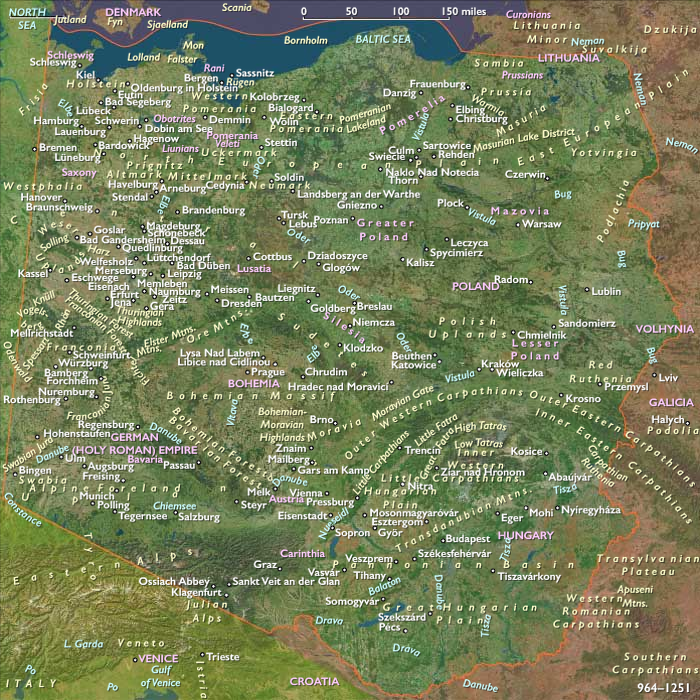
Otto III has in 997 to deal …
Years: 997 - 997
Otto III has in 997 to deal with a new Lutician attack on Arneburg on the Elbe, which they manage to retake for a short while.
Locations
People
Groups
- Polabian Slavs (West Slavs)
- Christianity, Chalcedonian
- Obotrites (Slavic tribal confederation)
- Vikings
- German, or Ottonian (Roman) Empire
- Poland, Principality of
- Lutici (West Slavic Polabian tribe)
- Poles (West Slavs)
Topics
Commodoties
Subjects
Regions
Subregions
Related Events
Filter results
Showing 10 events out of 52133 total
The short reign of Abu'l-Harith Mansur II, who is still young when he succeeds his father Nuh II as amir of the Samanids in 997, is marked by his inability to control his governors and generals.
Shortly after he comes to power, a rebellion is launched, and its leaders invite the Kara-Khanids under Nasr Khan to intervene.
Nasr Khan does so, but after defeating the rebellion, he contacts Fa'iq, Mansur's governor of Samarkand, and sends him to the Samanid capital with an army.
Mansur flees, but later is persuaded to return, although Fa'iq retains his power.
Olaf Tryggvason, who plays an important part in the conversion of the Vikings to Christianity, is said to have built in 995 at Moste the first church in Norway.
Olaf soon brings all Norway except the inland districts under his rule, proclaims himself king and Norway a Christian kingdom in 997, establishing several Christian churches, especially in the southwest.
As King Olaf I of Norway, he establishes his seat of government in 997 in Kaupangr (later called Trondheim) on the west central coast of Norway, situated about two hundred and fifty miles (four hundred kilometers) north of Oslo.
Here, where he had first held thing with those who had revolted against Haakon, the River Nid twists itself before entering the fjord, creating a peninsula requiring just one short wall to easily defend against land attacks.
Trondheim will function as the main city and capital of Norway until the founding in 1070 of Bergen.
Boleslaw, endeavoring to extend his influence to the territory of the Prussians, encourages Christianizing missions in the Prussian lands.
Most famous of these is the mission of Vojtěch from the Bohemian princely Slavník clan, former bishop of Prague.
Known as Adalbert of Prague upon the death of Adalbert of Magdeburg in 981, Adalbert's mission takes place in 997 and ends in the missionary's martyrdom at the hands of the pagan Prussians.
It is a standard procedure of Christian missionaries to attempt to chop down sacred oak trees, which they had done in many other places, including Saxony.
Because the trees are objects of worship and the spirits believed to inhabit the trees are feared for their powers, this is done to demonstrate to the non-Christians that no supernatural powers protect the trees from the Christians.
When the missionaries ignore warnings to stay away from the sacred oak groves, Adalbert is martyred for his supposed sacrilege in April 997 on the Baltic Sea coast east of Truso (a medieval emporia near the modern city of Elbląg), or near Tenkitten and Fischhausen.
The remains of the missionary are held for ransom by the Prussians and Bohemian Přemyslid rulers refuse to pay for Adalbert's body.
Consequently it is purchased by Duke Boleslaw, according to one story, in exchange for its weight in gold, and buried in Gniezno.
A few years later Adalbert will be canonized as Saint Adalbert of Prague.
The twenty-two-year-old son of the supreme Magyar prince Géza of the Árpád dynasty, originally named Vajk, had been born to Sarolt, daughter of Gyula of Transylvania, a Hungarian nobleman who had been baptized in Greece.
Though Sarolt had been baptized into the Orthodox Christian faith at her father's court in Transylvania by the Greek bishop Hierotheos, she had not persisted in the religion.
According to his legends, Vajk had been baptized a Christian by Adalbert of Prague and given the baptismal name Stephen (István) in honor of the original early Christian Saint Stephen.
When Stephen reached adolescence, Great Prince Géza had convened an assembly in which it was decided that Stephen would follow his father as the monarch of the Hungarians.
This decision, however, had contradicted the Magyar tribal custom that gave the right of succession to the eldest close relative of the deceased ruler.
Stephen had married Giselle of Bavaria, the daughter of Henry II, called the Wrangler or the Quarrelsome, in or after 995.
By this marriage, he has become the brother-in-law of the future Henry II, Holy Roman Emperor.
Giselle had arrived to her husband's court accompanied by German knights.
At the death of Géza in 997, a succession struggle ensues.
Stephen claims to rule the Magyars by the principle of Christian divine right, while his uncle Koppány, a powerful pagan chieftain in Somogy, claims the traditional right of seniority, standing for the old tribal values and pagan religion of the ancient Magyars.
Boleslaw, the son of Mieszko I and of his first wife, the Bohemian princess Dubrawka, had in 984 married an unknown daughter of Rikdag, Margrave of Meissen, and subsequently married Judith Arpad, a daughter of Geza, Grand Duke of Hungary; then Emnilda, daughter of Dobromir; and lastly Oda, another daughter of the Margrave of Meissen.
His wives have borne him sons, including Bezprym, Mieszko II and Otton; and a daughter, Mathilde.
After his father's death around 992, Boleslaw had expelled his father's second wife, Oda von Haldensleben, and her sons, thereby attempting to unite Poland again.
Boleslaw has inherited from his father his principality, centered on Greater Poland, being along the river Warta ("valley of Warta"), and much smaller than modern Poland.
By 1997, Boleslaw already possesses Silesia and the eastern parts of Pomerania (with its chief city, Gdańsk) and Lesser Poland (with its chief city, Kraków).
Boleslaw sends Adalbert of Prague to Prussia, on the Baltic Sea, in 997 on a mission to convert the heathen Prussians to Christianity—an attempt that will end in Adalbert's martyrdom and subsequent canonization.
Imperial forces sack the Arab city of Homs in 997 to reassert their power over the Hamdanids and forestall the invasion of the Empire that they suspect the Hamdanids of plotting.
Mahmud of Ghazni (modern Ghazni, Afghanistan, belongs to the Yamini tribe, a Turco-Persian clan residing in the Nakhistan district of Turkestan.
The Yamini are the alleged descendants of the last prince of Persia, Yazdgard i Shahryar, whose family had fled to Turkestan after his death in 628.
According to Ferishta, Mahmud's mother was a Persian noble from Zabulistan; this information contradicts Ferdowsi's satirization of Mahmud for being the son of "the slave of a slave".
However, both appear correct.
Mahmud's father Sebüktigin had, at the age of twelve, been taken prisoner by a neighboring tribe and sold as a slave to a merchant named Nasr the Haji.
He had been purchased by Alptigin, the Lord Chamberlain of the Samani ruler of Khurasan, but when Alptigin later rebelled against the Saminid influence, capturing Zabulistan and Ghazni, he had raised Sebüktigin to the position of General and married his daughter to him.
He had served Alptigin, and his two successors Ishaq and Balkatigin.
He had later succeeded another slave of Alptagin to the throne, and in 977 had become the popular ruler of Ghazni.
Enlarging upon Alptigin's conquests, Sebüktigin has extended his domain north to Balkh, west to Kandahar including most of Khorasan, and east to the Indus River.
Recognized by the Caliph in Baghdad as governor of his dominions, Sebüktigin dies in 997, and is succeeded by his younger son Sultan Ismail of Ghazni.
Mahmud rebels against his younger brother and takes over Ghazni as the new Sultan.
Mahmud, with his father, had been engaged in 994 in the capture of Khorasan from the rebel Fa'iq in aid of the Samanid Emir, Nuh II.
During this period, the Samanid state had become highly unstable, with shifting internal political tides as various factions vie for control, as well as the neighboring Buyids and Kara-Khanids.

The circumstances that led to the war with the Chalukya king Satyasraya, who had ascended the throne around 996, are not clear.
The conquest of Gangapadi and Nulambapadi must have brought the Cholas into direct contact with the Western Chalukyas.
Both the Cholas and the Western Chalukyas are powerful and must have been looking for an opportunity to measure their respective strength.
Under these circumstances any slight cause would have been enough to provoke a quarrel.
Also, the Chalukyas are being pressed from the north by the hostile Paramaras of Malwa and must be finding it difficult to sustain themselves against two powerful enemies attacking from two opposite directions. (This is the first known authentic record of war between the Cholas led by Raja Raja I and the Chalukyas under Satyashraya. There is mention among some historians of an earlier war between Chalukya king Tailapa-II, father of Satyashraya and Raja Raja I in 992, but there is no confirmation or authentic proof of this occurrence. This war apparently ended in heavy defeat for Tailapa-II, who had already been defeated sixteen times by the Paramara kings. Chola records however, speak of the first war fought by Raja Raja I as not being earlier than 994.)
The large-scale preparations by Caliph Al-Aziz against Constantinople had been cut short upon his death in 996, but warfare between the two powers continues as Constantinople supports an anti-Fatimid uprising in Tyre.
An imperial army under the Domestic of the West, Nikephoros Ouranos, is sent after the Bulgarians, who return north to meet it.
Basil II has appointed Ouranos commander of all Balkan territories of the Empire and has given him a large army to cope with the Bulgarians.
He follows the Bulgarian army and confronts it after the Bulgarians go through the Thermopylae pass on the river of Spercheios.
Due to heavy rainfalls, the river has swollen and flooded a large area on both shores.
The Bulgarians camp on the southern shore and the imperial forces on the northern, separated from each other by the river.
The two armies remain thus encamped for several days.
Samuel is confident that the Greeks will be unable not cross, and neglects to take measures to protect his camp.
Ouranos however, seeks and finds a ford, leading his army across during the night, and attacking the Bulgarians at dawn.
The Bulgarians are not able to put up effective resistance, and the larger part of their army is routed.
Samuel himself is wounded and he and his son Gavril Radomir evade capture by feigning death among the bodies of their slain soldiers while twelve thousand of their men are said to be captured.
After nightfall, they set off to Bulgaria and in the Pindus mountains gather the remains of their army.
Due to the difficult four-hundred-kilometer journey to Ochrid, his arm healed at an angle of 140°.
According to Yahya of Antioch, Nikephoros Ouranos returned to Constantinople with one thousand heads of Bulgarian soldiers and twelve thousand captives.
The battle is the first major defeat of the Bulgarian army.
Years: 997 - 997
Locations
People
Groups
- Polabian Slavs (West Slavs)
- Christianity, Chalcedonian
- Obotrites (Slavic tribal confederation)
- Vikings
- German, or Ottonian (Roman) Empire
- Poland, Principality of
- Lutici (West Slavic Polabian tribe)
- Poles (West Slavs)