
Paleolithic sites in Potohar near Pakistan's capital …
Years: 609165BCE - 360334BCE
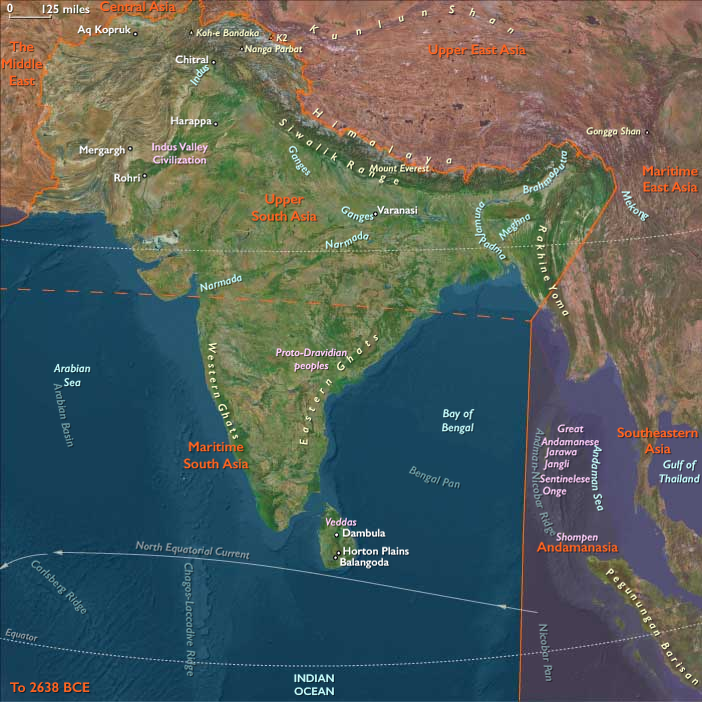
Paleolithic sites in Potohar near Pakistan's capital Islamabad, will yield the stone tools of the Soan Culture, an archaeological culture of the Lower Paleolithic (from around 1,800,000 to about 300,000 BP) in Pakistan, contemporary to the Acheulean.
It is named after the Soan River Valley in the Sivalik Hills, Pakistan.
The bearers of this culture are thought to be Homo erectus.
Hundreds of edged pebble tools will be discovered in Adiyala and Khasala, about sixteen kilometers (ten miles) from Rawalpindi terrace on the bend of the river.
Hand axes and cleavers will be found at Chauntra.
No human skeletons of this age have yet been found.
Locations
Topics
Subjects
Regions
Subregions

Related Events
Filter results
Showing 10 events out of 69769 total
Homo ergaster (or erectus) makes large stone hand-axes out of flint and quartzite, at first quite rough and later "retouched" by additional, more subtle strikes at the sides of the flakes during the period known as the Acheulean, from seven hundred thousand to three hundred thousand years before the present.
Cranial capacity has again doubled within the Homo genus from H. habilis to an archaic Homo species called Homo heidelbergensis by six hundred thousand years ago.
The cranial capacity of H. heidelbergensis overlaps with the range found in modern humans.
Sites such as Boxgrove in Sussex illustrate the later arrival in the archaeological record of H. heidelbergensis around five hundred thousand years years ago.
Homo heidelbergensis is the second human wave to be pumped from Africa into the Middle East and Western Europe.
These early peoples make Acheulean flint tools (hand axes) and hunt the large native mammals of the period.
They are thought to have driven elephants, rhinoceroses, and hippopotamuses over the tops of cliffs or into bogs to kill them more easily.
These kill sites, often at waterholes where animals would gather to drink, were interpreted up until the 1970s as being where Acheulean tool users killed game, butchered their carcasses, and then discarded the tools they had used.
Since the advent of zooarchaeology, which has placed greater emphasis on studying animal bones from archaeological sites, this view has changed.
Many of the animals at these kill sites have been found to have been killed by other predator animals, so it is likely that humans of the period supplemented hunting with scavenging from already dead animals.
The extreme cold of the Anglian Stage, from four hundred and seventy-eight thousand to four hundred and twenty-four thousand years ago, is likely to have driven humans out of Britain altogether and the region does not appear to have been occupied again until the ice receded during the Hoxnian Stage.
The fossil was discovered by archeologist Italo Biddittu and was nicknamed "Ceprano Man" after a nearby town in the province of Frosinone, eighty-nine kilometers southeast of Rome, Italy.
The age of the fossil is estimated to be between three hundred and fifty thousand to five hundred thousand years old.
An adjacent site, Fontana Ranuccio, was dated to 487,000 +/- 6000 years and Muttoni, et al., suggest that Ceprano is most likely four hundred and fifty thousand years old.
The cranial features on the bone seem to be intermediate between those found on Homo erectus and those of later species such as Homo heidelbergensis, which dominated Europe long before Homo neanderthalensis.
There is yet not enough material to make a complete analysis of the individual.
Cranial capacity had again doubled within the Homo genus by six hundred thousand years ago, from H. habilis to an archaic Homo species called Homo heidelbergensis, the second human wave to be pumped from Africa into the Middle East and Western Europe.
Sites such as Boxgrove in Sussex illustrate the later arrival in the archaeological record of heidelbergensis around five hundred thousand years ago.
The cranial capacity of H. heidelbergensis overlaps with the range found in modern humans; these early peoples make Acheulean flint tools (hand axes) and hunt the large native mammals of the period.
They are thought to have driven elephants, rhinoceroses, and hippopotamuses over the tops of cliffs or into bogs to kill them more easily.
Up until the 1970s, these kill sites, often at waterholes where animals would gather to drink, were interpreted as being where Acheulean tool users killed game, butchered their carcasses, and then discarded the tools they had used.
Since the advent of zooarchaeology, which has placed greater emphasis on studying animal bones from archaeological sites, this view has changed.
Many of the animals at these kill sites have been found to have been killed by other predator animals, so it is likely that humans of the period supplemented hunting with scavenging from already dead animals.
The extreme cold of the Anglian Stage, from four hundred and seventy-eight thousand to four hundred and twenty-four thousand years ago, is likely to have driven humans out of Britain altogether and the region will apparently be unoccupied until the ice recedes during the Hoxnian Stage.
The Middle Pleistocene, which began approximately seven hundred and eighty-one thousand thousand years ago, to the Late Pleistocene around one hundred and twenty-six thousand years ago.
The change to a cooler, dry, seasonal climate has considerable impacts on Pliocene vegetation, reducing tropical species worldwide.
Deciduous forests proliferate, coniferous forests and tundra cover much of the north, and grasslands spread on all continents (except Antarctica).
Tropical forests are limited to a tight band around the equator, and in addition to dry savannas, deserts appear in Asia and Africa.
The Wolstonian Stage, a Middle Pleistocene stage of the geological history of earth that precedes the Ipswichian Stage (Eemian Stage in Europe) and follows the Hoxnian Stage in the British Isles, apparently includes three periods of glaciation.
Commencing three hundred and fifty-two thousand years ago and ending one hundred and thirty thousand years ago, it is temporally analogous to the Warthe Stage and Saalian Stage in northern Europe and the Riss glaciation in the Alps, and temporally equivalent to all of the Illinoian Stage and the youngest part of the Pre-Illinoian Stage in North America.
It is contemporaneous with the North American Pre-Illinoian A, Early Illinoian, and Late Illinoian glaciations.
The so-called Levallois technique of stone working, in which a large thin flake is struck from a prepared core and used as a blank for making more specialized tools such as knives and scrapers, is invented during this period.
A striking platform is formed at one end, then the core's edges are trimmed by flaking off pieces around the outline of the intended flake.
This creates a domed shape on the side of the core, known as a tortoise core as the various scars and rounded form are reminiscent of a tortoise's shell.
When the striking platform is finally hit, a flake separates from the core with a distinctive plano-convex profile and with all of its edges sharpened by the earlier trimming work.
This method provides much greater control over the size and shape of the final flake, which is employed as a scraper or knife; the technique can also be adapted to produce projectile points known as Levallois points.
The technique is first found in the Lower Paleolithic but is most commonly associated with the Neanderthal Mousterian industries of the Middle Paleolithic.
In the Levant, Levallois methods are also in use in the Upper Paleolithic and later.
The distinctive forms of the flakes were originally thought to indicate a wide-ranging Levallois culture but the wide geographical and temporal spread of the technique has rendered this interpretation obsolete.
The more refined Levallois technique consists of a series of consecutive strikes, by which scrapers, slicers ("racloirs"), needles, and flattened needles are made.
The global average temperature in the mid-Pliocene (three hundred and thirty thousand to three hundred thousand years ago) is two to three degree centigrade higher than today; global sea level is twenty-five meters higher than today.
Britain first becomes an island about three hundred and fifty thousand years ago, near the beginning of the Wolstonian stage, named after the site of Wolston in the English county of Warwickshire where corresponding deposits were first identified.
This period sees the introduction of Levallois flint tools, possibly by humans arriving from Africa, although finds from Swanscombe and Botany Pit in Purfleet support Levallois technology as a European rather than African introduction.
This more advanced flint technology, which made hunting more efficient, therefore made Britain a more worthwhile place to remain until the increasingly cool climate of the Wolstonian Stage, which apparently includes three periods of glaciation, made continued habitation unattractive, if not impossible.
Acheulean flint tools, typically found with Homo erectus remains, have been found in Wolstonian deposits.
The Northern Hemisphere ice sheet is ephemeral before the onset of extensive glaciation over Greenland that occurs in the late Pliocene around three hundred thousand years ago.
The formation of an Arctic ice cap is signaled by an abrupt shift in oxygen isotope ratios and ice-rafted cobbles in the North Atlantic and North Pacific ocean beds.
Mid-latitude glaciation is probably underway before the end of the epoch.
The global cooling that occurs during the Pliocene may have spurred on the disappearance of forests and the spread of grasslands and savannas.
