Parliament ultimately achieves the aims of the …
Years: 1646 - 1646
October
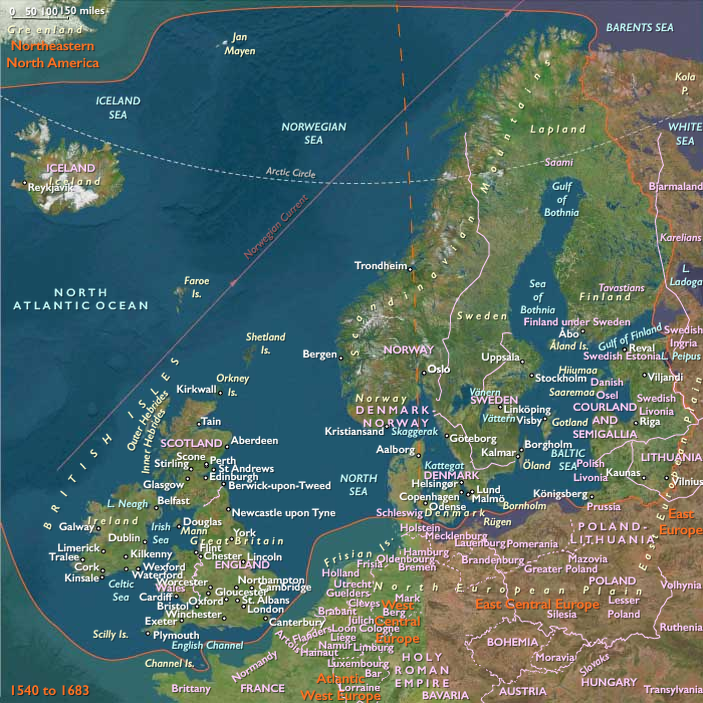
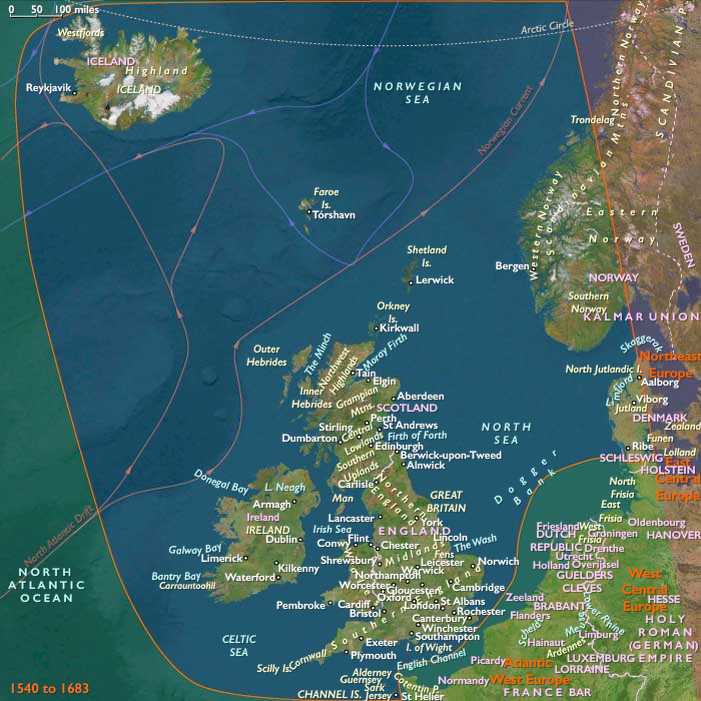
Parliament ultimately achieves the aims of the Root and Branch Bill in October 1646, when it passes the Ordinance for the abolishing of Archbishops and Bishops in England and Wales and for settling their lands and possessions upon Trustees for the use of the Commonwealth.
Locations
People
Groups
- Scotland, Kingdom of
- Anglicans (Episcopal Church of England)
- Presbyterians
- England, (Stuart) Kingdom of
Topics
- Three Kingdoms, Wars of the
- Irish Rebellion, Great
- Irish Confederate Wars
- English Civil War, First, or Great
- Scotland in the Wars of the Three Kingdoms
Commodoties
Subjects
Regions
Subregions
Related Events
Filter results
Showing 10 events out of 31973 total
Abel Tasman discovers the passage into the Pacific, north of Australia’s Gulf of Carpenteria, during a subsequent 1644 mission to establish Australia’s relationship to New Guinea and Tasmania.
On the north coast, Tasman finds black, “naked beach-roving wretches, miserably poor, and in many places of a very bad disposition.”
Athanasius Kircher had attended the Jesuit College in Fulda from 1614 to 1618, when he joined the order himself as a seminarian.
At Heiligenstadt, he had taught mathematics, Hebrew and Syriac, and produced a show of fireworks and moving scenery for the visiting Elector Archbishop of Mainz, showing early evidence of his interest in mechanical devices.
He had joined the priesthood in 1628 and become professor of ethics and mathematics at the University of Würzburg, where he also taught Hebrew and Syrian, and began to show an interest in Egyptian hieroglyphs.
Kircher had published his first book (the Ars Magnesia, reporting his research on magnetism) in 1631, but the same year he was driven by the continuing Thirty Years' War to the papal University of Avignon in France.
In 1633, he had been called to Vienna by the emperor to succeed Kepler as Mathematician to the Habsburg court.
On the intervention of Nicolas-Claude Fabri de Peiresc, the order had been rescinded and he was sent instead to Rome to continue with his scholarly work, but he had already set off for Vienna.
On the way, his ship had been blown off-course and he arrived in Rome before he knew of the changed decision.
He bases himself in the city for the rest of his life, and from 1638, is to teach mathematics, physics and oriental languages at the Collegio Romano for several years before being released to devote himself to research.
He studies malaria and the plague, amassing a collection of antiquities, which he exhibits along with devices of his own creation in the Museum Kircherianum.
Kircher publishes a large number of substantial books on a very wide variety of subjects, such as Egyptology, geology, and music theory.
His syncretic approach pays no attention to the boundaries between disciplines which are now conventional: his Magnes, for example, is ostensibly a discussion of magnetism, but also explores other forms of attraction such as gravity and love.
Kircher is not now considered to have made any significant original contributions, although a number of discoveries and inventions (e.g., the magic lantern, an early prototype of the modern slide projector) have sometimes been mistakenly attributed to him.
In 1646, Kircher publishes Ars Magna Lucis et Umbrae, on the subject of the display of images on a screen using an apparatus similar to the magic lantern as developed by Christian Huygens and others.
Kircher describes the construction of a "catotrophic lamp" that uses reflection to project images on the wall of a darkened room.
Although Kircher did not invent the device, he makes improvements over previous models, and suggests methods by which exhibitors could use his device.
Much of the significance of his work arises from Kircher's rational approach towards the demystification of projected images.

The earliest known Masonic Lodge to allow nonprofessional, or free, masons is founded in 1646, in Warrington, England.
The New Haven Colony in its first years has has ships capable only of coastal travel.
Trade with England is done with the Massachusetts Bay Colony as the middleman.
The Colony had in 1645 built an eighty-ton ocean going ship to be captained by Lamberton.
Economic disaster strikes in 1646, when the town sends its first fully loaded ship of local goods back to England.
This ship never reaches the Old World, and its disappearance stymies New Haven's development in the face of the rising trade power of Boston and New Amsterdam.
The uneasy truce with the Lenape allows for further settlement, including Constable Hook in 1646, based on a land grant to Jacob Jacobsen Roy, a chief gunner or constable in Fort Amsterdam in New Amsterdam.
The area, "Konstapel's Hoeck" in Dutch, takes its name from Roy's title.
Roy, however, never cultivates or settles on the land.
The nuncio considers himself the virtual head of the Confederate Catholic party in Ireland.
The Supreme Council of the Confederates has come to an agreement with Ormonde, signed March 28, 1646.
Under its terms, Catholics will be allowed to serve in public office and find schools; there are also verbal promises of future concessions on religious toleration.
There is an amnesty for acts committed in the Rebellion of 1641 and a guarantee against further seizure of Irish Catholic land.
The Supreme Council also puts great hope in a secret treaty they have concluded with the Earl of Glamorgan on the King's behalf, which promises further concessions to Irish Catholics in the future.
However, there is no reversal of Poynings Law which subordinates the Irish Parliament to the English one, no reversal of the Protestant domination of Parliament and no reversal of the main plantations, or colonization, in Ulster and Munster.
Moreover, regarding the religious articles of the treaty, all churches taken over by Catholics in the war will have to be returned to Protestant hands and public practice of Catholicism is not guaranteed.
In return for the concessions that are made, Irish troops are to be sent to England to fight for the royalists in the English Civil War.
However, the terms agreed are not acceptable to either the Catholic clergy, the Irish military commanders—notably Owen Roe O'Neill and Thomas Preston—or the majority of the General Assembly.
Nor is Rinuccini the papal nuncio party to the treaty, which leaves untouched the objects of his mission; he had induced nine of the Irish bishops to sign a protest against any arrangement with Ormonde or the king that will not guarantee the maintenance of the Catholic religion.
Governor Leonard Calvert, returning to Maryland with an armed force, has by August 1646 retaken both St. Mary's and ...
...Kent Island with support from Governor Berkeley of Virginia.
Calvert reasserts proprietarial rule.
Although most of Ingle’s men are granted amnesty, Ingle himself is specifically excepted from it and executed.
Isaac Jogues, born in Orléans, France, had entered the Society of Jesus in 1624.
He had been sent in 1636 to New France as a missionary to the Huron and Algonquin allies of the French.
while on his way by canoe to the country of the Hurons in 1642, Jogues had been captured by a war party of Mohawk Iroquois, in the company of Guillaume Couture, René Goupil, and several Huron Christians.
They had been taken back to the Mohawk village and subjected to gruesome torture, during which several of Jogues' fingers were cut off by this captors.
Jogues had survived this torment and gone on to live as a slave among the Mohawks for some time, even attempting to teach his captors the rudiments of Christianity.
He was finally able to escape thanks to the pity of some Dutch merchants who smuggled him back to Manhattan, from where he had managed to sail back to France, where he was greeted with surprise and joy.
As a "living martyr," Jogues had been given a special permission by Pope Urban VIII to say Holy Mass with his mutilated hands, as the Eucharist could not be touched with any fingers but the thumb and forefinger.
Jogues's ill-treatment by the Mohawks had not dimmed his missionary zeal: within a few months, he was on his way back to Canada to continue his work.
A tentative peace had been forged in 1645 between the Iroquois and the Hurons, Algonquins, and French.
Jogues had been sent back to the Mohawk country in the spring of 1646, along with Jean de Lalande, to act as ambassador among them.
Some among the Mohawks regard Jogues as a sorcerer, however, and he is a convenient scapegoat when the double-calamity of sickness and crop failure hits the tribe.
Jogues and LaLande are clubbed to death and beheaded by their Mohawk hosts near Auriesville, New York on October 18, 1646.
His martyrdom will earn him eventual canonization in 1930.
Turkish forces on Crete, having gained a foothold by the summer of 1647, prepare to lay siege to the capital city of Candia.
Venetian ships meanwhile keep Candia continuously supplied and blockade the Dardanelles.
The Cretan War, or War of Candia will continue for another twenty-two years.
Years: 1646 - 1646
October
Locations
People
Groups
- Scotland, Kingdom of
- Anglicans (Episcopal Church of England)
- Presbyterians
- England, (Stuart) Kingdom of
Topics
- Three Kingdoms, Wars of the
- Irish Rebellion, Great
- Irish Confederate Wars
- English Civil War, First, or Great
- Scotland in the Wars of the Three Kingdoms