
The Emperor Diocletian undertakes the reorganization of …
Years: 244 - 387
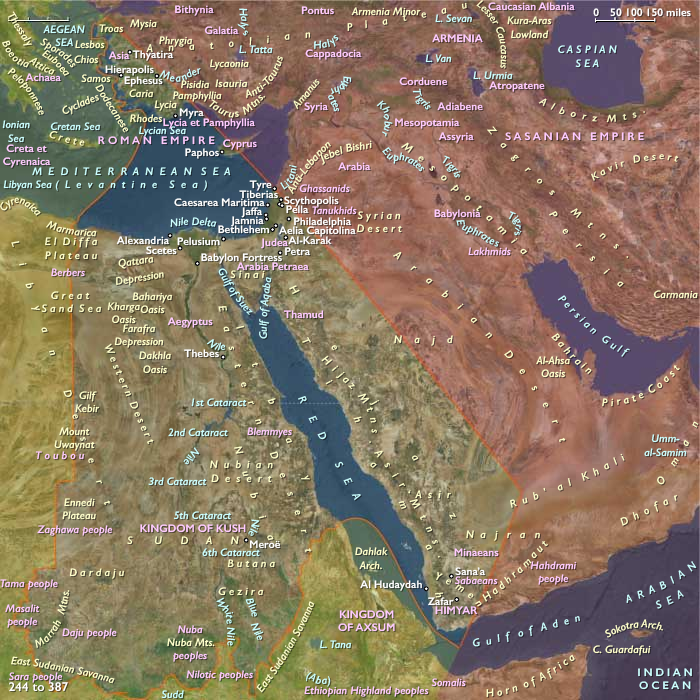
The Emperor Diocletian undertakes the reorganization of the Roman Empire in 285, dividing its jurisdiction between its Latin-speaking and Greek-speaking halves.
Diocletian's successor, Constantine, accepts conversion and becomes the first Christian Roman emperor.
He establishes his imperial residence at Byzantium, on the shore of the Bosporus, in 324.
Byzantium is renamed Constantinople and eventually becomes the capital of the Eastern (Byzantine) Empire.
From Constantine's establishment until the crusaders arrive more than eight hundred years later, the history of Cyprus is part of the history of that empire.
Under Constantinople's rule, the Greek orientation that had been prominent since antiquity develops the strong Hellenistic-Christian character that continues to be a hallmark of the Greek Cypriot community.
Christianity is probably already predominant on Cyprus by the time Constantine accepts the new religion for himself, owing mainly to the early missionary work of Paul, Barnabas, and Mark.
Earthquakes in the early fourth century create havoc on the island, and drought seriously damages the economy.
The most significant event of the century, however, is the struggle of the Church of Cyprus to maintain its independence from the patriarchs of Antioch.
Three bishops represent Cyprus at the first Ecumenical Council of Nicaea in 325.
At the second council (Sardica, 343), there are twelve Cypriot bishops, indicating a great increase in the number of communicants in the intervening years.
Locations
People
Groups
- Cyprus, Roman
- Roman Empire (Rome): Julio-Claudian dynasty
- Christians, Jewish
- Christians, Early
- Christianity, Nicene
Subjects
Regions
Subregions
Related Events
Showing 10 events out of 60511 total
Years: 244 - 387
Locations
People
Groups
- Cyprus, Roman
- Roman Empire (Rome): Julio-Claudian dynasty
- Christians, Jewish
- Christians, Early
- Christianity, Nicene
Subjects
Regions
Subregions