
Persia’s King Khosrau—called in Eastern sources Khosrow …
Years: 568 - 568
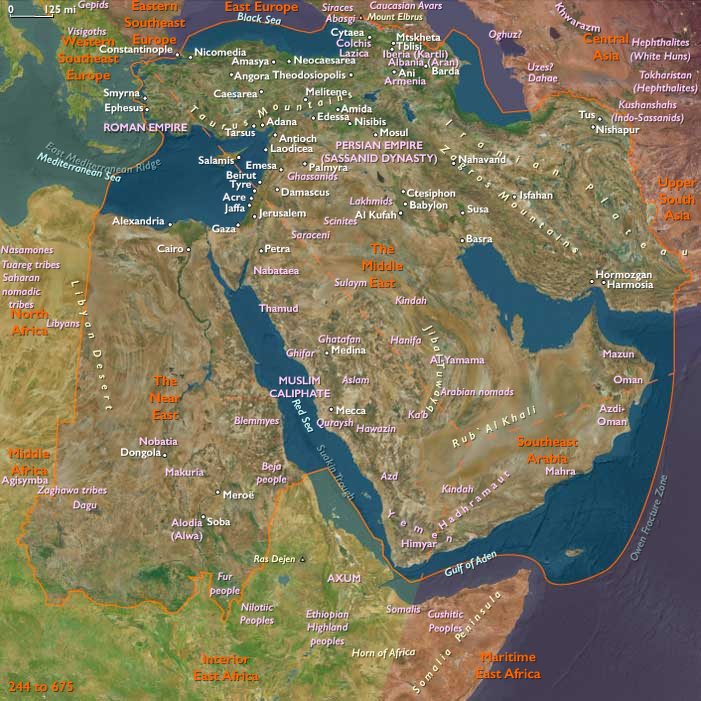
Persia’s King Khosrau—called in Eastern sources Khosrow Anushirvan, “of the immortal soul,” because of his fame (called Chosroes in the West)—has conquered areas as distant as Yemen and the Caucasus, crushed the nomadic Hephthalites, and established Sassanian hegemony over present Afghanistan.
Ctesiphon, capital of the Sassanid Empire, is during this era the largest city of the world, edging past Constantinople.
The site is famous for the remains of a gigantic vaulted hall, the Taq Kisra, which is traditionally regarded as Khosrau’s palace, although Shapur I (reigned CE 241–272) also undertook work on the site.
The hall has one of the largest single-span brick arches in the world.
The so-called Spring of Khosrau Carpet made for the Ctesiphon palace, possibly the most costly and magnificent of all time, is described in the historical annals of the Muslim scholar al-Tabari.
The model for subsequent garden carpets, it is called the Spring of Khosrau because it represents, in silk, gold, silver, and jewels, the splendor of flowering spring.
It is also called the Winter Carpet because it is used in bad weather, when real gardens are unavailable.
As such, it symbolizes the king's power to command the return of the seasons.
Its design is a formalized paradise with streams, paths, rectangular plots of flowers, and flowering trees.
Water is represented by crystals, soil by gold, and fruits and flowers by precious stones.
Locations
People
Groups
- Persian Empire, Sassanid, or Sasanid
- Roman Empire, Eastern: Justinian dynasty
- Hephthalite Principalities
Topics
Commodoties
Subjects
- Commerce
- Symbols
- Architecture
- Painting and Drawing
- Labor and Service
- Decorative arts
- Conflict
- Faith
- Government
- Technology
- Movements
Regions
Subregions

Related Events
Showing 10 events out of 57489 total
Years: 568 - 568
Locations
People
Groups
- Persian Empire, Sassanid, or Sasanid
- Roman Empire, Eastern: Justinian dynasty
- Hephthalite Principalities
Topics
Commodoties
Subjects
- Commerce
- Symbols
- Architecture
- Painting and Drawing
- Labor and Service
- Decorative arts
- Conflict
- Faith
- Government
- Technology
- Movements
Regions
Subregions