
Filters:
The Early Reign of Philip II of …
Years: 1180 - 1180
The Early Reign of Philip II of France (1179–1180): His Rise to Power
Philip II, the son of Louis VII and Adela of Champagne, was born in Gonesse on August 21, 1165. From an early age, his father intended for him to share the throne, ensuring a stable succession for the Capetian dynasty. However, his coronation was delayed due to a near-fatal incident in 1179, which would ultimately accelerate his rise to power.
Philip’s Near-Death Experience and Louis VII’s Decline
- At the age of thirteen, Philip became lost in the Forest of Compiègne during a royal hunt, separated from his companions.
- He wandered throughout the night, struggling against cold, hunger, and exhaustion, before being found by a peasant with a charcoal burner.
- The ordeal left him severely ill, developing a high fever that threatened his life.
- His father, Louis VII, went on pilgrimage to the Shrine of Thomas Becket in Canterbury, praying for his son’s recovery.
- While Philip did recover, Louis suffered a stroke on his way back to Paris, leaving him in rapidly declining health.
Philip’s Coronation as Co-King (November 1, 1179)
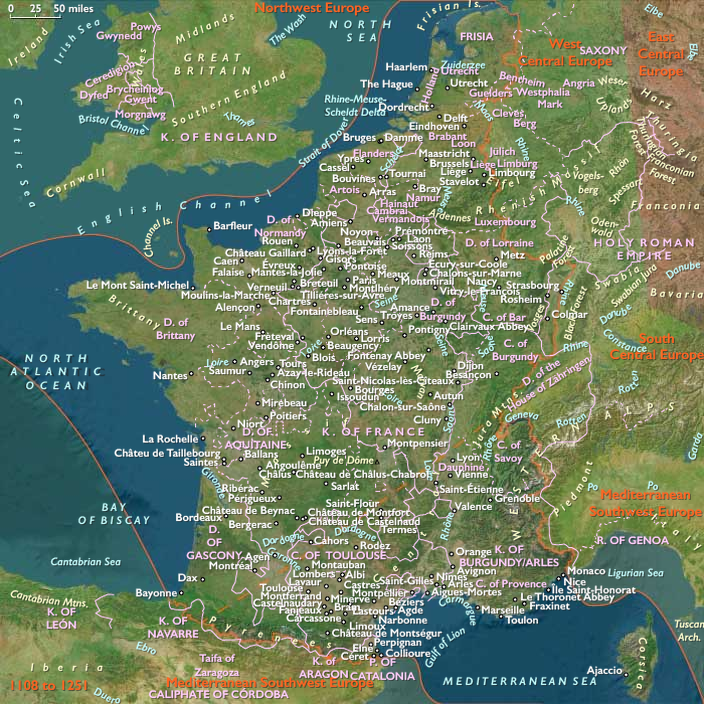
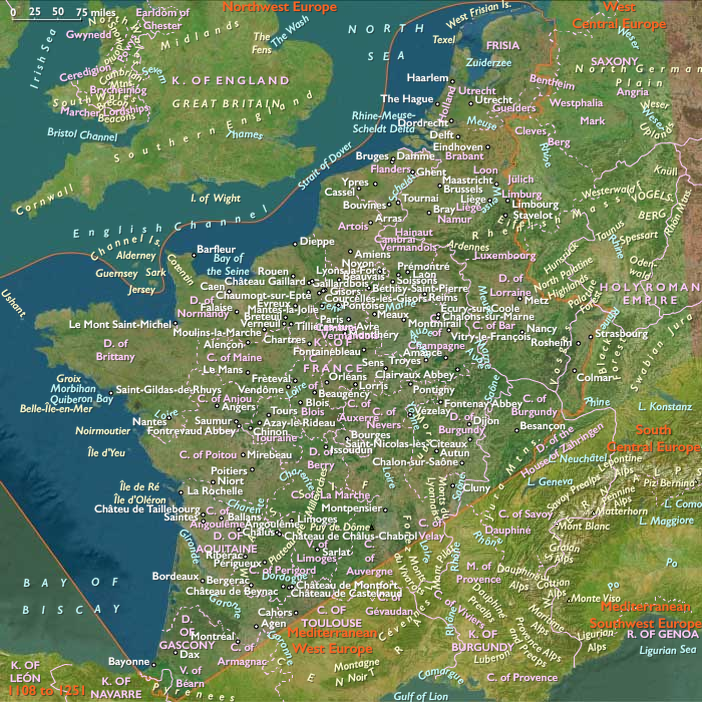
- Due to Louis VII’s failing health, Philip was crowned co-king and anointed at Reims Cathedral on November 1, 1179, by Archbishop William Whitehands.
- Although Louis VII remained king in name, real power passed to Philip, who now effectively ruled France.
Philip’s Arrest and Ransom of the Jews (January 1180)
- While Louis VII had attempted to protect the Jewish population, Philip took a more aggressive stance.
- On January 9, 1180, he ordered the mass arrest of Jews found in Parisian synagogues on the Sabbath.
- He agreed to release them for a ransom of fifteen thousand silver marks, using Jewish wealth to strengthen the royal treasury.
- This action was one of many anti-Jewish policies that Philip would later implement.
Marriage to Isabelle of Hainaut and Conflict with the Nobles (April 28, 1180)
- Philip married Isabelle of Hainaut on April 28, 1180.
- Her dowry included the County of Artois, expanding royal control in northern France.
- His marriage displeased many nobles, particularly his mother and uncles, who saw it as a threat to their own influence at court.
Death of Louis VII and Philip’s Sole Rule (September 18, 1180)
- Louis VII died on September 18, 1180, leaving Philip II as the sole King of France.
- Louis left behind a stronger and more respected monarchy than he had inherited, paving the way for Philip’s ambitions.
Philip II’s Initial Actions as King
- Philip quickly ended hostilities with England, likely to consolidate his power at home before resuming conflicts later.
- He turned his attention to wars against rebellious French barons, seeking to expand and strengthen the Capetian domain.
Philip’s early reign demonstrated his political shrewdness, ruthlessness, and determination to centralize royal power, setting the stage for his later victories against the Angevin Empire and his transformation of the French monarchy.
Locations
People
Groups
- Jews
- Flanders, County of
- French people (Latins)
- France, (Capetian) Kingdom of
- Hainaut, County of
- England, (Plantagenet, Angevin) Kingdom of
Topics
Commodoties
Subjects
Regions
Subregions
Years: 1180 - 1180
Locations
People
Groups
- Jews
- Flanders, County of
- French people (Latins)
- France, (Capetian) Kingdom of
- Hainaut, County of
- England, (Plantagenet, Angevin) Kingdom of
Topics
Commodoties
Subjects
Regions
Subregions