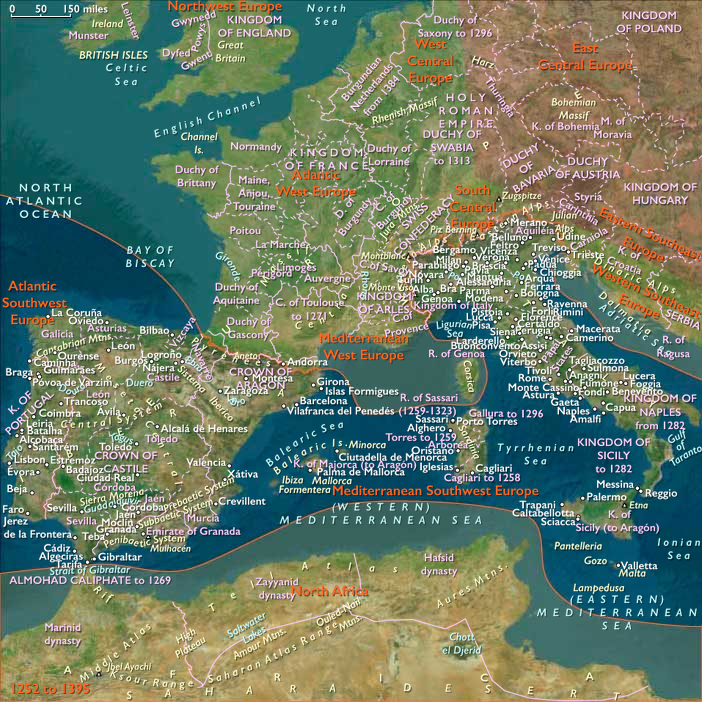
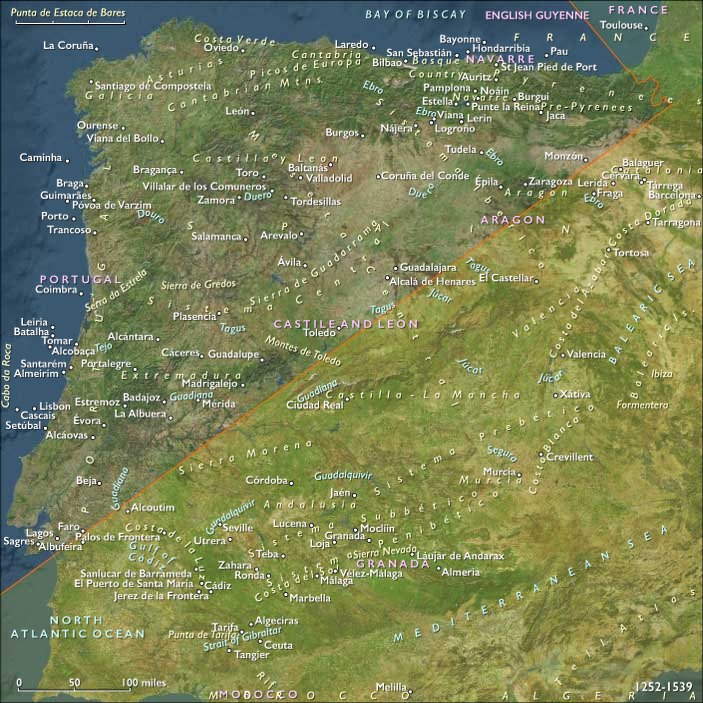
The Peace of …
Years: 1371 - 1371
The Peace of Alcoutim (1371): Ferdinand I Abandons His Claim to Castile
After his humiliating defeat in the First Fernandine War (1369–1371) against Henry II of Castile, King Ferdinand I of Portugal was forced to negotiate peace to prevent further destruction.
Terms of the Peace Treaty (1371)
- Ferdinand formally renounced his claim to the Castilian throne, abandoning his support for towns that had remained loyal to Peter I of Castile.
- Portugal agreed to pay reparations to Castile.
- To secure the peace, Ferdinand pledged to marry Henry II’s daughter, Leonor of Castile, creating a dynastic alliance between the two kingdoms.
Ferdinand’s Betrayal of the Treaty
Despite the treaty’s terms, Ferdinand soon broke his engagement to Leonor of Castile, choosing instead to marry Leonor Teles de Meneses, a Portuguese noblewoman of ambitious and controversial reputation.
- His abandonment of the arranged marriage infuriated Castile, further damaging relations between the two kingdoms.
- This betrayal renewed hostilities and contributed to the outbreak of the Second Fernandine War (1372–1373).
- The Portuguese nobility was divided, as many saw his decision as reckless and politically dangerous.
Consequences of the Peace of Alcoutim
- While it ended immediate warfare, the treaty failed to establish a lasting peace between Portugal and Castile.
- Ferdinand’s personal ambitions and disregard for diplomatic agreements kept Portugal embroiled in conflict, weakening its stability and draining its resources.
- These tensions would culminate in the Portuguese crisis of 1383–1385, a succession dispute that ultimately led to the rise of the House of Avis and the consolidation of Portuguese independence.
Thus, the Peace of Alcoutim (1371), though a temporary truce, did little to prevent further wars, betrayals, and political instability in Portugal’s relations with Castile.
Locations
People
Groups
Topics
Commodoties
Subjects
Regions
Subregions
Related Events
Filter results
Showing 10 events out of 43855 total
Sukhothai, declining under King Leuthai, revolts against its new Ayutthayan overlord, King Borommarachathirat, who leads a military expedition north to reestablish control, sending gifts to the Chinese emperor at Nanjing to discourage possible Chinese involvement in the conflict.
Japan’s Gempei wars of 1180-85, which had brought an end to the comfortable, aesthetic life of courtier-poets and court ladies writing in the capital, become the subject of the epic Tale of the Heike, a work of complex mixed oral and written origins that reaches its final form in 1371.
Collections of short tales, some religious, some secular in nature, enjoy continuing popularity among Japanese readers of the age.
Louis of Hungary intervenes during a war between Emperor Charles IV and Stephen II, Duke of Bavaria, on the duke's behalf and the Hungarian army invades Moravia.
After the duke and the emperor sign a peace treaty, Louis and the emperor agree upon the betrothal of their children early in the next year.
Murad, having already married Greek and Bulgarian princesses, next incorporates into the rapidly expanding Ottoman empire many European vassals.
He retains local native rulers, who in return accept his suzerainty, pay annual tributes, and provide contingents for his army when required.
This policy enables the Ottomans generally to avoid local resistance by assuring rulers and subjects that their lives, properties, traditions, and positions will be preserved if they peacefully accept Ottoman rule.
It also enables the Ottomans to govern the newly conquered areas without building up a vast administrative system of their own or maintaining substantial occupation garrisons.
The efforts of Emperor John V to mobilize European assistance by uniting the churches of Constantinople and Rome have only further divided Constantinople without assuring any concrete help from the West.
He is forced in 1371 to recognize the suzerainty of the Turks.
The advance of the Ottoman Turks in Europe is a far more serious problem for Serbia—and the entire Balkans—than the internal squabbling of the Serbian nobles.
Following their acquisition of Gallipoli on the European side of the Dardanelles in 1354, the Ottoman Turks had expanded into Thrace, taking Demotika from the Greeks in 1361 and Philippopolis from the Bulgarians in 1363 and finally in 1369 the major city of Adrianople.
By 1370, Turks had occupied most of Thrace to the Rhodopes and to the Balkan Mountains.
As they reached the Rhodopes they collided with Jovan Uglješa, brother of Serbian co-king Vukašin, who has extended his realm beyond the Mesta into this territory, and the threat from them becomes increasingly serious.
Vukašin, the king of the southern Serbian lands, with his brother leads a Serb army against the advancing Ottoman Empire forces, led by the beylerbey of Rumeli Lala Şâhin Paşa, at the Battle of Maritsa on September 26, 1371.
The offensive against the Turks, originally scheduled for early 1371, had been delayed, perhaps because Uglješa had hoped that Bulgaria might also join the coalition.
King Vukašin and his son Marko had been preparing for action against Nicholas Altomanovich, intending to recapture Skadar (now Shkodër) for the Serbian Empire, when they were informed of a large Ottoman army advancing from the east.
Summoned to join up with Uglješa and his army, the Mrnjavčević brothers and their troop easily penetrate into what is supposedly Turkish territory and reach Cernomen on the Maritsa River, where the Serbs do not bother to post sentries or deploy scouts.
Furthermore, they have not kept their horses or their weapons in readiness.
The Serbian army numbers twenty thousand to seventy thousand men.
Most sources agree on the higher number.
Despot Uglješa wants to make a surprise attack on the Ottomans in their capital city, Adrianople, while Murad I is in Asia Minor.
The Ottoman army is much smaller.
Byzantine Greek scholar Laonikos Chalkokondyles and other sources give the number of eight hundred men, but due to superior tactics, by conducting a night raid on the Serbian camp, Şâhin Paşa is able to defeat the Serbian army and kill King Vukašin and despot Uglješa.
Thousands of Serbs are killed, and thousands drown in the Maritsa river when they try to flee.
After the battle, the Maritsa runs scarlet with blood.
The bodies of the two Serbian commanders are not found.
The battle involves such carnage that the field will later be referred to as “the Serbs' destruction.” Ottoman sultan Murad has thus increased his own confidence and demoralized his smaller enemies, who rapidly accept his suzerainty without further resistance.
The independent South Serbian kingdom is thus destroyed; its new ruler, Marko Kraljevic (“Mark, the King's Son”), the son of Vukashin and a chieftain of Prilep, becomes a vassal of Murad and retains a nominal independence.

Lazar Hrebeljanović, one of the Serbian lords, swears loyalty to Louis of Hungary after the Ottomans annihilate the Serbian armies in the Battle of Maritza on September 26 , 1371.
The Serbs' defeat at Chernomen exposes Macedonia and, ultimately, the remainder of the Balkan Peninsula to Turkish conquest.
Murad takes the Macedonian towns of Dráma, …
…Kavála, …
…and Seres (Sérrai), …