Primitive humans first migrate to the Indian …
Years: 215181BCE - 194446BCE
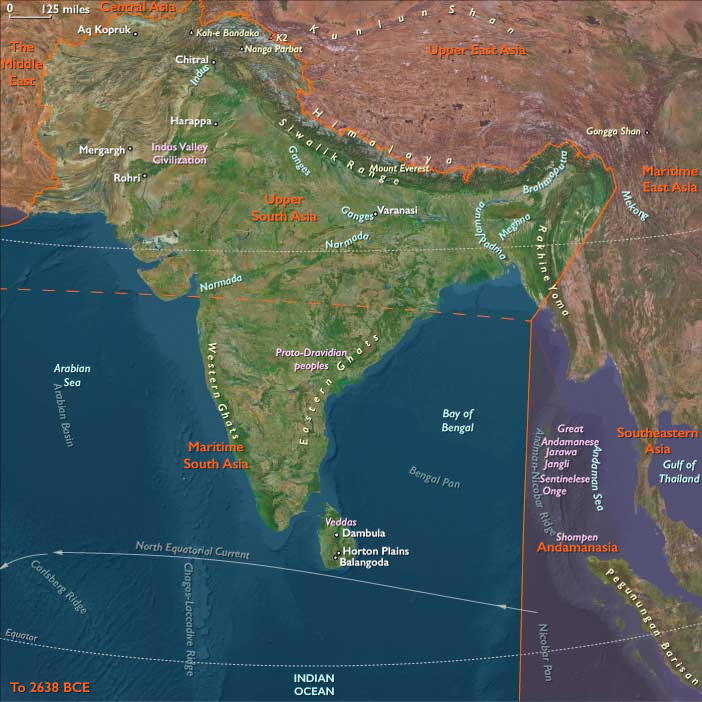
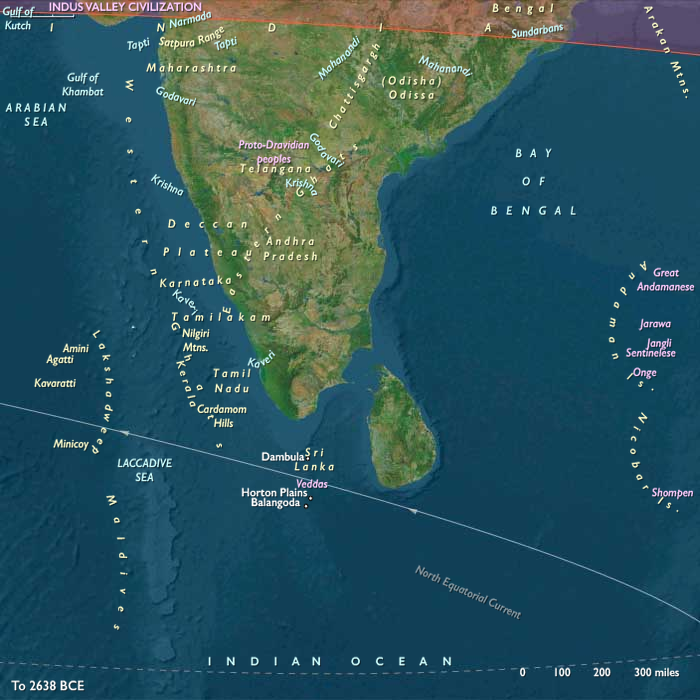
Primitive humans first migrate to the Indian subcontinent between 400,000 and 200,000 BCE; some of them possibly sail to southern India from eastern Africa.
Locations
Groups
Topics
Subjects
Regions
Subregions
Related Events
Filter results
Showing 10 events out of 69746 total
Homo erectus, long settled in sparse communities throughout East Asia, probably becomes extinct in China before 200,000 BCE, evidently replaced by Homo sapiens.
The approximate time of divergence from the common ancestor of all modern human populations was two hundred thousand years ago, based on evidence from studies of molecular biology.
The broad study of African genetic diversity found the ǂKhomani San people to express the greatest genetic diversity among the 113 distinct populations sampled, making them one of fourteen "ancestral population clusters".
The research also located the origin of modern human migration in southwestern Africa, near the coastal border of Namibia and Angola.
Anatomically modern humans first appear in the fossil record in Africa about one hundred and ninety-five thousand years ago, and studies of molecular biology give evidence that the approximate time of divergence from the common ancestor of all modern human populations was two hundred thousand years ago.
Twentieth-century archaeologists will find fragments of anatomically modern humans in Omo in southwestern Ethiopia.
The results of potassium-argon dating of the tuffs, published in February 2005, attribute them to circa one hundred and ninety-five thousand years ago, making Ethiopia the current choice for the ‘cradle of Homo Sapiens’.
The bones, which include two partial skulls, four jaws, a legbone, around two hundred teeth and several other parts, were found between 1967 and 1974.
They are now assumed to be considerably older than the one hundred and sixty thousand-year-old Herto remains designated Homo sapiens idaltu, which had been thought to be the earliest humans, and suggests that, if humans did originate in Africa as is currently thought, they did not expand from there for much longer than previously thought.
It also suggests that H. sapiens sapiens evolved alongside other hominids for a considerable time before the other hominids became extinct.
Part of the skull of a nine-year old child from the Grotte du Lazaret (English: Cave of Le Lazaret), a cave now in the eastern suburbs of the French town of Nice and now overlooking the Mediterranean Sea, suggests that either Homo heidelbergensis or a proto-Neanderthal group occupied it almost two hundred thousand years ago.
The Lazaret cave dwellers evidently represent a transitional form between Homo erectus and more advanced species of early humans.
Southern Oceania encompasses Eastern East Antarctica, Tasmania, New Zealand’s South Island (including its southern coast), and Australia, extending northward to the continent’s Top End and Cape York Peninsula.
The term Australasia (French: Australasie) was coined by Charles de Brosses in Histoire des navigations aux terres australes (1756). Derived from Latin, meaning "south of Asia," the term was intended to distinguish this region from Polynesia (to the east) and the southeastern Pacific (Magellanica).
Southern Oceania’s southwestern boundary divides East Antarctica into its Western and Eastern subregions, running from the South Pole to the Kerguelen Islands. These islands, among the most remote on Earth, form part of the Kerguelen Plateau, a vast igneous geological province largely submerged beneath the southern Indian Ocean.
The French Southern and Antarctic Lands (Terres australes et antarctiques françaises)—which include Adélie Land, the Crozet Islands, the Kerguelen Islands, Amsterdam and Saint Paul Islands, and France’s Scattered Islands in the Indian Ocean—are administered as a separate district.
The southeastern boundary runs a little north of the Cook Strait, which separates New Zealand’s South Island—sometimes called the "mainland"—from the smaller yet more populous North Island (Te Ika-a-Māui).
The northern boundary divides Southern Oceania from The Far East, to which Australia’s tropical north belongs.
HistoryAtlas contains 569 entries for Southern Oceania from the Paleolithic period to 1899.
Narrow results by searching for a word or phrase or select from one or more of a dozen filters.

Australia is possibly occupied by at least 174,000 BCE (a date suggested by archaeological fieldwork in Western Australia’s Kimberley district).
Homo sapiens begins to evolve from two hundred thousand to one hundred and fifty thousand years ago as more modern-looking Africans use increasingly refined and more specialized toolkits to kill game of all kinds.
They also have more enhanced speaking abilities than their predecessors, displaying a blend of archaic and modern features.
Herto Bouri is a region of Ethiopia under volcanic layers.
By using radioisotope dating, the layers date between one hundred and fifty-four thousand and one hundred and sixty thousand years old.
Idaltu is the Afar word for "elder, first born.”
These fossils differ from those of chronologically later forms of early H. sapiens such as Early European Modern Humans found in Europe and other parts of the world in that their morphology has many archaic features not typical of H. sapiens (although modern human skulls do differ across the globe).
Despite the archaic features, these specimens are postulated to represent the direct ancestors of Homo sapiens sapiens.
"Modern humans" are defined as the Homo sapiens species, of which the only extant subspecies is known as Homo sapiens sapiens.
According to the "Recent African Origin (RAO)" or "Out-Of-Africa" theory, H. sapiens sapiens developed shortly after this period (Khoisan mitochondrial divergence dated not later than 110,000 BP) in Eastern Africa, and as such, to be the oldest representative of the H. sapiens species found so far.
Anatomically modern humans, Homo sapiens sapiens, evidently evolve in tropical Africa between 150,000 and 100,000 BCE.
Archaeological evidence reveals signs of technological change throughout eastern and southern Africa before 130,000 BCE, as the heavier toolkits of earlier times gave way to lighter, more specialized toolkits, which included sharp spearpoints that can be mounted on wooden shafts.
The Neanderthals move into Europe around 150,000 BCE.
The game-hunting occupants of the Grotte du Lazaret (English: Cave of Le Lazaret), now in the eastern suburbs of the French town of Nice and now overlooking the Mediterranean Sea, dating to about this time, make tents, probably of animal hides stretched over a wooden framework, with the tent entrances facing away from the cave opening.
A wolf skull is situated inside the doorway of each tent.