
Provence had been legally a part of …
Years: 880 - 880
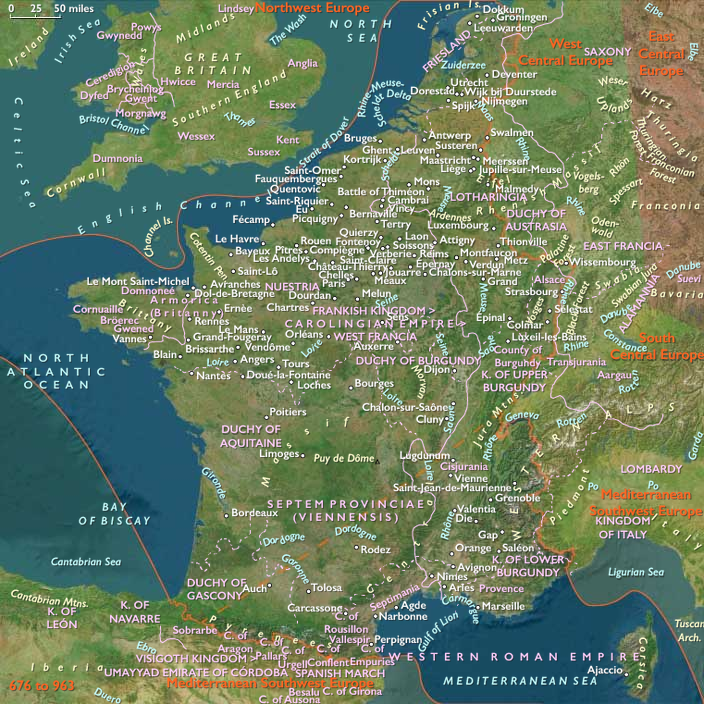
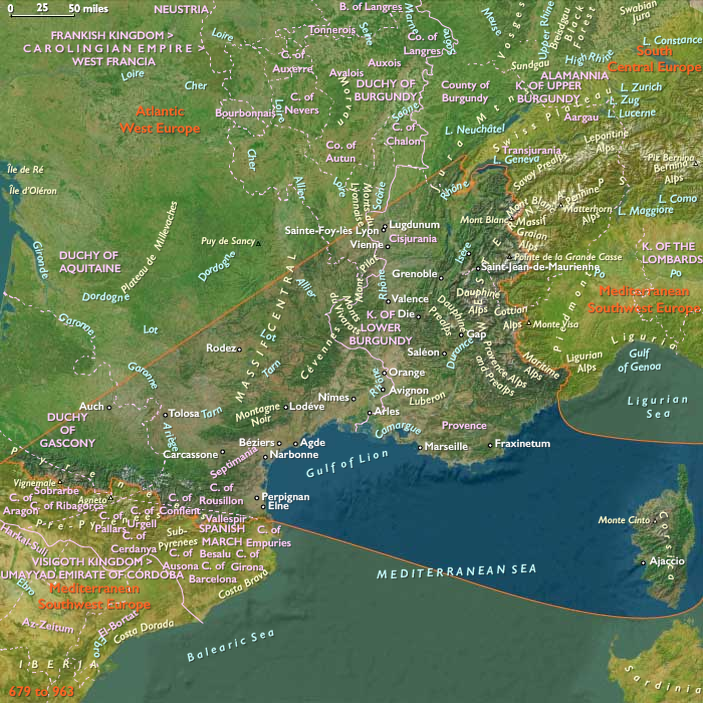
Provence had been legally a part of the Italian kingdom from 863.
Following the death of Louis the Stammerer and the division of his realm between his two sons, Carloman and Louis, some nobles advocate electing a sole king, but eventually both brothers are elected kings.
Although doubts are cast upon their legitimacy, the brothers had obtained recognition and in March 880 divide their father's realm at Amiens, Carloman receiving Burgundy and Aquitaine.
However, Duke Boso has renounced his allegiance to both brothers and had been elected King of Provence, or Lower Burgundy.
The brothers Carloman and Louis march against him in the summer of 880, taking Mâcon and the northern parts of Boso's realm.
They unite their forces with those of Charles the Fat and unsuccessfully besiege Vienne from August to November.
Locations
People
Groups
- Provence, Early Medieval
- Italy, Carolingian Kingdom of
- Aquitaine, (Carolingian) Kingdom of
- Frankish, or Carolingian (Roman) Empire
- Francia Occidentalis (West Francia, or France), Kingdom of
- Burgundy, Upper, Kingdom of
- Burgundy, Lower, Kingdom of
Commodoties
Subjects
Regions
Subregions
Related Events
Filter results
Showing 10 events out of 44 total
...his control over the Nantais is contested by Fulk I of Anjou, though Alan holds the upper hand during his lifetime.
A Strong and Wealthy Ruler
- Alan's power base remains in southeastern Brittany, particularly around Vannes and Nantes, where he amasses great wealth and land.
- His control over Frankish territories solidifies Brittany’s independence from West Francia, ensuring that it is not merely a vassal state of the Carolingians.
The Last Ruler of a Unified Brittany
- Alan I is the last ruler to govern all of Brittany and its adjacent Frankish territories as a unified realm.
- After his death, Brittany will never again reach this level of political and territorial unity, as internal divisions and external pressures fragment the region.
Legacy of Alan I
- His reign represents the pinnacle of Breton independence, securing territories beyond Brittany itself.
- He successfully defends Breton sovereignty against Frankish and Viking threats.
- His rivalry with Fulk I of Anjou foreshadows the future struggles between Brittany and Anjou, particularly in the 11th and 12th centuries.
Alan I’s rule stands as the golden age of Breton expansion, marking the height of Brittany’s influence in medieval Europe.
Viking Devastation of Brittany and the Fall of Nantes (Early 10th Century)
At the beginning of the 10th century, Brittany comes under renewed heavy Viking attacks, leading to territorial losses and political fragmentation. By 914, the Vikings seize Nantes, dealing a major blow to the once-powerful Breton kingdom.
Brittany’s Loss of Eastern Territories
- Brittany had already lost control over Normandy and Anjou, with Normandy falling under Rollo’s rule after the Treaty of Saint-Clair-sur-Epte (911).
- The County of Nantes, previously part of Breton control, had been granted to Fulk I ("the Red"), Count of Anjou, in 909 by the Carolingian rulers of West Francia.
- This shift in authority weakens Breton resistance against further Viking incursions.
The Fall of Nantes to the Vikings (914)
- In 914, Viking forces seize Nantes, reversing Fulk’s earlier efforts to restore Carolingian control over the region.
- Nantes, one of the wealthiest and most strategically important cities in Brittany, falls into Viking hands, becoming a base for further raids into the Loire Valley and the interior of Brittany.
- The capture of Nantes marks the beginning of a prolonged Norse presence in the region, forcing both Breton and Frankish leaders to contend with a major Viking stronghold.
Consequences of the Viking Invasions in Brittany
-
Brittany’s Declining Power
- The kingdom is now reduced in size, having lost Normandy, Anjou, and now Nantes.
- Viking raids prevent the emergence of a strong central authority, leaving the region fractured and vulnerable.
-
Anjou’s Rise Under Fulk the Red
- With Nantes lost, Fulk I of Anjou shifts his focus toward consolidating power in Anjou, laying the groundwork for the future rise of the House of Anjou.
-
Nantes as a Viking Base
- The Vikings use Nantes as a stronghold for further raids along the Loire and into the interior of West Francia.
- Their control of river routes ensures that their influence remains strong in the region for years to come.
Conclusion: The Fragmentation of Brittany
The loss of Nantes in 914, following the earlier loss of Normandy and Anjou, weakens Brittany significantly, ensuring that Viking and Frankish forces will continue to shape the region’s political landscape. The region remains politically divided, with local rulers struggling to contain further Norse incursions, while Frankish influence in Brittany wanes.
The Collapse of Brittany and the Viking Conquest (919)
After decades of internal conflict and external threats, Brittany succumbs to Viking domination in 919, with the region's nobility fleeing to Francia and England, leaving the land under the control of Rognvald, a Viking leader who establishes Nantes as his capital.
Background: Breton Expansion and Internal Struggles
- After the death of Charlemagne, Breton expansion intensifies, with the region increasingly asserting independence from West Francia.
- In 850, Nominoë, ruler of Brittany, invades and conquers Nantes and Rennes, establishing Breton control over the Frankish-controlled Breton March.
- Following the Battle of Jengland (851) and the Treaty of Angers, the Breton March is integrated into Brittany, marking a high point of Breton sovereignty.
Eighty Years of Breton Civil Strife and Viking Raids
- Despite its independence, Brittany is destabilized by internal power struggles among its warlords.
- Rival nobles often turn to Viking allies to gain an advantage, leading to repeated Norse incursions.
- One of the most catastrophic Viking attacks occurs on June 24, 843, when the Norse sack Nantes and kill Bishop Gohard, an event described in the Chronicle of Nantes:
- "The city of Nantes remained for many years deserted, devastated, and overgrown with briars and thorns."
The Final Collapse: Viking Conquest of Brittany (919)
- By 919, Breton defenses have completely collapsed, and the remaining Breton nobility flee to Francia and England, abandoning their homeland.
- Rognvald, a Viking warlord, establishes Nantes as his new capital, consolidating Norse rule over Brittany.
- The Viking occupation represents the complete breakdown of Breton autonomy, reversing the gains of Nominoë and his successors.
Consequences of the Viking Conquest of Brittany
-
Brittany is No Longer Independent
- The Breton ruling class is exiled, leaving Viking chieftains in control.
- This is the first time in nearly a century that Brittany is completely dominated by a foreign power.
-
Nantes Becomes a Viking Stronghold
- Under Rognvald’s rule, Nantes serves as the center of Norse power in Brittany.
- From here, the Vikings launch further raids into Frankish territories.
-
Future Efforts to Reclaim Brittany
- In the coming decades, exiled Breton nobles in Francia and England will attempt to reclaim their homeland, leading to the eventual reconquest of Brittany in the mid-10th century.
Conclusion: A Temporary Viking Victory
The Viking conquest of Brittany in 919 marks a low point in Breton history, as internal conflict, noble rivalries, and external invasions culminate in the region’s total collapse. However, the exiled Bretons will not remain idle, and efforts to restore Breton rule will eventually lead to a resurgence of independence later in the century
Æthelstan’s Role in the Restoration of Alan II of Brittany and Louis IV of West Francia (936)
Æthelstan, King of England (924–939), played a significant role in supporting dispossessed young royals, acting as a foster-father to exiled princes and using English resources to restore legitimate rulers to their thrones. In 936, he assists two young rulers in reclaiming their hereditary lands:
- Alan II, Duke of Brittany, regaining his duchy from the Vikings.
- Louis IV of West Francia, returning to the Frankish throne after the death of King Rudolph.
Æthelstan Aids Alan II in the Reconquest of Brittany
- Alan II Wrybeard, the son of Count Mathuedoï of Poher, had fled to Æthelstan’s court in England after Brittany was overrun by Viking forces in 919.
- Having spent years in exile under Æthelstan’s protection, Alan gains English support to reclaim his lands.
- In 936, Æthelstan sends an English fleet to support Alan’s return, allowing him to drive out the Vikings and reestablish his rule in Brittany.
- This marks the beginning of the Breton Reconquest, restoring Breton independence and weakening Viking control in western Francia.
Alan Barbetorte Reclaims Brittany: The Retaking of Nantes (937)
Alan II Barbetorte ("Twisted-Beard"), the exiled Breton leader, successfully reclaims Nantes in 937, marking a turning point in the reconquest of Brittany from Viking rule. Having spent years in exile in England, Alan returns with military support from King Æthelstan, leading a Breton invasion to restore his ancestral homeland.
Alan Barbetorte’s Exile and Return to Brittany
- After Viking forces, led by Rognvald, conquered Brittany in 919, Alan fled to England, where he was given refuge at the court of King Æthelstan.
- He remained in exile for nearly two decades, waiting for the opportunity to reclaim his duchy.
- In 936, with Æthelstan’s backing, Alan returns to Brittany with a fleet and a well-trained army, beginning the Breton Reconquest.
The Battle for Nantes (937)
- Nantes had been a Viking stronghold for nearly two decades, serving as their capital in Brittany.
- Alan’s Breton forces engage the Norse occupiers in a fierce battle, using guerrilla tactics, cavalry raids, and knowledge of the terrain to their advantage.
- After intense fighting, Alan emerges victorious, and the Vikings lose control of the city.
- The victory at Nantes symbolizes the resurgence of Breton rule and inspires further resistance against Viking occupiers in Brittany.
Impact of Alan Barbetorte’s Victory
-
End of Viking Rule in Brittany Begins
- The fall of Nantes weakens Norse control over the region, marking the beginning of the end of Viking occupation in Brittany.
-
Brittany is Reclaimed as an Independent Duchy
- Alan’s victory allows him to establish himself as Duke of Brittany, restoring Breton sovereignty.
- His rule solidifies Breton independence from both Normandy and West Francia.
-
Continued Breton Resistance
- The war against the Vikings is not over, but Alan’s leadership ensures that Breton forces continue pushing them out of the region.
- Over the next few years, Alan systematically expels Norse forces, securing complete control over Brittany.
Conclusion: The Restoration of Breton Rule
Alan Barbetorte’s victory at Nantes in 937 marks the beginning of the full Breton Reconquest, leading to the reestablishment of Brittany as a powerful independent duchy. Having successfully defeated the Vikings, Alan’s rule ensures that Brittany remains free from Norse domination, paving the way for its continued cultural and political autonomy in medieval Europe.
Conan I and the Reunification of Brittany (990)
In the spring of 990, Conan I, Count of Rennes, assumed the title of Duke of Brittany, following his successful attack on Nantes and the subsequent death of Count Alan. His rise to power marked the end of a period of fragmentation in Brittany, as he sought to unify the duchy under his rule.
The End of Fractured Rule
Brittany had endured a prolonged period of instability following the death of Drogo of Brittany, whose regency had governed the duchy. After his passing, Brittany fractured under the divided rule of his brothers:
- Hoël and Guerech controlled different regions, resulting in a brief vacancy in the ducal title.
- This political disunity weakened the duchy and left it vulnerable to external pressures.
Conan I emerged as the dominant Breton leader, but before he could secure the title of Duke, he had to ally himself with Odo I, Count of Blois, a powerful regional figure who helped consolidate his claim.
Marriage Alliance with Anjou
Long before assuming the title of Duke, Conan had reinforced his position through a dynastic marriage:
- In 973, he wed Ermengarde-Gerberga of Anjou, daughter of Geoffrey I, Count of Anjou, and Adele of Vermandois.
- This alliance with the House of Anjou bolstered Conan’s standing among the great feudal lords of northwestern France.
Religious Patronage and Land Grants
As Duke, Conan I extended land grants to religious institutions, strengthening ties with the powerful monastic orders. In a charter dated July 28, 990, he granted Villamée, Lillele, and Passille to Mont Saint-Michel—territories that would later become part of the seigneury of Fougères.
A More Unified Brittany
With his consolidation of power in 990, Conan I helped end the fractured rule that had plagued Brittany, asserting ducal authority over Rennes and Nantes. Though tensions among Breton nobles persisted, his reign marked the beginning of a more centralized rule in the duchy, setting the stage for future Bretons to assert their independence within the feudal order of medieval France.
Rising Tensions Between Henry II and Louis VII and the Conquest of Brittany (1160s CE)
During the 1160s, the long-standing tensions between Henry II of England and Louis VII of France continued to escalate, as the French king became increasingly concerned with Henry’s growing power in Europe. By the middle of the decade, their relations had deteriorated once again, as Louis formed new alliances, while Henry consolidated his control over Brittany.
Louis VII’s Strengthening of Alliances (1160–1165)
- In 1160, Louis sought to counterbalance Henry’s influence by forming alliances in central France, strengthening ties with:
- The Count of Champagne (Henry I).
- Odo II, Duke of Burgundy.
- In 1163, Philip, Count of Flanders, wary of Henry’s increasing power, openly allied himself with the French king, further isolating Henry in France.
- In 1165, Louis and his wife, Adèle of Champagne, had a long-desired male heir, Philip Augustus.
- This greatly improved Louis’s position, as he no longer lacked a direct Capetian successor.
- With a secure dynastic future, Louis became more confident in his rivalry with Henry, leading to a renewed deterioration in relations by the mid-1160s.
Henry II’s Intervention and Conquest of Brittany (1164–1166)
At the same time, Henry II had begun shifting his policy in Brittany:
- Previously, he had ruled indirectly, relying on Duke Conan IV to manage the duchy while maintaining nominal Angevin overlordship.
- By 1164, Henry began exerting direct control, seizing lands along the Brittany-Normandy border.
- In 1166, he launched a full-scale invasion, punishing the Breton barons who resisted his rule.
Deposition of Conan IV and Betrothal of Constance (1166)
-
After securing Brittany by military force, Henry forced Conan IV to abdicate as Duke.
-
Instead of taking the title himself, Henry:
- Arranged for Conan’s daughter, Constance, to inherit the duchy.
- Had Constance betrothed to his son, Geoffrey (then a child).
-
This arrangement was highly unusual under medieval law, as:
- Conan IV could have had male heirs, who traditionally would have had a stronger claim to inherit.
- By controlling Constance’s marriage, Henry effectively secured Brittany as an Angevin possession for his son.
Consequences of Henry’s Moves in Brittany
- The conquest of Brittany expanded Angevin power, giving Henry direct control over the entire region.
- Louis VII, already worried about Henry’s strength, viewed this move as another aggressive expansion.
- The increased tensions between England and France during the mid-1160s laid the foundation for further conflicts between the Angevins and the Capetians.
Henry’s strategic maneuvering in Brittany was part of his broader goal to secure his dynasty’s dominance in France, further straining his already fragile relationship with Louis VII and escalating tensions across western Europe.
End of Hostilities in 1204: The Capetian Triumph
- By the time Philip ceased hostilities in 1204, he had:
- Permanently ended English rule in Normandy, Anjou, and Brittany.
- Restored nearly all of France’s continental lands to Capetian control.
- Weakened the Plantagenet dynasty, securing French dominance in Western Europe.
The fall of Normandy and the Angevin lands in 1204 marked the end of England’s dominance in France and the beginning of a more centralized and powerful French monarchy under Philip II. Though England would continue to claim its lost territories, the Anglo-French balance of power had permanently shifted in favor of the Capetians.
John I "the Red," Duke of Brittany (r. 1237–1286): A Reign of Stability and Ecclesiastical Conflict
John I, Duke of Brittany (r. 1237–1286), known as John the Red, was the son of Peter I of Brittany. His reign marked the beginning of a century of peace for the duchy, lasting until the Breton War of Succession (1341–1364). However, despite this broader stability, John I encountered several internal conflicts, particularly with the Church.
Conflicts with the Clergy and Excommunication
- John I sought to curb the political influence of the clergy, continuing the policies of his father, Peter I.
- His attempts to limit the temporal power of the Bishop of Nantes and the Breton clergy led to tensions that escalated into formal ecclesiastical censure.
- As a result, he was excommunicated by Church authorities.
- To resolve the situation, he traveled to Rome, where he secured absolution from the Pope, enabling him to restore relations with the Church.
Expulsion of Jews from Brittany (1240)
- In 1240, John I issued an edict expelling Jews from the duchy, effectively ending Jewish presence in Brittany.
- This edict also canceled all debts owed to Jewish moneylenders, reflecting both economic motivations and religious pressures.
- This policy aligned with broader European trends, as rulers in France, England, and other Christian kingdoms increasingly restricted Jewish communities during the 13th century.
Participation in the Eighth Crusade (1270)
- In 1270, John I and his wife, Blanche of Champagne, joined King Louis IX of France (Saint Louis) on his Eighth Crusade to Tunisia.
- While Louis IX succumbed to plague in Tunis, John I and his wife survived the campaign and returned safely to Brittany.
Legacy
- John I’s reign marked the start of a century of peace in Brittany, lasting until the succession crisis of 1341.
- His struggles with the Church reflected broader tensions between secular rulers and ecclesiastical authorities in medieval Europe.
- His edict against Jews followed a pattern of medieval expulsions, which would later culminate in the final expulsion of Jews from France in 1394.
- His participation in Louis IX’s crusade cemented his status as a pious yet politically assertive ruler, balancing local governance with Capetian alliances.
John I’s policies and conflicts helped shape the trajectory of Brittany, ensuring relative internal stability while navigating the broader challenges of 13th-century European politics.
The Breton Succession Crisis (1341) and the War of the Breton Succession
The death of Duke John III of Brittany in April 1341 triggered a succession dispute between his half-brother, John of Montfort, and his preferred heir, Joan of Penthièvre, who was married to Charles of Blois, a nephew of King Philip VI of France. This conflict marked the beginning of the War of the Breton Succession (1341–1365), a key theater in the Hundred Years' War.
The House of Dreux and the Inheritance Dispute
-
Duke Arthur II of Brittany had married twice:
- First to Mary of Limoges, with whom he had:
- John III (his heir, Duke of Brittany from 1312).
- Guy, Count of Penthièvre (father of Joan of Penthièvre).
- Second to Yolande of Dreux, with whom he had:
- John of Montfort, Count of Montfort-l'Amaury.
- First to Mary of Limoges, with whom he had:
-
John III strongly disliked the children of his father’s second marriage and spent much of his reign trying to annul the marriage and bastardize John of Montfort.
-
Failing to disinherit his half-brother, he designated his niece, Joan of Penthièvre, as his successor.
-
In 1337, Joan married Charles of Blois, linking her claim to the powerful House of Blois and the French Crown.
John III’s Death and the Immediate Crisis (April 1341)
- In 1340, John III unexpectedly reconciled with his half-brother, John of Montfort, and made a will appointing him as his heir.
- On his deathbed in April 1341, however, John III made no final, clear statement on the succession, saying only:
- "For God's sake leave me alone and do not trouble my spirit with such things."
- With no unambiguous decision, a succession crisis erupted immediately.
John of Montfort’s Swift Seizure of Power (1341)
-
John of Montfort knew that most of the Breton nobility supported Charles of Blois, largely because of his French royal connections.
-
To strengthen his claim, Montfort acted decisively:
- He took control of Nantes, the ducal capital.
- He seized the ducal treasury at Limoges, ensuring he had the financial resources for war.
-
Montfort’s quick actions gave him an early advantage, but his claim relied on English support, setting the stage for a protracted conflict between pro-French and pro-English factions in Brittany.
Years: 880 - 880
Locations
People
Groups
- Provence, Early Medieval
- Italy, Carolingian Kingdom of
- Aquitaine, (Carolingian) Kingdom of
- Frankish, or Carolingian (Roman) Empire
- Francia Occidentalis (West Francia, or France), Kingdom of
- Burgundy, Upper, Kingdom of
- Burgundy, Lower, Kingdom of
