
Proverbs are popular during Bruegel's time, during …
Years: 1559 - 1559
Proverbs are popular during Bruegel's time, during which a number of collections are published, including a famous work by Erasmus.
Rabelais in 1553 depicted a land of proverbs in his novel Pantagruel.
Frans Hogenberg had produced an engraving illustrating about forty proverbs in around 1558 and Bruegel himself had painted a collection of Twelve Proverbs on individual panels by 1558; he had also produced Big Fish Eat Little Fish in 1556, but his Netherlandish Proverbs in 1559 is thought to be the first large scale painting on the theme.
Bruegel's paintings feature themes of the absurdity, wickedness, and foolishness of mankind, and this painting is no exception.
The picture's original title, The Blue Cloak or The Folly of the World, indicates he was not intending to produce a mere collection of proverbs but rather a study of human stupidity.
Depicting a land populated with literal renditions of Flemish proverbs of the day, the picture, is overflowing with references and most of the representations can still be identified; while many of the proverbs have either been forgotten or never made the transition to the English language, some are still in use.
Many of the people depicted show the characteristic blank features that Bruegel uses to portray fools.His son, Pieter Brueghel the Younger, will specialize in making copies of his father's work, and paint up to twenty copies of Netherlandish Proverbs.
Not all versions of the painting, by father or son, show exactly the same proverbs, also differing in other details.
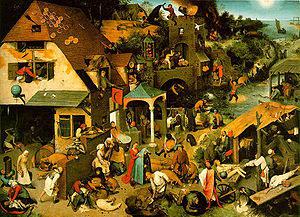
Pieter Bruegel the Elder, Netherlandish Proverbs, 1559
Locations
People
Groups
Topics
- Renaissance in the Low Countries
- Protestant Reformation
- Counter-Reformation (also Catholic Reformation or Catholic Revival)
- Western Art: 1552 to 1564
Subjects
Regions
Subregions

Years: 1559 - 1559
Pieter Bruegel the Elder, Netherlandish Proverbs, 1559
Locations
People
Groups
Topics
- Renaissance in the Low Countries
- Protestant Reformation
- Counter-Reformation (also Catholic Reformation or Catholic Revival)
- Western Art: 1552 to 1564
Subjects
Regions
Subregions