
…Qau. The large quantity of remains from …
Years: 4365BCE - 4222BCE
…Qau.
The large quantity of remains from Naqada have enabled the dating of the entire culture, throughout Egypt and environs.
The Naqada period was first divided by the British Egyptologist William Flinders Petrie, who explored the site in 1894, into three sub-periods: Amratian (after the cemetery near El-Amrah), Gerzean (after the cemetery near Gerzeh), and Semainean (after the cemetery near Es-Semaina).
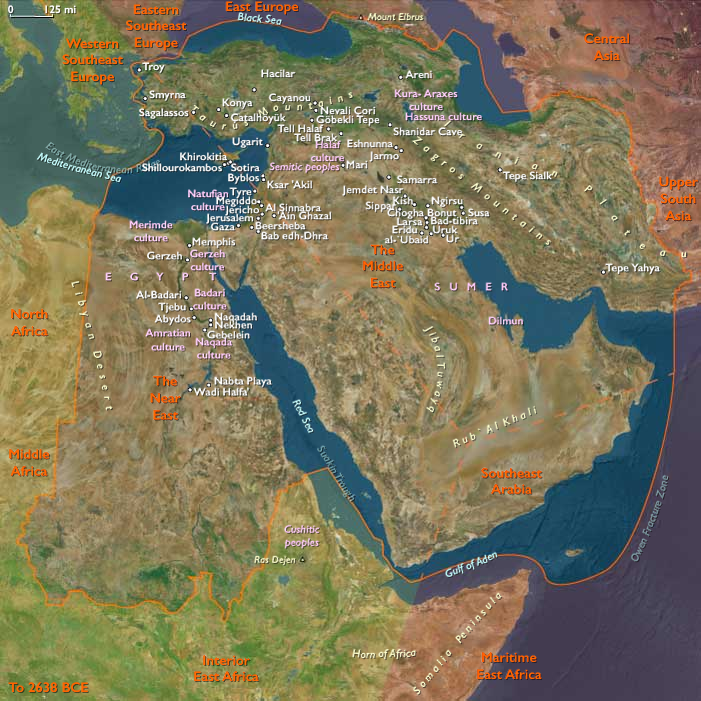
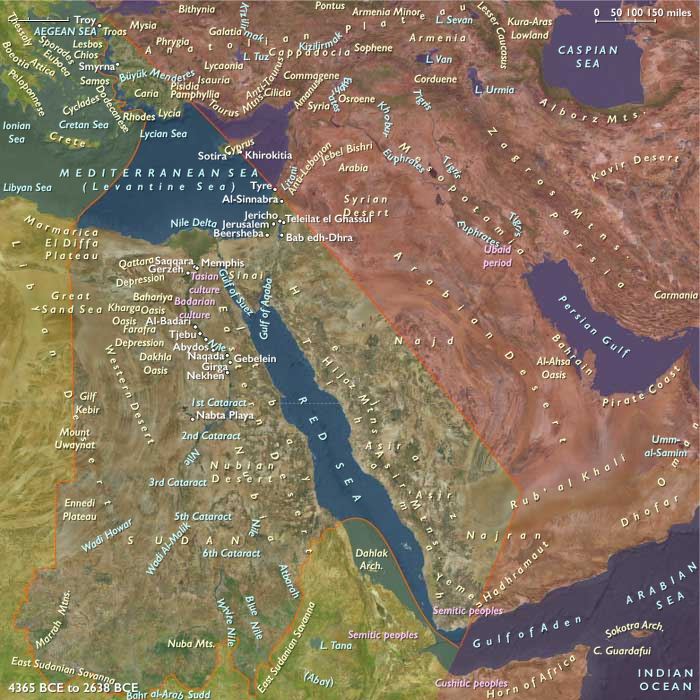
The first site where the so-called Amratian Culture group is found unmingled with the later Gerzean culture group is the site of el-Amra, about one hundred and twenty kilometers south of Badari, but because this period is better attested at the Naqada site, it is referred to also as the Naqada I culture.
The production of black-topped pottery continues; the production of white cross-line ware, decorated by close parallel white lines being crossed by another set of close parallel white lines, begins.
The Amratian culture trades with Nubia, Western Desert oases and the eastern Mediterranean, and obtains obsidian from Ethiopia.
Petrie's chronology was superseded by that of Werner Kaiser in 1957.
Kaiser's chronology began around 4000 BCE, but the modern version begins slightly earlier, as follows: Naqada I a-b-c (about 4400–3500 BCE), characterized by black-topped and painted pottery; Naqada II a-b-c (about 3500–3200 BCE), a culture represented throughout Egypt and characterized by the first marl pottery, and metalworking; and Naqada III a-b-c (about 3200–3000 BCE), characterized by more elaborate grave goods, cylindrical jars, and writing.
Locations
Groups
Topics
Commodoties
Subjects
Regions
Subregions
Years: 4365BCE - 4222BCE
Locations
Groups
Topics
Commodoties
Subjects
Regions
Subregions