
Relations between Parthia and Greco-Bactria deteriorate after …
Years: 177BCE - 166BCE
Relations between Parthia and Greco-Bactria deteriorate after the death of Diodotus II, when Mithridates' forces capture two eparchies of the latter kingdom, at this time under Eucratides I.
Commodoties
Subjects
Regions

Subregions
Related Events
Filter results
Showing 10 events out of 63293 total
The Middle East: 177–166 BCE
The Sixth Syrian War and the Ascendancy of Roman Influence
The era from 177 to 166 BCE is marked by the turbulent events of the Sixth Syrian War, a critical confrontation between the Seleucid Empire under Antiochus IV Epiphanes and Ptolemaic Egypt. The causes of this war are somewhat obscure, but the immediate provocation arises in 170 BCE when the two regents of Egypt's young king Ptolemy VI Philometor, Eulaeus and Lenaeus, declare war against the Seleucids.
Initially successful, Antiochus swiftly captures strategic positions, notably the fortress city of Pelusium. Realizing the disastrous course of their strategy, the Egyptians depose the original regents, replacing them with Comanus and Cineas, who seek peace negotiations. Antiochus exploits the turmoil by taking Ptolemy VI, his nephew, under his guardianship and effectively assumes control over Egypt. The people of Alexandria, however, reject this arrangement and proclaim Ptolemy VIII Physcon as the sole ruler.
Antiochus responds by besieging Alexandria, but unable to sever its supply lines, he withdraws by the end of 169 BCE. In his absence, reconciliation occurs between Ptolemy VI and his brother, undermining Antiochus' position and prompting a renewed Seleucid invasion. Facing imminent conquest, the Egyptians appeal to Rome, marking a critical turning point.
In 168 BCE, Roman envoy Gaius Popilius Laenas confronts Antiochus near Alexandria. In a dramatic scene at Eleusis, Popilius famously draws a circle around Antiochus, demanding a decision on the Roman Senate’s ultimatum—immediate withdrawal from Egypt and Cyprus. Antiochus, cornered by Rome's authority, concedes, marking the event remembered as the "Day of Eleusis," effectively ending Seleucid ambitions in Egypt.
This era also sees the continued consolidation of the Parthian kingdom under Phraates I, who expands Parthian control beyond the Gates of Alexander and captures strategic locations like Apamea Ragiana. The groundwork laid during his reign paves the way for the extensive territorial expansion that will soon be realized by his successor, Mithridates I.
Thus, the era 177–166 BCE signifies the waning of Seleucid power, the consolidation of Roman authority in Mediterranean geopolitics, and the rising prominence of Parthia, reshaping the geopolitical landscape of the Middle East significantly.
The causes of the Sixth Syrian War are obscure.
Eulaeus and Lenaeus, the two regents of the young king of Egypt, Ptolemy VI Philometor, declare war on the Seleucid ruler Antiochus IV Epiphanes in 170.
Ptolemy's younger siblings Ptolemy VIII Physcon and Cleopatra II are in the same year declared co-rulers in order to bolster the unity of Egypt.
Military operations do not begin until 169, when Antiochus quickly gains the upper hand, seizing the important strategic town of Pelusium.
The Egyptians realize their folly in starting the war, Eulaeus and Lenaeus are overthrown and replaced by two new regents, Comanus and Cineas, and envoys are sent to negotiate a peace treaty with Antiochus.
Antiochus takes Ptolemy VI (who is his nephew) under his guardianship, giving him effective control of Egypt.
However, this is unacceptable to the people of Alexandria, who respond by proclaiming Ptolemy Physcon as sole king.
Antiochus besieges Alexandria but he is unable to cut communications to the city so, at the end of 169, he withdraws his army.
In his absence, Ptolemy VI and his brother are reconciled.
Antiochus, angered at his loss of control over the king, invades again.
The Egyptians send to Rome asking for help and the Senate dispatches Gaius Popilius Laenas to Alexandria.
Meanwhile, Antiochus has seized Cyprus and Memphis and is marching on Alexandria.
At Eleusis, on the outskirts of the capital, he meets Popilius Laenas, with whom he had been friends during his stay in Rom, but instead of a friendly welcome, Popilius offers the king an ultimatum from the Senate: he must evacuate Egypt and Cyprus immediately.
Antiochus begs to have time to consider but Popilius draws a circle round him in the sand with his cane and tells him to decide before he steps outside it.
Antiochus chooses to obey the Roman ultimatum.
The "Day of Eleusis" ends the Sixth Syrian War and Antiochus' hopes of conquering Egyptian territory.
Phraates I is recorded as expanding Parthia's control past the Gates of Alexander and occupying Apamea Ragiana, the locations of which are unknown, yet the greatest expansion of Parthian power and territory takes place during the reign of his brother and successor Mithridates I of Parthia.
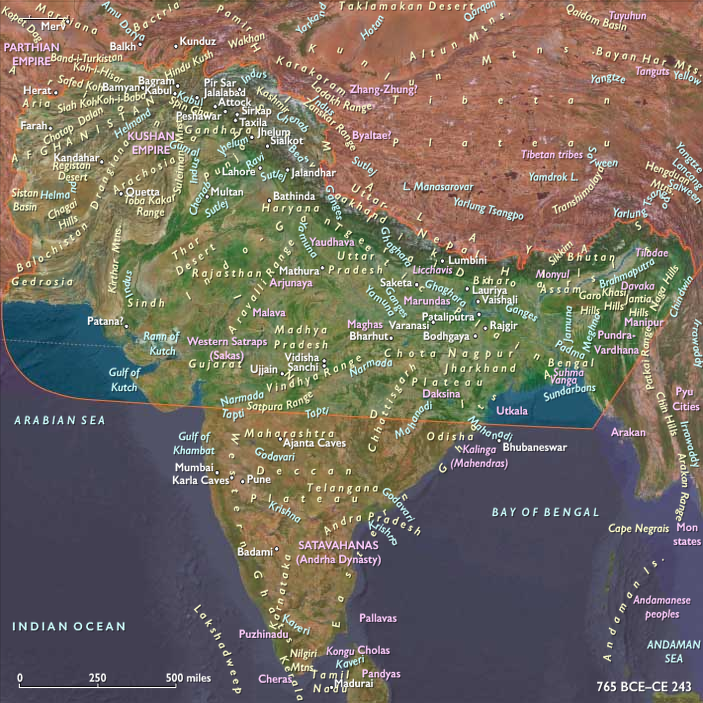
Brahmanism competes in the political and spiritual realm with Buddhism in the Gangetic plain.
Buddhist sources, such as the Asokavadana, mention that Pusyamitra was hostile towards Buddhists and allegedly persecuted the Buddhist faith.
A large number of Buddhist monasteries (viharas) were allegedly converted to Hindu temples, in such places as Nalanda, Bodhgaya, Sarnath or Mathura.
While it is established by secular sources that Hinduism and Buddhism were in competition during this time, with the Sungas preferring the former to the latter, historians such as Etienne Lamotte and Romila Thapar argue that Buddhist accounts of persecution of Buddhists by Sungas are largely exaggerated.
The traditional narratives are dated to two centuries after Pushyamitra’s death in Asokâvadâna and the Divyâvadâna, Buddhist books of legend.
The Asokavadana legend is likely a Buddhist version of Pusyamitra's attack on the Mauryas, reflecting the declining influence of Buddhism in the Sunga Imperial court.
Support of the Buddhist faith by the Sungas at some point is suggested by an epigraph on the gateway of Barhut, which mentions its erection "during the supremacy of the Sungas".
On the other hand, Sir John Marshall noted that the Sanchi stupa was vandalized during the second century BCE before it was rebuilt later on a larger scale, suggesting the possibility that the original brick stupa built by Ashoka was destroyed by Pusyamitra and then restored by his successor Agnimitra.
Similarly, the Deokothar Stupas (geographically located between Sanchi and Barhut) suffered destruction during the same period, also suggesting some kind of involvement of Sunga rule.
Proponents also point to the proclamations and claim that the Manu Smriti was propagated.
Under the Sunga dynasty, stupas—brick-faced, domical mounds containing the relics of the Buddha, whose form symbolically represents the Buddhist universe—will become increasingly elaborate structures.
Sri Lanka becomes the seat of Buddhism after a Brahmin-led Hindu reaction appears to have virtually extinguished Buddhism in India.
Near East (177–166 BCE): The Sixth Syrian War and Roman Intervention
The era from 177 to 166 BCE in the Near East is dominated by the tumultuous events of the Sixth Syrian War, a significant conflict between the Seleucid Empire and Ptolemaic Egypt. The war's origins are obscure but are initiated by the Egyptian regents Eulaeus and Lenaeus in 170 BCE, during the reign of the young king Ptolemy VI Philometor. To fortify Egypt's unity, the king's younger siblings, Ptolemy VIII Physcon and Cleopatra II, are declared co-rulers.
Military operations commence in 169 BCE. The Seleucid king Antiochus IV Epiphanes swiftly gains the advantage, capturing the strategic city of Pelusium and effectively controlling Egypt. Egyptian leaders quickly realize their miscalculation, depose Eulaeus and Lenaeus, and appoint new regents Comanus and Cineas to negotiate peace. Antiochus IV takes Ptolemy VI, his nephew, under his guardianship, effectively asserting dominance over Egypt. This arrangement proves unacceptable to the people of Alexandria, who instead proclaim Ptolemy Physcon sole king.
Antiochus retaliates by laying siege to Alexandria but withdraws at the end of 169 BCE, failing to isolate the city. During Antiochus's absence, reconciliation occurs between the Ptolemaic siblings, frustrating Antiochus, who launches another invasion. The Egyptians appeal to Rome for assistance, prompting the Roman Senate to dispatch envoy Gaius Popilius Laenas.
In a dramatic encounter at Eleusis near Alexandria, Antiochus is confronted by Popilius Laenas in 168 BCE. The Roman envoy delivers a stern ultimatum demanding immediate withdrawal from Egypt and Cyprus. Antiochus hesitates, prompting Popilius to famously draw a circle around him, insisting on an immediate decision before stepping out. Antiochus submits to Rome’s demands, marking the "Day of Eleusis," effectively ending the Sixth Syrian War and Antiochus's ambitions in Egypt.
Legacy of the Era
This era underscores the decisive role Rome begins to play in Near Eastern affairs, curbing Seleucid expansion and reinforcing Roman diplomatic dominance. The resolution of the Sixth Syrian War through Roman intervention signifies a pivotal shift toward Rome’s growing hegemony in the eastern Mediterranean, setting a precedent for future political dynamics in the region.
The Romans lay the foundation of their hegemony in Greece.
Upon the death of Philip V in Macedon in 179 BCE, his son Perseus had attempted to restore Macedon's international influence, and has moved aggressively against his neighbors.
When Perseus is implicated in an assassination plot against an ally of Rome, the Senate declares the third Macedonian War.
Initially, Rome does not fare well against the Macedonian forces, but Roman legions smash the Macedonian phalanx at the Battle of Pydna in 168 BCE.
Perseus is later captured and the kingdom of Macedon divided into four puppet republics that Rome controls.
Mediterranean Southwest Europe (177–166 BCE): Roman Consolidation and Iberian Resistance
The era 177–166 BCE witnesses Rome's intensified efforts to consolidate control over its growing Mediterranean territories, accompanied by persistent resistance from indigenous populations, notably the Celtiberians in the Iberian Peninsula.
Roman Administrative Reforms in Iberia
In response to continued challenges from Celtiberian and Iberian tribes, Rome reinforces its presence in the Iberian Peninsula by strengthening administrative structures in Hispania Citerior and Hispania Ulterior. These reforms aim to stabilize Roman authority and improve governance, integrating these provinces more firmly into the Roman economic and political sphere. Roman influence now extends deeply into local societies, reshaping the region's cultural and economic dynamics.
Persistent Celtiberian and Iberian Resistance
Despite Roman administrative expansion, resistance among indigenous populations remains robust. The Celtiberian tribes continue to contest Roman advances through guerrilla tactics, creating a persistent state of instability and conflict. This era further solidifies the Celtiberian reputation as formidable opponents, emphasizing their resilience in the face of Roman military pressure.
Influence and Integration of Greek Culture
In parallel, Rome further consolidates its cultural and political dominance in the Eastern Mediterranean and southern Italy, promoting Greek arts, philosophy, and administrative practices within its territories. The exchange between Roman and Greek traditions intensifies, embedding Greek culture firmly within the Roman administrative and cultural framework, thus shaping the distinctive character of the emerging Greco-Roman civilization.
Long-term Significance
The period 177–166 BCE solidifies Rome’s expansive ambitions and underscores the complexities inherent in governing diverse territories. The continued Iberian resistance and Rome's administrative and cultural strategies in Mediterranean Southwest Europe lay essential groundwork for the eventual integration and Romanization of these regions, setting critical precedents for the evolution of Roman imperial governance.
North Africa (177–166 BCE)
Continued Recovery, Diplomatic Stability, and Cultural Integration
Carthaginian Economic and Diplomatic Strengthening
From 177 to 166 BCE, Carthage furthers its economic revival and strategic diplomatic positioning. Focused efforts in agriculture continue enhancing productivity and prosperity, particularly across fertile North African regions. Key cities such as Leptis and Oea (modern Tripoli) sustain their critical roles in regional commerce and economic rejuvenation.
Diplomatically, Carthage carefully manages its relationship with Rome and other Mediterranean states, ensuring regional stability and continued economic growth. The cautious approach adopted during this period allows Carthage to strengthen internal stability without provoking external conflict.
Cyrenaica’s Ongoing Economic Prosperity and Autonomy
Cyrenaica continues its prosperous trajectory under consistent Ptolemaic influence. The Greek Pentapolis—Cyrene, Barce (Al Marj), Euhesperides (Benghazi), Teuchira (Tukrah), and Apollonia (Susah)—maintains substantial economic growth through persistent trade in grain, wine, wool, livestock, and notably the medicinal plant Silphium.
The region remains culturally vibrant, continuing as a center for Hellenistic scholarship, medicine, and philosophy. Cyrene, in particular, maintains its reputation for prestigious academies, medical expertise, and architectural grandeur, drawing intellectuals from across the Greek-speaking world.
Numidian Diplomatic Balance
Numidia carefully balances its independence and alliance with Rome, maintaining its strategic position in North Africa through ongoing diplomatic and economic stability.
Berber Economic Integration and Cultural Continuity
Berber communities remain actively integrated into the regional economy, significantly contributing to trade, agriculture, and artisanal industries. Coastal hubs like Oea (Tripoli) thrive economically, further strengthening ties between coastal settlements and inland Berber populations.
Inland Berber tribes continue preserving traditional autonomy and governance systems, indirectly benefiting from coastal prosperity. This symbiotic relationship enhances regional economic stability and cultural resilience, supporting North Africa’s broader prosperity.
Cultural Exchange and Religious Syncretism
Cultural interactions among Berber, Carthaginian, and Greek populations remain dynamic and influential, driving continued advances in pottery, textiles, and metalworking. Religious syncretism flourishes, integrating indigenous Berber traditions seamlessly with Phoenician and Greek religious practices, enriching regional cultural diversity and complexity.
Solid Foundations for Continued Regional Stability
By 166 BCE, North Africa solidifies its economic recovery, political stability, and cultural integration. Carthage’s cautious diplomatic strategies, Cyrenaica’s ongoing economic prosperity, and the enduring integration and stability of Berber communities collectively establish robust regional foundations, ensuring North Africa’s continued prominence within the Mediterranean geopolitical landscape.
Atlantic Southwest Europe (177–166 BCE): Growing Roman Pressure, Tribal Resistance, and Economic Integration
Between 177 and 166 BCE, Atlantic Southwest Europe—comprising northern and central Portugal, Galicia, Asturias, Cantabria, and northern Spain (south of the Franco-Spanish border at 43.05548° N, 1.22924° W)—experienced intensified Roman diplomatic and military pressures, increasing local tribal resistance, deeper economic integration into Mediterranean trade networks, and continued reliance on slavery within tribal economies. These dynamics heightened tensions, accelerated societal complexity, and clearly foreshadowed the region’s eventual incorporation into the expanding Roman sphere.
Political and Military Developments
Increased Roman Pressure and Diplomatic Influence
-
Rome continued consolidating territorial control in southern and eastern Iberia (Hispania Citerior and Ulterior), placing diplomatic and economic pressure on Atlantic Southwest European tribes.
-
Roman diplomatic missions sought alliances or treaties with border tribes, aiming to secure peaceful relations, expand trade, and isolate resistant groups such as the Lusitanians and Vettones.
Tribal Resistance and Militarization
-
Tribes like the Lusitanians, Gallaeci, Astures, Cantabri, and interior tribes like the Vettones and Vaccaei strengthened military defenses and social organization in anticipation of potential Roman incursions.
-
The Vascones reinforced territorial autonomy, maintaining a strategic stance toward Roman diplomacy and preserving their distinct cultural identity.
Economic and Technological Developments
Deepening Mediterranean Economic Integration
-
Mediterranean trade significantly expanded, driven by growing Roman economic interests. Tribes actively exchanged metals (silver, copper, tin), salt, grain, wool, timber, and particularly captive slaves with Mediterranean merchants, importing wine, oil, iron products, ceramics, and luxury goods.
-
Tribal elites notably profited from these exchanges, increasing social stratification and wealth concentration.
Slave Economy and Labor Specialization
-
Slavery remained integral to tribal economies, increasingly institutionalized and employed extensively in agriculture, mining operations, domestic service, and artisanal production.
-
Tribes intensified participation in Mediterranean slave markets, reinforcing local economic structures and trade dependencies.
Advances in Iron Metallurgy
-
Technological progress in ironworking continued, significantly enhancing agriculture, artisanal craft, and warfare, facilitating regional economic growth and defensive preparedness.
-
Metallurgical expertise among tribes such as the Lusitanians, Gallaeci, and Vascones produced sophisticated weapons and decorative objects, reflecting indigenous styles alongside Roman and Mediterranean influences.
Cultural and Religious Developments
Cultural Fusion and Distinctiveness
-
Artistic and material culture further synthesized Celtic, indigenous Iberian, and emerging Roman influences, evident in metalwork, pottery designs, ceremonial artifacts, and decorative jewelry, underscoring cultural interactions and complexities.
-
Distinct tribal identities intensified, clearly defining groups such as the Lusitanians, Gallaeci, Vascones, Astures, and Cantabri.
Elaborate Ritual Practices and Religious Structures
-
Tribal religious practices evolved with growing complexity, blending indigenous traditions, Celtic influences, and elements derived from increasing Mediterranean contacts.
-
Major ceremonial sites, hilltop sanctuaries, and sacred landscapes became central to reinforcing tribal cohesion and spiritual identity, particularly among the Lusitanians, Vascones, and Gallaeci.
Notable Tribal Groups and Settlements
-
Lusitanians: Continued consolidating fortified settlements and military strength, preparing actively against potential Roman expansion.
-
Vascones: Maintained distinctive cultural autonomy and territorial integrity near the Pyrenees, actively navigating emerging Roman diplomatic pressures.
-
Gallaeci, Astures, Cantabri: Enhanced military capabilities and regional influence, fortifying settlements against anticipated Roman encroachment.
-
Vettones and Vaccaei: Expanded strategic alliances, enhancing regional economic strength and tribal solidarity, anticipating conflicts with Roman-allied groups.
Long-Term Significance and Legacy
Between 177 and 166 BCE, Atlantic Southwest Europe:
-
Experienced deepening regional tensions resulting from increasing Roman diplomatic, economic, and military pressures, setting the stage for future armed conflicts and confrontations.
-
Strengthened local resistance, social cohesion, and tribal militarization, particularly among Lusitanians, Gallaeci, and Vascones.
-
Became economically intertwined with the Mediterranean world, significantly reinforcing trade networks and social structures reliant upon extensive slave labor.
This era critically shaped regional trajectories, laying foundations for complex tribal-Roman interactions, future resistance movements, and eventual integration into Roman Hispania.
Years: 177BCE - 166BCE
Commodoties
Subjects
Regions
Subregions