Roxelana has remained Suleiman’s favorite wife. …
Years: 1559 - 1559
Roxelana has remained Suleiman’s favorite wife.
Her sons Selim and Bayezid become rivals upon her death.
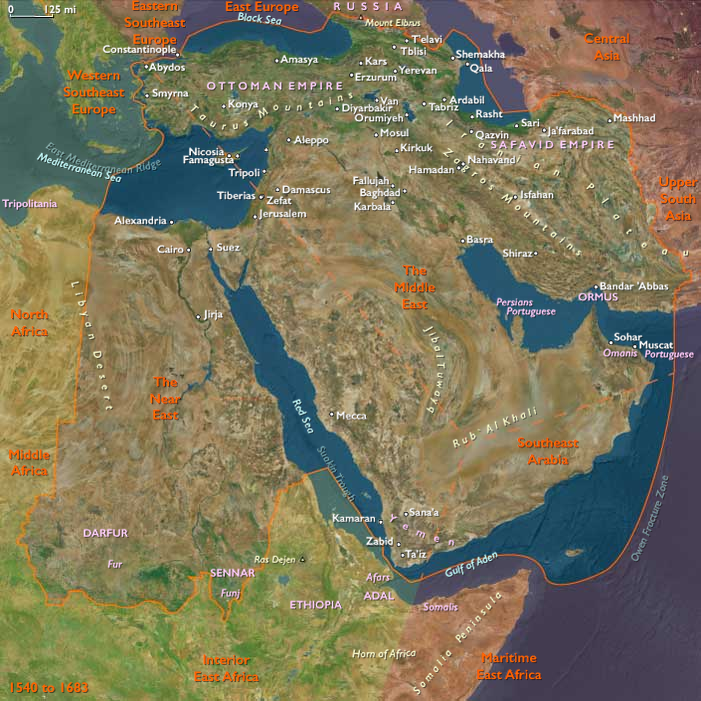
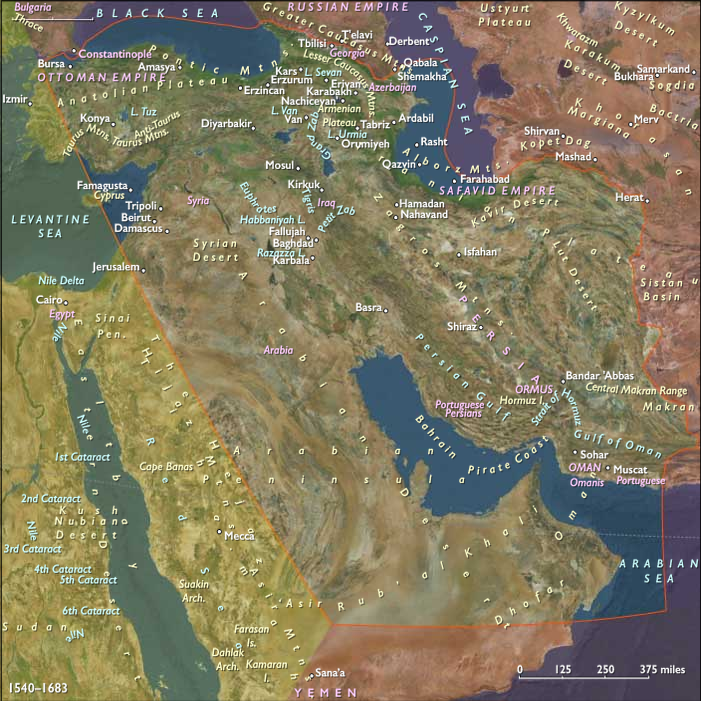
Suleiman favors Selim, but Bayezid raises an army and defeats his brother at the Battle of Konya in 1559, causing Selim to flee to Persia.
Locations
People
Groups
Topics
Commodoties
Subjects
Regions
Subregions
Related Events
Filter results
Showing 10 events out of 35957 total
Setthathirat’s anti-Burmese alliance with the Shans disintegrates in 1559.
Akbar has gradually consolidated and extended his authority under the guidance of his chief minister, Bairam Khan, who has dealt successfully with pretenders to the throne, improved the discipline of the Mughal armies, ensured centralized power in order to expand the empire’s boundaries with orders from the capital.
These moves have helped to consolidate Mughal power in the newly recovered empire.
The majority of the court is Sunni Muslims, who are antipathetic to Bairam's Shi'ism and critical of his excessively opulent lifestyle.
Despite this prejudice towards the Shia, Bairam has appointed a Shia Sheikh, one Gadai, to the important post of the Administrator General.
Nur invades Fatagar, where he fights against Geladewos and kills him in battle on March 23, 1559.
Nur will continue fighting for twelve years until, according to legend, at Gibe he says "Kaffa!", or "Enough!", and returns to Harar.
Some believe the province is called Kaffa for this reason.
Menas, a brother of Gelawdewos, is made king at Mengista Samayat, southwest of Debre Werq in Gojjam, and shortly afterwards he campaigns against the Falasha in Semien province.
As the Collège Calvin, it is today is the oldest public secondary school in Geneva.
The last edition of his Institutes of the Christian Religion, published in this year, has grown in twenty-three years from six brief sections to seventy-nine full chapters.
Calvin clearly and emphatically presents his vision of God in his majesty, of Christ as prophet, priest, and king, of the Holy Spirit as the bestower of faith, of the Bible as the supreme authority, and of the church as God’s holy people.
Calvin deduces his fatalistic doctrine of predestination from his belief in human sinfulness and God's sovereign mercy in Christ.
The Roman Catholic Church, in the centuries subsequent to the first formal index of forbidden books decreed in the late fifth century by Pope Gelasius I, has continued the condemnation of specific works.
At the Council of Trent, convened intermittently from 1545, the church has decreed that certain books may not be used for liturgical celebrations and, further, that no book on a religious subject may be published without the approval of ecclesiastical authorities.
The Congregation of the Inquisition produces in 1559 a long list of forbidden books, which Pope Paul IV accepts and publishes as an index, the first instance of the word itself being used to describe a listing of unacceptable literature.
Paul places the Talmud on the list of banned books, Index liborum prohibitorum.
He permits the printing of the Zohar, the book of medieval Jewish mysticism, while at the same time burning twelve thousand other books; because he is persuaded that the Zohar contains no anti-Christian statements.
Cardinal Giovanni Angelo de Medici, unrelated to the Medicis of Florence, in 1559 succeeds Paul IV as Pope Pius IV.
Pius permits the printing of the Talmud, but allows censorship of passages that are deemed insulting to Christianity; therefore, the Talmud is not printed in Italy.
He agrees to allow the Jews to construct one building to house Rome's five synagogues, which satisfies the literal restrictions, but permits the Jews to establish Castilian, Catalan, Temple and New Congregations.
A man of violent antipathies, austerity, uncompromising reformism, and exalted concept of papal authority, Pius expels the Jews from the papal states, with the exception of Rome and ...
...Ancona.
Montalcino, since the conquest of Siena by Florence under the Medici family in 1555, has held out for almost four years under a Republican government of seven hundred Sienese families, but ultimately falls in 1559 to the Florentines, under whose control it will remain until the Grand Duchy of Tuscany is amalgamated into a united Italy in 1861.
Lattanzio Gambara, a native of Brescia, had as a fifteen-year-old initially apprenticed with Giulio Campi in Cremona; by 1549, he was working alongside Girolamo Romanino, who had eventually become his father-in-law.
An altarpiece of S. Maria in Silva dates to 1558.
He frescoes for the Villa Contarini in Asolo, and shows the influenced of Il Pordenone.
He paints a cycle of frescoes on the History of the Apocalypse that will decorate the Loggia of Brescia until they are destroyed by bombing in 1944.
The artist has returned to Brescia in these years to work with Romanino in a series of generally lost frescoes for Sant'Eufemia and Saint Lorenzo in Brescia.
He has painted altarpieces for the abbey of Saint Benedict in Polirone.
He has also decorated Palazzo Mayo in Cadignano (Lama Mocogno, in collaboration with Giulio and Antonio Campi).
Cardinal Alessandro Farnese, the future Pope Paul III, had acquired an estate at Caprarola in 1504 and had commissioned the architects Antonio da Sangallo the Younger and Baldassare Peruzz to design a fortified castle or rocca.
Surviving plan drawings by Peruzzi show a pentagonal arrangement with each face of the pentagon canted inwards towards its center, to permit raking fire upon a would-be scaling force, both from the center and from the projecting bastions that advance from each corner angle of the fortress.
Peruzzi's plan also shows a central pentagonal courtyard and it is likely that the later development of the circular central court was also determined by the necessities of the pentagonal plan.
The pentagonal fortress foundations, constructed probably between 1515 and 1530, becomes the base upon which the present villa sits; so the overall form of the villa had been predetermined by the rocca foundations.
Cardinal Alessandro Farnese, a grandson of Pope Paul III, and a man who is known for promoting his family's interests, plans to turn this partly constructed fortified edifice into a villa or country house.
He had commissioned Vignola as his architect for this difficult and inhospitable site in 1556; building work commences in 1559.
Vignola had recently proved his mettle in designing Villa Giulia on the outskirts of Rome for the preceding pope, Julius III.
Vignola in his youth had been heavily influenced by Michelangelo.
For the villa at Caprarola, his plans as built are for a pentagon constructed around a circular colonnaded courtyard.
In the galleried court, paired Ionic columns flank niches containing busts of the Roman Emperors, above a rusticated arcade, a reworking of Bramante's scheme for the "House of Raphael", in Via Giulia, Rome.
A further Bramantesque detail is the entablature that breaks forward over the columns, linking them above, while they stand on separate bases.
The interior loggia formed by the arcade is frescoed with Raphaelesque grotesques, in the manner of the Vatican Logge.
The gallery and upper floors are reached by five spiral staircases around the courtyard: the most important of these is the Scala Regia ("Royal Stairs") rising through the principal floors.
Fountains have by the mid-sixteenth century become a crucial element in Italian landscape architecture, whose practitioners often exploit natural undulations in the land to create water pressure, as in Vignola's Villa Farnese.
One of the finest examples of Renaissance architecture, the Villa Farnese reflects Vignola’s ability to formulate inventive and graceful designs using classical elements.

King Philip, owing huge sums to the Medici, cedes the city of Siena (apart from a series of coastal fortress annexed to the State of Presidi) to Cosimo I de' Medici in 1559.