Duke Rudolf IV of Austria had declared …
Years: 1365 - 1365
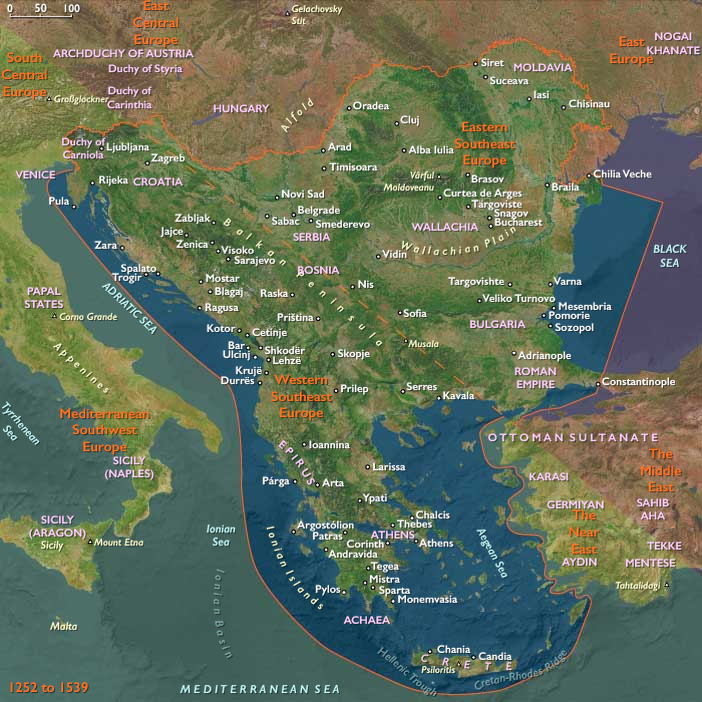
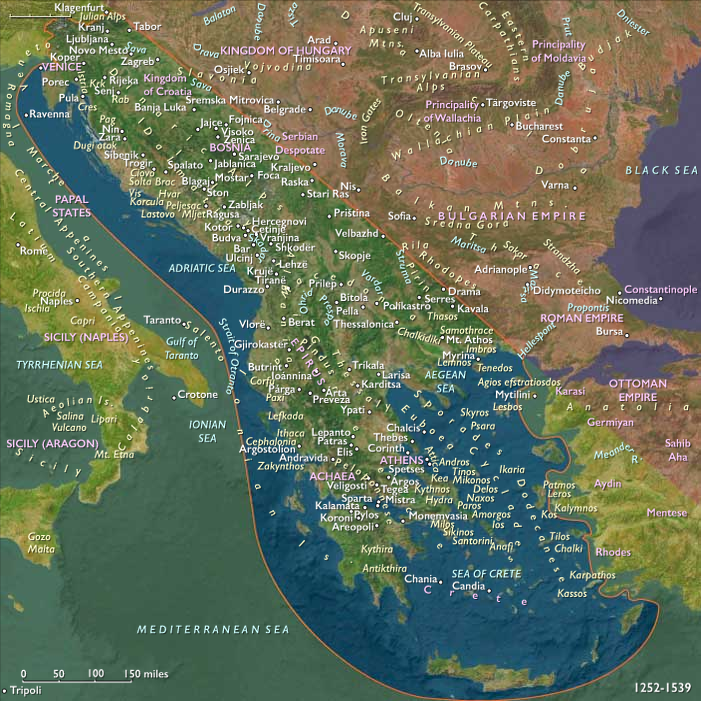
Duke Rudolf IV of Austria had declared the Carinthian March of Carniola a duchy in 1364 and in the next year established the Lower Carniolan town of Novo Mesto (in present-day Slovenia), whose German name Rudolfswert is given in his honor.
Locations
People
Groups
Commodoties
Subjects
Regions
Subregions
Related Events
Filter results
Showing 10 events out of 43942 total
Urban had in May 1363 made an appeal to Louis I of Hungary for a crusade against the Turks, and the king has spent the winter of 1364–65 preparing an army for a major offensive designed to push the Turks out of Europe.
In January 1365, as reported at Venice, ten galleys were being gathered in Provence for Louis's use, and Louis had issued a call for support in Zadar (Zara) and Dalmatia.
In the spring he invades, not Turkish Europe (Rumelia), but rather the north of Bulgaria, at this time ruled by the tsar's second son, Sratsimir.
He conquers and occupies Vidin, and takes Sratsimir captive back to Hungary.
His expedition is thus completed in time for him to cooperate with Amadeus of Savoy in a joint attack on the Turks in the spring of 1366.
Rudolf dies suddenly at Milan in 1365, aged twenty-five.
His and his wife's mortal remains are buried at the Ducal Crypt underneath the Stephansdom in Vienna.
In spite of the high-flying (and maybe sometimes megalomaniac) character of his plans, he has managed to modernize his territories and his city, the prominence of which is considerably increasing.
His untimely death without issue halts further progress, however.
His younger brothers Albert III and Leopold III, who are to rule jointly under the Rudolfinische Hausordnung (Rudolfinian House Rules), will begin to quarrel ceaselessly and ultimately agreed to divide the Habsburg territories between them according to the 1379 Treaty of Neuberg.
The fruit of Rudolf's efforts will be reaped by Leopold's descendant Frederick V of Austria, elected King of the Romans in 1440 and sole ruler over all Austrian lands from 1457, who will lay the foundations of the Habsburg Monarchy.
Peter Thomas, who had become patriarch of Constantinople in 1364, is one of the chief promoters of the crusade of 1365.
Peter, having collecting money and mercenaries in western Europe, leads a mixed Cypriote and Western force of Crusaders against Alexandria on October 11, 1365, subjecting the city to a horrible sack and massacre.
Mézières, who accompanies the king to Alexandria, receives the government of a third part of it and a promise for the creation of his order, but the European knights, satisfied by the immense booty, refuse to follow Peter in attacking Cairo, and the king is obliged to return to Cyprus, the only permanent result of his expedition being the enmity of the Mamluk sultan of Egypt.
Peter's unruly crusaders return to Cyprus with immense booty.
Pierre plans to return to Egypt, but no European aid is forthcoming.
Ioánnina is ruled from 1365 by Thomas Comnenus Palaiologos, also known as Preljubovic, the son of the caesar Gregory Preljub, who had been Serbian governor of Thessaly under Stefan Urosh IV Dushan.
The Treaty of Guérande (April 12, 1365): The End of the Breton War of Succession
On April 12, 1365, the First Treaty of Guérande formally ended the Breton War of Succession (1341–1364) and established John IV de Montfort as the Duke of Brittany. The treaty settled the long-standing dispute between the Montfort and Penthièvre factions, while also securing French royal recognition for John’s rule.
Terms of the Treaty
- John IV de Montfort was officially recognized as Duke of Brittany.
- The Penthièvre family was not entirely excluded from succession:
- The Duchy of Brittany would pass through the male line of the Montfort family.
- If the Montfort line died out, the title would pass to the Penthièvre family’s male heirs.
- Joan of Penthièvre, widow of Charles of Blois, retained:
- The Prerogative of Penthièvre (her family’s noble status).
- The Viscountcy of Limoges, ensuring her family’s continued wealth and influence.
Why Did Charles V Accept the Treaty?
King Charles V of France did not oppose John IV’s elevation to duke, despite Montfort’s previous English support, for several reasons:
-
Preventing an English Alliance
- John IV had once been a protégé of Edward III of England, and there was a risk that he might declare full allegiance to England.
- Edward’s daughter Mary, John IV’s first wife, had died in 1361, leaving Brittany’s political alignment uncertain.
- By recognizing John IV as duke, Charles V secured his loyalty and prevented a potential English stronghold in Brittany.
-
France’s Weakness in the Hundred Years’ War
- France was militarily and financially exhausted due to the ongoing Hundred Years’ War.
- Mercenary bands (routiers) still roamed the countryside, making another campaign in Brittany unfeasible.
-
Winning the Support of the Breton Nobility
- By accepting John IV’s oath of loyalty, Charles V ensured the friendship of the Breton nobility, strengthening France’s political control over the region.
Impact and Legacy
- The Treaty of Guérande (1365) firmly established Montfort rule in Brittany, but tensions between Brittany and France remained unresolved.
- John IV remained largely autonomous, balancing his allegiance between France and England.
- The Penthièvre family’s conditional succession rights would later fuel future conflicts, including the War of the Breton Succession (second phase) in 1420.
- By recognizing John IV, Charles V stabilized the region temporarily, allowing France to focus on rebuilding its strength in the Hundred Years’ War.
The Treaty of Guérande (1365) successfully ended decades of civil war in Brittany, securing Montfortist rule while preserving the Penthièvre family's status, ensuring that Brittany remained a key political player in medieval France.
The Aftermath of Auray: Political Tensions Between John IV and Olivier de Clisson (1364–1365)
Following the decisive Montfortist victory at the Battle of Auray (September 29, 1364), Joan, Duchess of Brittany (widow of Charles de Blois) accepted the outcome, and peace negotiations between the House of Blois and the House of Montfort began. John IV de Montfort was officially recognized as the sole Duke of Brittany, earning him the nickname "the Conqueror."
However, tensions soon arose between John IV and Olivier de Clisson, one of the key Montfortist commanders, over the distribution of rewards following the victory.
Olivier de Clisson’s Discontent Over Gâvre
- While recovering from his injuries, Olivier de Clisson learned that John IV had granted the Gâvre castle and forest to the English commander, John Chandos.
- Clisson had coveted Gâvre as a reward for his loyal service, expecting it as recognition for his crucial role in the battle.
- Furious at being overlooked, Olivier reportedly exclaimed:
- "I would rather give myself to the devil than have an English neighbor."
The Burning of Gâvre Castle and Retaliation by John IV
- Two weeks later, Gâvre Castle was mysteriously burned down.
- Though there was no direct evidence linking Clisson to the fire, many suspected his involvement, given his outrage over its grant to Chandos.
- In retaliation, Duke John IV confiscated Clisson’s lordship of Châteauceaux, punishing him for his suspected role in the destruction.
Consequences and Rising Tensions
- This incident marked the beginning of a rift between Clisson and John IV, leading to Olivier’s eventual shift in allegiance from the English-backed Montfortists to the French Crown.
- John IV’s strong ties to the English were beginning to alienate Breton nobles, who feared excessive English influence in Brittany.
- Over time, Clisson would grow closer to King Charles V of France, becoming a key figure in the kingdom’s renewed efforts against England.
The postwar tensions between John IV and Olivier de Clisson foreshadowed deeper divisions within Brittany, setting the stage for Clisson’s eventual defection to the French side, where he would later rise to become Constable of France.
The paintings of Wang Meng, a leading Chinese landscape master, reflect a distinctively individual approach to the problems of space, form, and tactile quality in compositions of astonishing density, as exemplified in his masterful landscape Dwelling in the Qingbian Mountains, executed in 1366.
Wang Meng is considered to be one of the Four Masters of the Yuan Dynasty, along with Huang Gongwang, Wu Zhen, and Ni Zan.
They had famously refused to serve the Mongolian rulers of their country.
In contrast to many renowned painters in previous history, these artists mostly work on paper instead of silk, an indication of the importance they give to the calligraphic touch of the brush on paper.
They exclusively paint landscapes, which they believe to be the visible key to the invisible reality.
They restrict their acquaintanceship to each other, and like-minded "wen ren" (gentleman-scholars).
Wang Meng is the youngest of the group, and the least famous in his own time.
Nevertheless, his style will greatly influence later Chinese painting.
In contrast to the relatively spare style of his compatriots, his ropy brushstrokes pile one on the other to produce masses of texture combined in dense and involved patterns.
Many artists will be influenced by the works of Wang Meng centuries after his death, most notably Dong Qichang.
His most famous works are the Ge Zhichuan Relocating, Forest Grotto at Juqu, Writing Books under the Pine Trees, The Simple Retreat, and Dwelling in the Qingbian Mountains.
Most of his masterpieces are now located in notable museums around the world, such as the Palace Museum, National Palace Museum, Shanghai Museum, Cleveland Museum of Art and the Metropolitan Museum of Art In 2011, a lesser known work of his from a private collection, titled Zhichuan Resettlement, will be sold for 402.5 million yuan (US$62.1 million) at art auction.

Emperor John V Palaiologos has appealed to the West for help, proposing to end the schism between the Greek and Latin churches by submitting to the supremacy of the Roman Church.
He visits Hungary in 1366 to beg for help, but in vain.
Amadeus VI of Savoy initiates a minor crusade (with fifteen ships and seventeen hundred men) in 1366 against Murad I of the Ottoman Empire to aid his cousin, the Emperor John V Palaiologos, son of the Dowager Empress, Anne of Savoy.
On this campaign, Amadeus joins forces with Francesco I of Lesbos, and Hungarian king Louis the Great, and they drive the Turks from Gallipoli. (This victory will be short-lived, though, for they will lose Gallipoli to the Turkish Sultan Murad I when, after three years of civil war between John V and his son, Andronikos IV, it will handed over to the Ottomans by the latter as payment for their support.)
The alliance of Hungary, Serbia and Bulgaria against the Ottomans ends in defeat, and the Bulgarians are compelled to become vassals of the sultan in 1366.