Sampsiceramus I builds a castle during his …
Years: 48BCE - 48BCE
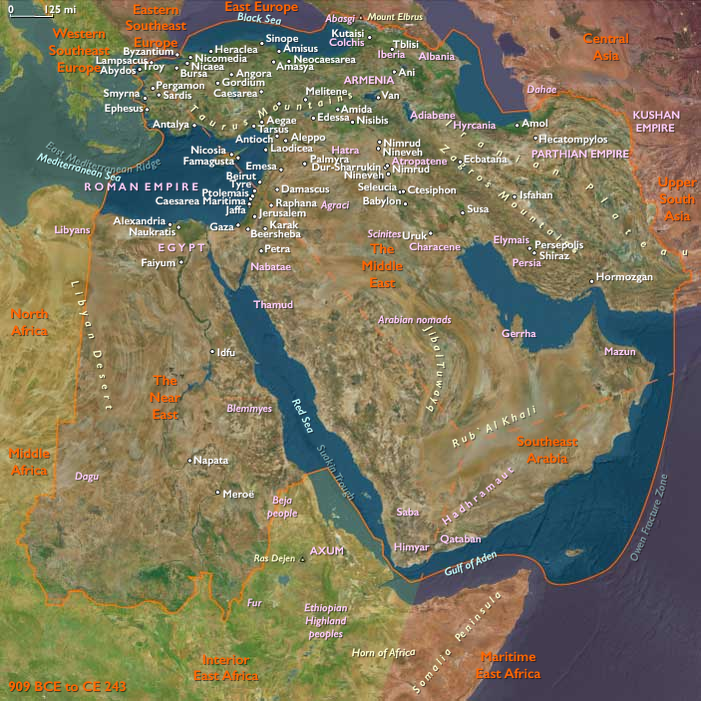
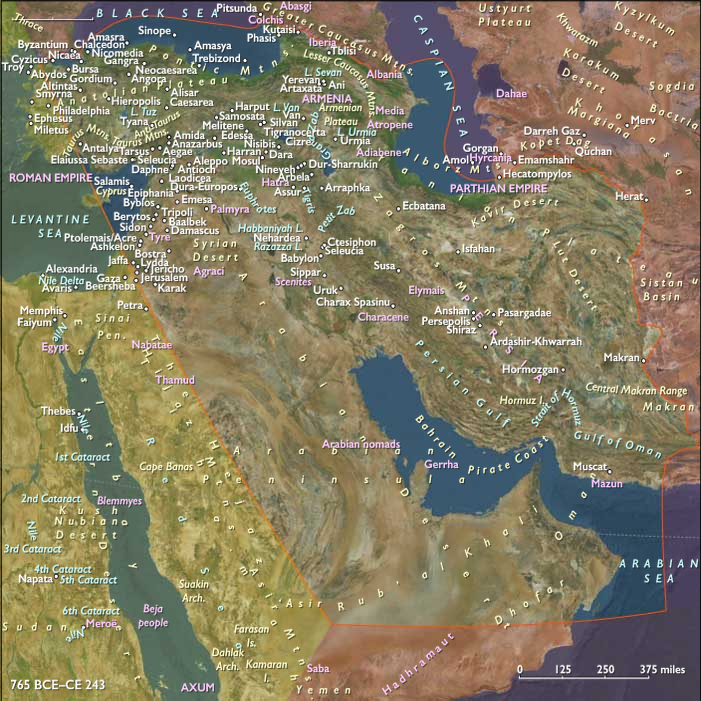
Sampsiceramus I builds a castle during his reign (64-48 BCE) at Shmemis, on top of an extinct volcano, and ...
Locations
People
Groups
Topics
Commodoties
Subjects
Regions
Subregions
Related Events
Filter results
Showing 10 events out of 62490 total
…rebuilds the city of Salamiyah, which the Romans incorporate in the ruling territory.
In time, Sampsiceramus I establishes and forms a powerful ruling dynasty and a leading kingdom in the Roman East.
His priest-king dynasty is to rule from 64 BCE until at least 254.
Caesar, with Spain secure, crosses the Adriatic to Epirus, landing here on January 4 and occupying Oricum and …
…Apollonia.
Moving north towards Dyrrhachium, Caesar discovers Pompey entrenched here with an army of forty-five thousand.
Pompey sees no reason to risk a battle, as his fleet controls the Adriatic, and Caesar's troops go hungry in the spring of 48, although eventually reinforcements arrive with Mark Antony.
Caesar on July 10 attempts to surround Pompey in Dyrrhachium, but Pompey is able to break Caesar's line on the left.
After losing one thousand of his veterans in the fighting, Caesar leaves the field to Pompey, withdrawing toward Thessaly; Pompey decamps in pursuit.
Cicero travels with the Pompeian forces to Pharsalus in 48 BCE, though he is quickly losing faith in the competence and righteousness of the Pompeian lot.
He eventually provokes the hostility of his fellow senator Cato, who tells him that he would have been of more use to the cause of the optimates if he had stayed in Rome.
Both armies again make contact somewhere near what is today Fársala, Greece.
After several days of maneuvering, Pompey finally offers Caesar battle (August 9 by the uncorrected Roman calendar; June 6, Julian).
Caesar has approximately twenty-two thousand men, mostly hardened veterans; Pompey possibly has as many as forty-five thousand.
Pompey masses the main force of his cavalry on his left infantry wing, hoping to outflank and overpower Caesar's right wing, which is composed of a mixed band of cavalry and infantry.
Caesar, however, foresees the defeat of his right wing and has stationed behind it about two thousand of his best legionnaires.
In the ensuing battle, Pompey's cavalry drive back Caesar's cavalry, only to find itself faced by the advancing corps of select men using their pila as stabbing spears rather than as javelins.
Confused by the unusual infantry attack, Pompey's cavalry turns and flees.
The victorious legionnaires then begin to outflank the left wing of Pompey's infantry; at the same time, Caesar's third division, which has been held in reserve, is ordered to attack.
Pompey's legions break, and as the enemy storms the camp he himself flees to Larissa and the coast.
About twenty-four thousand of Pompey's troops surrender; the rest are dead or in flight.
When Caesar, whose casualties are less than two hundred and fifty, surveys the stricken field and Pompey's dead supporters he exclaims, “They would have it so” (“Hoc voluerunt”).
Pompey, hurried on by Caesar's rapid pursuit, loses contact with his own fleet; he sails first to Mytilene, where he meets his wife Cornelia and his son Sextus Pompeius.
He now wonders where to go next.
The decision of running to one of the eastern kingdoms is overruled in favor of Egypt.

Pompey, fleeing Caesar after his loss at Pharsalus, stops at Cyprus, after which …
…Pompey decides to land at Pelusium, a city on the northeast frontier of Egypt, and seek the assistance of Ptolemy, his former client.
Cleopatra, expelled by the King and his clique earlier in the year, had meanwhile quickly raised an Arab army and is besieging Pelusium.
As the opposing forces prepare for war, Pompey appears at Pelusium seeking refuge.
The King marches down to the coast, ostensibly to welcome him, but he and his counselors have chosen not to risk offending the victorious Caesar.
Pompey's small squadron lies offshore while Pompey, bidding farewell to his wife, Cornelia, complies with an insidious invitation to enter, with several companions, a small boat sent to bring him to land.
As he prepares to step ashore on September 28, 48, he is treacherously struck down and killed by an officer of the King.
Caesar returns in late 48 BCE to Rome, where he is appointed dictator, with Mark Antony as his Master of the Horse (second in command); Caesar presides over his own election to a second consulship and then, after eleven days, resigns this dictatorship.
Caesar now pursues Pompey to Egypt.
Caesar now becomes involved with the Egyptian civil war between the child pharaoh and his sister, wife, and co-regent, Cleopatra.
Arriving at Alexandria four days after Pompey's murder and seizing the palace quarter, he orders the warring factions to submit to his arbitration as authorized by the will of Ptolemy's father.
Caesar sides with Cleopatra, perhaps as a result of the young pharaoh's role in Pompey's murder; he is reported to have wept at the sight of Pompey's head, which is offered to him by the pharaoh as a gift.
Ptolemy, leaving General Achillas with the army, goes with Pothinus to Caesar's camp, while Cleopatra arrives in the palace, reportedly concealed in a carpet.
Caesar claims he is owed money for the expenses of the restoration of Ptolemy XII.
Cleopatra is determined to restore the glories of the first Ptolemies and to recover as much as possible of their dominions, which had included southern Syria and Palestine.
She realizes that Caesar is the strong man of Rome, and it is therefore on him that she relies.
Caesar, with all the members of the Ptolemaic royal family in his grasp, effects a reconciliation between Ptolemy and his sister.
Pothinus' group, however, continues to foment trouble against the Romans and their Egyptian allies; and after Achillas brings up the army to besiege Alexandria, Ptolemy's youngest sister, Arsinoe IV, escapes to the native forces with the aid of Ganymedes, her mentor.
Caesar meanwhile persuades Cleopatra to execute Pothinus, while Achillas is killed after feuding with Arsinoe, thus effectively destroying the clique.
Pharnaces, following his defeat in the Battle of Zela, manages to assemble a small force of Scythian and Sarmatian troops, with which he is able to gain control of a few cities.
His former governor and son-in-law Asander attacks his forces and kills him.
(The historian Appian states that he died in battle; Cassius Dio says he was captured and then killed.)
Caesar makes Mithridates of Pergamon king of the Bosporan Kingdom, by commanding him to declare war on his niece Dynamis and her husband Asander (who are now the ruling monarchs) to keep the kingship for himself.
Dynamis and Asander are defeated by Mithridates and his army, and Mithridates becomes the Bosporan king.