Soldiers Chen Sheng, Wu Guang, and others …
Years: 209BCE - 209BCE
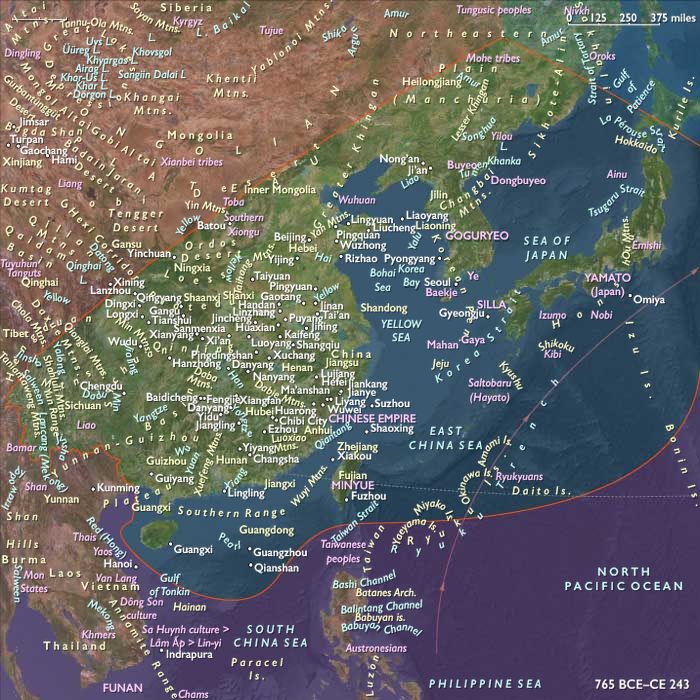
Soldiers Chen Sheng, Wu Guang, and others seize the opportunity to revolt against the Qin government in 209 BCE.
Insurrections spread throughout much of China (including those led by Xiang Yu and Liu Bang, who will later face off over the founding of the next dynasty) and the entire Yellow River region devolves into chaos.
Locations
People
Groups
Topics
Commodoties
Subjects
Regions
Subregions
Related Events
Filter results
Showing 10 events out of 63606 total
Antiochus having entered upon the eastward campaign (212-205) for which he will gain renown, now attacks Artabanus.
The Parthians may in fact be hostile to the local Greek populations: during the initial phase of the war, they massacre all the Greek inhabitants of the city of Syrinx in Hyrcania.
Antiochus takes Syrinx and Hecatompylos, the Arsacid capital (the present location of which is uncertain), then crosses the mountains separating that province from Parthia, which he occupies.
Artabanus flees and takes refuge with the friendly Apasiacae, as had his father, Arsaces I.
The conflict between the Seleucids and Parthia, however, is ended by a compromise, just as it had been at the time of the invasion of Seleucus II.
A much more important struggle against the Bactrian kingdom of Euthydemus awaits Antiochus.
Preferred to make peace with Artabanus, he accords him the title of king in exchange for recognition of his fealty, and obliges the Parthian to send troops to reinforce the Syrian army.
This safeguards the rear of the Seleucid king, but the Macedonians have definitively lost the two provinces held by Artabanus.
Antiochus III, an ambitious Seleucid king who has a vision of reuniting Alexander the Great's empire under the Seleucid dynasty, launches a campaign in 209 BCE o regain control of the eastern provinces, and after defeating the Parthians in battle, he successfully regains control over the region.
The Parthians are forced to accept vassal status and now only control the land conforming to the former Seleucid province of Parthia.
However, Parthia's vassalage is only nominal at best and only because the Seleucid army is on their doorstep.
For his retaking of the eastern provinces and establishing the Seleuicd borders as far east as they had been under Seleucus I Nicator, Antiochus is awarded the title great by his nobles.
Luckily for the Parthians, the Seleucid Empire has many enemies, and it will not be long before Antiochus leads his forces west to fight Ptolemaic Egypt and the rising Roman Republic.
One Philopoemen, for some ten years a mercenary leader in Crete and now in his late fifties, had been trained to his career of arms by the Academic philosophers Ecdelus and Demophanes.
Elected federal cavalry commander for 210/209 on his return to Achaea, his reorganized troops defeat the Aetolians on the Elean frontier.
Tarantum supports Hannibal’s war against Rome, but in 209 BCE, the commander of a Bruttian force betrays the city to the Romans.
Indiscriminate slaughter ensues and among the victims are the Bruttians who had betrayed the city.
Afterwards thirty thousand of the Greek inhabitants are sold as slaves.
Tarentum's art treasures, including the statue of Nikè (Victory) are carried off to Rome.
Fabius Maximus had had the command in Campania in 211 BCE, during the year of his fourth consulship, and admitted the young soldier Marcus Porcius Cato, who had served at Capua, to the honor of intimate friendship.
At the siege of Tarentum, Cato, later to be known as Cato the Elder to distinguish him from his great-grandson, Cato the Younger, is again at the side of Fabius.
Fabius Maximus had been elected consul, for the fifth time, in 209.
Marcellus, named proconsul, retains control of his army.
During that year the Roman Army under Marcellus faced Hannibal's forces in a series of skirmishes and raids, without being drawn into open battle.
Marcellus defends his actions and tactics in front of the senate and is named consul for the fifth time for the year 208 BCE.
After entering his fifth consulship, Marcellus reenters the field and takes command of the army at Venusia.
While on a reconnaissance mission with his colleague, T. Quinctius Crispinus and a small band of two hundred and twenty horsemen, the group is ambushed and nearly completely slaughtered by a much larger Carthaginian force of Numidian horsemen.
Marcellus is impaled by a spear and dies on the field.
In the following days, Crispinus dies of his wounds.
The loss of both consuls is a major blow to Roman morale, as the Republic has lost its two senior military commanders in a single battle, while the formidable Carthaginian army is still at large in Italy.
In the year 23 BCE, Roman Emperor Augustus will recount that Hannibal had allowed Marcellus a proper funeral and even sent the ashes back to Marcellus’ son.
The Carthaginian armies disperse in the interior of Iberia in 209 BCE, possibly to maintain control over the Iberian tribes, on which they are dependent on for soldiers and provisions.
Scipio, landing at the mouth of the Ebro, is able to surprise and capture Carthago Nova (New Carthage), the headquarters of the Carthaginian power in Hispania, which had quickly grown as a trading and military post.
He obtains a rich cache of war stores and supplies, and an excellent harbor and base of operations.
Scipio's humanitarian conduct toward prisoners and hostages in Hispania helps in portraying the Romans as liberators as opposed to conquerors.
Livy tells the story of the capture of a beautiful woman by his troops, who offered her to Scipio as a prize of war.
Scipio was astonished by her beauty, but discovered that the woman was betrothed to a Celtiberian chieftain named Allucius.
He returned her to her fiancé, along with the money that had been offered by her parents to ransom her.
While Scipio was long known for his great chivalry, Scipio doubtless also realized that the Senate's first priority was the war in Italy, and in the midst of the Carthaginian base in Hispania, he was to be outnumbered without much hope of reinforcement.
It was paramount therefore that Scipio cooperate with local chieftains to both supply and reinforce his small army.
The woman's fiancé, who soon married her, naturally brought over his tribe to support the Roman armies.

Scipio fights his first set piece battle later in 209 BCE, driving back Hasdrubal Barca from his position at Baecula on the upper Guadalquivir.
Fearing that the armies of Mago and Gisco will enter the field and surround his small army, Scipio's objective is, therefore, to quickly eliminate one of the armies to give him the luxury of dealing with the other two piecemeal.
The battle is decided by a determined Roman infantry charge up the center of the Carthaginian position.
Roman losses are uncertain but may have been considerable in light of an effort by the infantry to scale an elevation defended by Carthaginian light infantry.
Scipio then orchestrates a frontal attack by the rest of his infantry to draw out the remainder of the Carthaginian forces.
Hasdrubal has not noticed Scipio's hidden reserves of cavalry moving behind enemy lines, and a Roman cavalry charge creates a double envelopment on either flank led by cavalry commander Gaius Laelius and Scipio himself.
This breaks the back of Hasdrubal's army and routs his forces—an impressive feat for the young Roman versus the veteran Carthaginian general.
Despite the Roman victory, Hasdrubal manages to retreat with two thirds of his army intact.
Much historical criticism has been leveled Scipio’s inability to effectively pursue Hasdrubal, who will eventually cross the Alps only to be defeated by Gaius Claudius Nero at the Battle of the Metaurus.
Chief minister Li Si’s death in 208 BCE deprives the new Qin ruler of invaluable counsel; the dynasty will soon collapse.
Antiochus meets strong resistance at the frontier by the Bactrian cavalry.
Euthydemus, failing in his attempt to defend the line of the Arius (Harirud) River, had fallen back to his capital, Bactra (probably Balkh in northern Afghanistan), where he withstands a two-year siege.
Finally, Antiochus concludes a peace by which Euthydemus is to keep his kingdom while acknowledging Seleucid overlordship.
The Romans have meanwhile countered the moves of Philip V of Macedon by an alliance with the Greek cities of the Aetolian League, but Philip has effectively aided his allies.
The Romans in 207 withdraw their armies from Greece.