Muhammad's house in Medina, often used for …
Years: 633 - 633
Muhammad's house in Medina, often used for gatherings of the faithful, becomes, soon after his death, a model of the appropriate kind of meeting place in which to pray at formally appointed times as well as to perform a variety of social, political, and administrative functions related to Islam.
Locations
Groups
Topics
Commodoties
Subjects
Regions
Subregions
Related Events
Filter results
Showing 10 events out of 56710 total
The Qawasim tribes, who live along the gulf during the pre-Islamic period, engage in trade, pearling, and piracy.
Diba al-Hisn (also spelled Dibbah or Daba), an important port of pre-Islamic Arabia, was traditionally renowned as a copper-exporting center for the interior of Oman.
A prosperous town at the time of the emergence of Islam, it is one of the last important places of resistance to the new religion in the Arabian Peninsula.
Under the Sasanians, and their Omani clients the Al-Julanda, an important market existed at Dibba; the city was sometimes the capital of Oman.
Soon after the death of the prophet Muhammad, a rebellion breaks out at Dibba and a faction of the Azd, led by Laqit bin Malik Dhu at-Taj, rejects Islam.
According to one tradition, Laqit was killed by an envoy of the caliph Abu Bakr in what may have been a relatively small struggle, while other sources including Al-Tabari say that at least ten thousand rebels were killed in one of the biggest battles of the Ridda wars.
The plain behind Dibba still contains a large cemetery which according to local tradition represents the fallen apostates of Dibba.
Abu Bakr sends Ula bin Al Hadhrami's corps against the rebels of Bahrain after the Battle of Yamamah.
Ula arrives in Bahrain to find the apostate forces gathered at Hajr and entrenched in a strong position.
Ula mounts a surprise attack one night and captures the city.
The rebels retreat to the coastal regions, where they make one more stand but are decisively defeated.
Most of them surrender and revert to Islam.
This operation is completed at about the end of January 633.
Xuanzang visits Chiniot and …
…Lahore as well and provides the earliest writings available on the ancient cities.
Sisenand convokes the Fourth Council of Toledo in 633, held at the church of Saint Leocadia.
He succeeds in increasing the power of the king.
He has himself confirmed in his election to the kingship and has Suintila declared a tyrant for his many crimes, his iniquity, and his accumulation of wealth at the expense of the poor.
He also removes all taxes on the clergy.
The council does not concede any hereditary right to the king, however.
The king will be elected of the bishops and magnates.
The position and deference granted to the king is remarkable.
The church is free and independent, yet bound in solemn allegiance to the acknowledged king: nothing is said of allegiance to the bishop of Rome.
The council, probably under the presidency of the noted Isidore of Seville, regulates many matters of discipline, decrees uniformity of liturgy throughout the Visigothic kingdom and takes stringent measures against baptized Jews who have relapsed into their former faith.
Sisenand renews Sisebut's decrees of 612-20.
Converts are forced to adhere strictly to Christianity and are forbidden to socialize with unbaptized Jews.
At this council, begun December 5, 633, all the bishops of Iberian Kingdoms are in attendance.
Isidore, though far advanced in years, presides over its deliberations, and is the originator of most of its enactments.
The council probably expresses with tolerable accuracy the mind and influence of Isidore, who, widely influential throughout Spain, has fostered unity between orthodox Christian Romans and Arian Goths.
A strong proponent of learning and culture, he promotes the education of clergy.
It is at the Fourth National Council of Toledo and through Isidore’s influence that a decree is promulgated commanding and requiring all bishops to establish seminaries in their Cathedral Cities, along the lines of the school associated with Isidore already existing at Seville.
Within his own jurisdiction, he has availed himself of the resources of education to counteract the growing influence of Gothic barbarism.
His is the quickening spirit that animated the educational movement of which Seville is the center.
The study of Greek and Hebrew as well as the liberal arts is prescribed.
Interest in law and medicine is also encouraged.
Through the authority of the fourth council, this policy of education is made obligatory upon all the bishops of the kingdom.

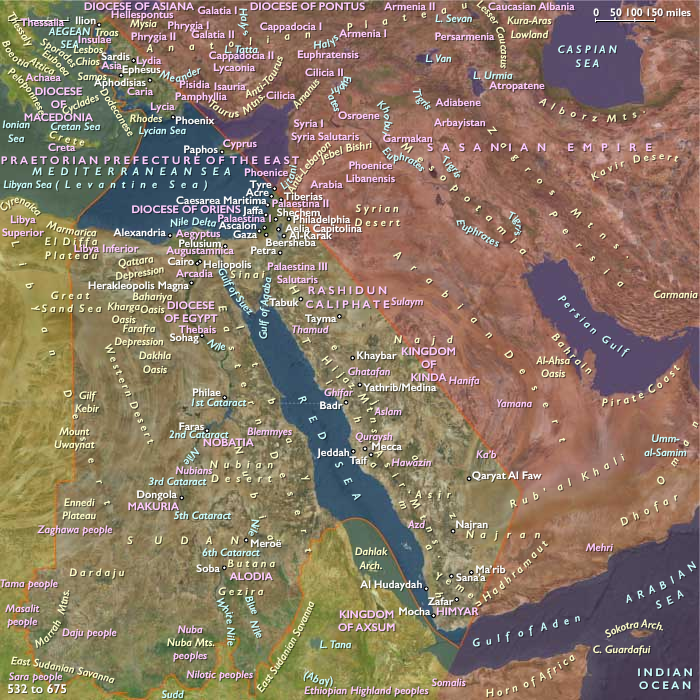
The year 12 Hijri dawns on March 18, 633, with Arabia united under the central authority of the Caliph at Medina.
The campaign to reestablish Muslim rule in the Arabian Peninsula has been Abu Bakr's greatest political and military triumph.
The last of the great revolts of the apostasy is that of the powerful tribe of Kinda, which inhabits the region of Najran, Hadhramaut, and eastern Yemen.
They do not break into revolt until January 633.
Ziyad bin Lubaid, Muslim governor of Hadhramaut, operates against them and raids Riyaz, after which the whole of the Kinda break into revolt under Ash'as bin Qais and prepare for war.
However, the strength of the two forces, i.e., apostate and Muslim, is so well balanced that neither side feels able to start serious hostilities.
Reinforcements are on the way, and Ziyad waits for them before attacking the rebels.
After Muhajir bin Abi Umayyah, the last of the corps commanders to be dispatched by Abu Bakr, defeats some rebel tribes in Najran, southern Arabia, he is directed by Abu Bakr to march to Hadhramaut and join Ziyad against the Kinda.
The Caliph also instructs Ikrimah, who is at Abyan, to join Ziyad and Muhajir's forces.
In late January 633, the forces of Muhajir and Ziyad combine at Zafar, capital of Hadhramaut, under the overall command of the former, and defeat Ash'as, who retreats to the fortified town of Nujair.
Just after this battle the corps of Ikrimah also arrives.
The three Muslim corps, under the overall command of Muhajir, advance on Nujair and lay siege to the fortified city.
Nujair is captured some time in mid-February 633.
With the defeat of the Kinda at Nujair, the last of the great apostate movements collapses.
Arabia is safe for Islam.
With the collapse of the rebellions and Arabia united under the central authority of the Caliph at Medina, Caliph Abu Bakr, Muhammad's father-in-law and successor, now decides to expand the empire.
The successful unification of the Arabian Peninsula has made it possible for the Caliph to channel the expansion of the Arab Muslims into new directions.
Abu Bakr, therefore, summons the faithful to a holy war (jihad) and quickly amasses an impressive army.
It is unclear what his intentions were; whether it was a full scale expansion plan or preemptive attacks to secure more territory to create a buffer zone between the Islamic state and the powerful Sassanid and East Roman empires.
This sets the stage for the Islamic conquest of Persia to begin.
Khalid is sent to the Persian Empire with an army consisting of eighteen thousand volunteers to conquer the richest province of the Persian empire: Iraq.
Khalid wins quick victories in four consecutive battles: the Battle of Chains in Kuwait and the Battle of River, in Iraq, are fought in April 633.
The Rashidun Caliphate army under Khalid defeats the Persians and their Arab Christian allies at the Battle of Walaja in May 633; the Persian army is at least three times the size of the Muslim force.
Next, at the Battle of Ullais, Khalid’s forces defeat an entire Persian army (seventy thousand men) near the river Euphrates.
Khalid now besieges the fortress city of Hira, the regional capital city of lower Mesopotamia, with fifteen thousand men.
After a brief fight, the citizens surrender and bring gifts to Khalid.
Khalid goes to Daumat-ul-jandal in August 633 and defeats the rebel Christian Arabs in battle, capturing the city fortress.