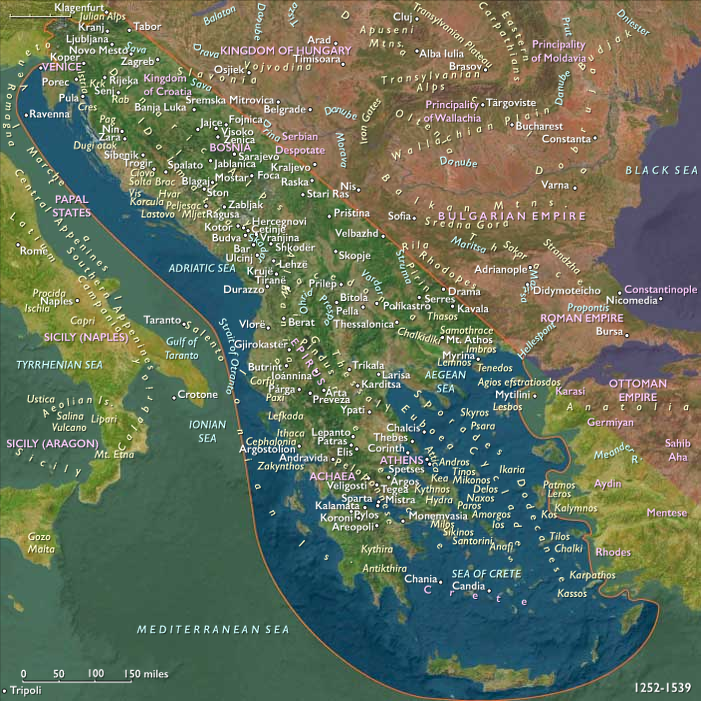
…take Athens.
Years: 1388 - 1388
…take Athens.
Locations
Groups
- Florence, Republic of
- Catalan Company of the East, Grand (officially the Company of the Army of the Franks in Romania, sometimes called the Grand Company and widely known as the Catalan Company
- Neopatras, Duchy of
- Navarrese Company
Commodoties
Subjects
Regions
Subregions
Related Events
Filter results
Showing 10 events out of 19 total
Because land is equivalent to power, these powerful men can try to claim the crown.
The autocratic and arrogant methods of Richard II only serve to alienate the nobility more, and his forceful dispossession in 1399 by Henry IV increased the turmoil.
Henry spends much of his reign defending himself against plots, rebellions and assassination attempts.
Rebellions continue throughout the first ten years of Henry's reign, including the revolt of Owain Glyndŵr, who declares himself Prince of Wales in 1400, and the rebellion of Henry Percy, 1st Earl of Northumberland.
The king's success in putting down these rebellions is due partly to the military ability of his eldest son, Henry of Monmouth, who later becomes king (though the son manages to seize much effective power from his father in 1410).
English military conflicts during this period are usually with domestic neighbors such as the Welsh, Irish and Scots, and include the Hundred Years' War against the French and their Scottish allies.
Notable English victories in the Hundred Years' War include Crécy and Agincourt.
The final defeat of the uprising led by the Welsh prince, Owain Glyndŵr, in 1412 by Prince Henry (who later becomes Henry V) represents the last major armed attempt by the Welsh to throw off English rule.
The Glyndŵr Rising, Welsh Revolt or Last War of Independence is an uprising of the Welsh against England beginning in 1400 and led by Owain Glyndŵr.
Owain’s negotiations with the Scots and the Lords of Ireland have been unsuccessful, but he has reasons to hope that the French and Bretons might be more welcoming.
Quickly Owain dispatches Gruffydd Young and his brother-in-law, John Hanmer, to France to negotiate a treaty with the French.
The result is a formal treaty that promises French aid to Owain and the Welsh.
The immediate effect seems to have been that joint Welsh and Franco-Breton forces attacks and lay siege to Kidwelly Castle.
The Welsh can also count on semi-official fraternal aid from their fellow Celts in Brittany and Scotland.
Owain in 1404 captures and garrisons the great western castles of Harlech and Aberystwyth.
Anxious to demonstrate his seriousness as a ruler, he holds Court at Harlech and appoints the devious and brilliant Gruffydd Young as his Chancellor.
Soon afterwards he calls his first Parliament (or more properly a "Cynulliad" or "gathering") of all Wales at Machynlleth where he is crowned Owain IV of Wales and announces his national program.
He declares his vision of an independent Welsh state with a parliament and separate Welsh church.
There are to be two national universities (one in the south and one in the north) and a return to the traditional law of Hywel Dda.
Senior churchmen and important members of society flow to his banner.
English resistance is reduced to a few isolated castles, walled towns, and fortified manor houses.
Owain demonstrates his new status by negotiating the "Tripartite Indenture" with Edmund Mortimer and the Earl of Northumberland.
The Indenture agrees to divide England and Wales between the three of them.
Wales is to extend as far as the rivers Severn and Mersey including most of Cheshire, Shropshire, and Herefordshire.
The Mortimer Lords of March are to take all of southern and western England and Thomas Percy, 1st Earl of Worcester, is to take the north of England.
Most historians have dismissed the Indenture as a flight of fantasy.
However, it must be remembered that in early 1404 things look very positive for Owain.
Local English communities in Shropshire, Herefordshire and Montgomeryshire have ceased active resistance and are making their own treaties with the rebels.
It is rumored that old allies of King Richard II are sending money and arms to the Welsh and the Cistercians and Franciscans are funneling funds to support the rebellion.
Furthermore, the Percy rebellion is still viable; even after the defeat in May of the Percy Archbishop Scrope.

French privateers with Welsh troops on board are by 1404 raiding the coast of England, setting fire to Dartmouth and devastating the coasts of Devon.
A dispute between the cunning and powerful Welsh lord Owen Glendower and an English neighbor in 1400 had sparked Glendower’s ruthless revolt against Henry IV, whom he had earlier supported.
Aided by countrywide resentment of high taxes and poor administration imposed by the English, Glendower, proclaimed prince of Wales in 1400, had rapidly ousted Henry’s forces from castles and towns in Wales.
Glendower in 1402 had gained the support of Edmund de Mortimer.
The powerful English Percys, after quarreling with Henry over the ransom of Scottish prisoners in 1402, had turned against him, becoming supporters of Glendower in his Wales-based rebellion.
With the defeat of the Percys at Shresbury in 1403, Glendower had turned to France for aid.
After seizing the key castles of Aberystwyth and Harlech by 1404, the able Glendower had gained control of most of Wales and the recognition of King Charles VI of France, with whom he has made an alliance.
Glendower begins losing battles in 1405, however, and, because the promised French support fails to appear, will continue to do so.
The French, having left Brest in July with more than twenty-eight hundred knights and men-at-arms led by Jean de Rieux, the Marshal of France, land in force simultaneously at Milford Haven in west Wales.
Unfortunately, though they bring modern siege equipment, they have not been provided with sufficient fresh water and many warhorses have died.
Joined by Owain's forces, …
…the coalition army marches inland and takes the town of Haverfordwest but fails to take the castle.
Moving on, …
…they retake Carmarthen and …
Years: 1388 - 1388
Locations
Groups
- Florence, Republic of
- Catalan Company of the East, Grand (officially the Company of the Army of the Franks in Romania, sometimes called the Grand Company and widely known as the Catalan Company
- Neopatras, Duchy of
- Navarrese Company