The Aetolians of south-central Greece fight with …
Years: 211BCE - 211BCE
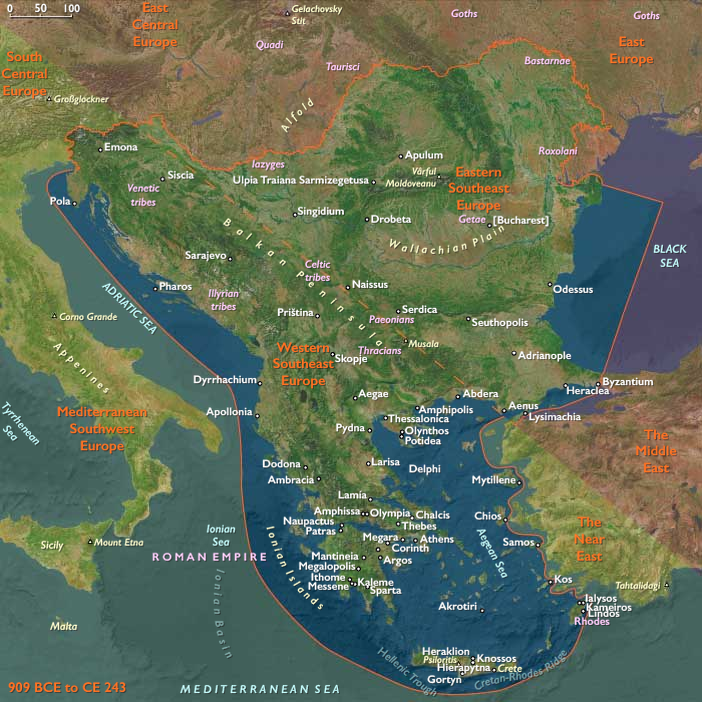
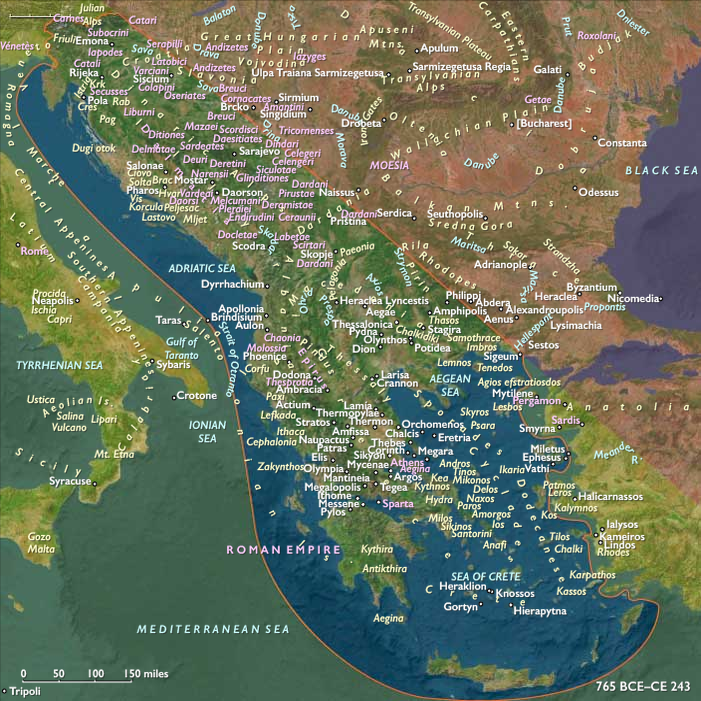
The Aetolians of south-central Greece fight with Rome against Philip in 211 BCE.
Locations
People
Groups
- Roman Republic
- Aetolian League
- Greece, Hellenistic
- Macedon, Antigonid Kingdom of
- Pergamon (Pergamum), Kingdom of
- Achaean League, Second
Topics
Commodoties
Subjects
Regions
Subregions
Related Events
Filter results
Showing 10 events out of 63618 total
Arcases' successor Artabanus I (sometimes known as Arsaces II, who reigned from about 211 BCE to 191 BCE, continues the work of consolidation of the Parthian realm.
Being already solidly established in Parthia and Hyrcania, Artabanus tries to extend his possessions toward Media, but events in the neighboring Greco-Bactrian kingdom work against him.
Attalus, with help from Rome and the Aetolians, fights also against Philip V of Macedon during the inconclusive First Macedonian War (215-205 BCE).
The Roman Republic first issues the silver coin known as the denarius in 211 BCE at the time of the Second Punic War, with a weight of 4.5 grams on average (denarii will be in use until the mid-third century CE when their replacement by the replaced by the antoninianus).
The earliest denarii feature the head of Diana on the obverse and the Dioscuri (Castor and Pollux) on the reverse.
The younger Publius Cornelius Scipio, had survived the disastrous battles at Ticinus, Trebia, and Cannae, the third of these having claimed the life of his would-be father-in-law Lucius Aemilius Paullus.
On hearing that Lucius Caecilius Metellus and other politicians were at the point of surrender, Scipio had gathered with his followers and stormed into the meeting, where at sword-point he forced all present to swear that they would continue in faithful service to Rome.
The Roman Senate, being of like mind, had refused to entertain thoughts of peace despite the great losses Rome has taken in the war—approximately one-fifth of the men of military age had died within a few years.
After serving as aedile in 213, the twenty-four-year-old Scipio had run for the office of quaestor, the most junior magistrate who was entitled to enter the Senate, apparently to assist his less popular cousin, Lucius Cornelius, who was also standing for election.
The Tribunes of the Plebs (elected representatives from the Plebeian Assembly) had objected to his candidacy, saying that he could not be allowed to stand because he had not yet reached the legal age (curule aediles were automatically entitled to enter the Senate and the legal age for Senate membership was 30).
Already known for his bravery and patriotism, Scipio was elected unanimously and the Tribunes abandoned their opposition.
Both Scipio's father, Publius Scipio, and uncle, Gnaeus Cornelius Scipio Calvus, are killed in battle against Hannibal's brother, Hasdrubal Barca, in 211.
In the following year, Scipio offers himself for the command of the new army which the Romans have resolved to send to Hispania, and is unanimously elected to be sent there as proconsul.
According to Livy, Scipio was the only man brave enough to ask for this position, and no other candidates wanted the responsibility, considering it a death sentence.

The importance of Capua during the third century BCE has increased steadily, and at the beginning of the Second Punic War it was considered to be only slightly behind Rome and Carthage themselves, and was able to furnish thirty thousand infantry and four thousand cavalry.
It had remained faithful to Rome until after the defeat of Cannae, but, after demanding in vain that one of the consuls should always be selected from it or perhaps in order to secure regional supremacy in the event of a Carthaginian victory, it had defected to Hannibal, who made it his winter quarters: he and his army were voluntarily received by Capua.
Livy and others have suggested that the luxurious conditions were Hannibal's "Cannae" because his troops became soft and demoralized by luxurious living.
Historians from Bosworth Smith onward have been skeptical of this, observing that his troops gave as good an account of themselves in battle after that winter as before.
After a long siege, it is taken by the Romans in 211 BCE and severely punished (Second Battle of Capua); its magistrates and communal organization are abolished, those inhabitants not killed lose their civic rights, and its territory is declared ager publicus (Roman state domain).
Marcellus, following his victory at Syracuse, moves to defeat a Carthaginian force near Himera.
He remains in Sicily, where he defeats more Carthaginian and rebel foes.
The important city of Akragas is still under Carthaginian control, though there is now little the Carthaginian leadership can do to support it as the campaigns against the Romans in Spain and Italy now take precedence.
Shi Huangdi dies prematurely in 210 BCE, leaving control in the hands of his son Zhao Huha, a weak heir incapable of dealing with the problems he faces.
Strife erupts immediately.
Shi Huangdi is buried at a grave complex in Xi'an in Shaanxi province with a magnificent treasure of approximately six thousand life-sized terra cotta soldiers, servants and horses.
The vast ceramic army is grouped in battle formation—some mounted on horse-drawn chariots, others foot soldiers armed with elaborately crafted bronze spears and swords and crossbows.
It is surprising that the metal trappings of the spears, swords, halberds, and crossbows, are all of bronze, in that China has reportedly been using iron for some hundreds of years, but bronze is the standard metal for weaponry (and will remain so until the first century CE).
The realistic features of many of the warriors, conveyed with remarkable simplicity, reflect the minority peoples incorporated into the Qin empire.
Arsinoe, the wife and sister of Ptolemy IV Philopater, ruler of the Hellenistic kingdom of Egypt, in 210 bears him a successor.
Ptolemy maintains peaceful relations with the neighboring kingdom to the south.
He retains a number of islands in the Aegean, but has refused to become embroiled in the wars of the Greek states, in spite of honors granted him.
He has avoided involvement in local struggles in Syria also, despite the attempts of his corrupt minister Sosibius to embroil Egypt there. (Polybius, the Greek historian, credits Ptolemy's debauched and corrupt character, rather than his diplomatic acumen, in having kept him clear of foreign entanglements.)
Marcellus had resigned from command of the Sicilian province at the end of 211 BCE, thereby putting the praetor of the region, M. Cornelius, in charge.
Upon his return to Rome, Marcellus had not received the triumphal honors that would be expected for such a feat, as his political enemies objected that he had not fully eradicated the threats in Sicily.
Akragas, which has suffered badly during the two Punic Wars, with both Rome and Carthage fighting to control it, eventually falls in 210 to the Romans, who rename it Agrigentum, although it will remain a largely Greek-speaking community for centuries hereafter.
Tauromenium, present Taormina, had undoubtedly continued to form a part of the kingdom of Syracuse until the death of Hieron, and only passes under the government of Rome when the whole island of Sicily is reduced to a Roman province.
However, we have scarcely any account of the part it took during the Second Punic War, though it would appear, from a hint in Appian, that it submitted to Marcellus on favorable terms; and it is probable that it is on this occasion it obtained the peculiarly favored position it is to enjoy under the Roman dominion.
We learn from Cicero that Tauromenium was one of the three cities in Sicily that enjoyed the privileges of a civitas foederata or allied city, thus retaining a nominal independence, and was not even subject, like Messana, to the obligation of furnishing ships of war when called upon.
Years: 211BCE - 211BCE
Locations
People
Groups
- Roman Republic
- Aetolian League
- Greece, Hellenistic
- Macedon, Antigonid Kingdom of
- Pergamon (Pergamum), Kingdom of
- Achaean League, Second