
The Agri Decumantes, the area of southwestern …
Years: 507 - 507
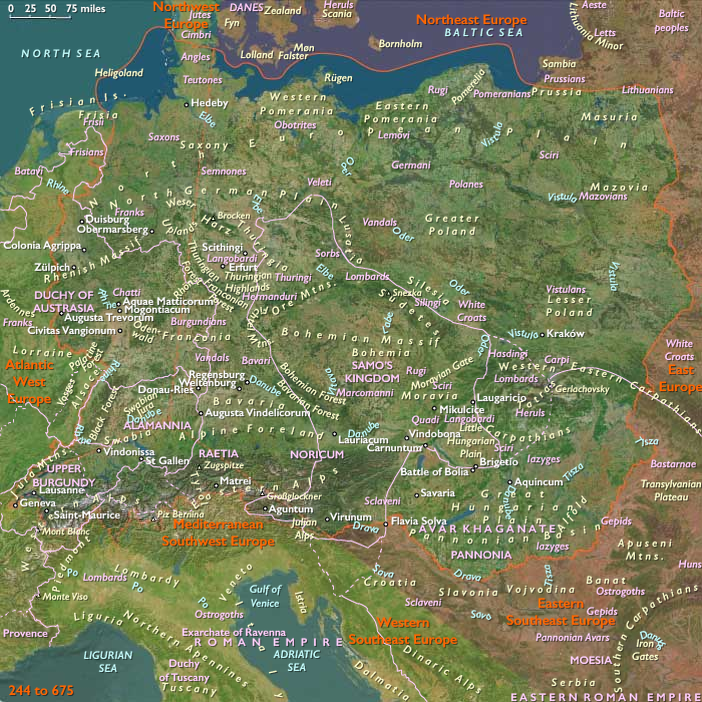
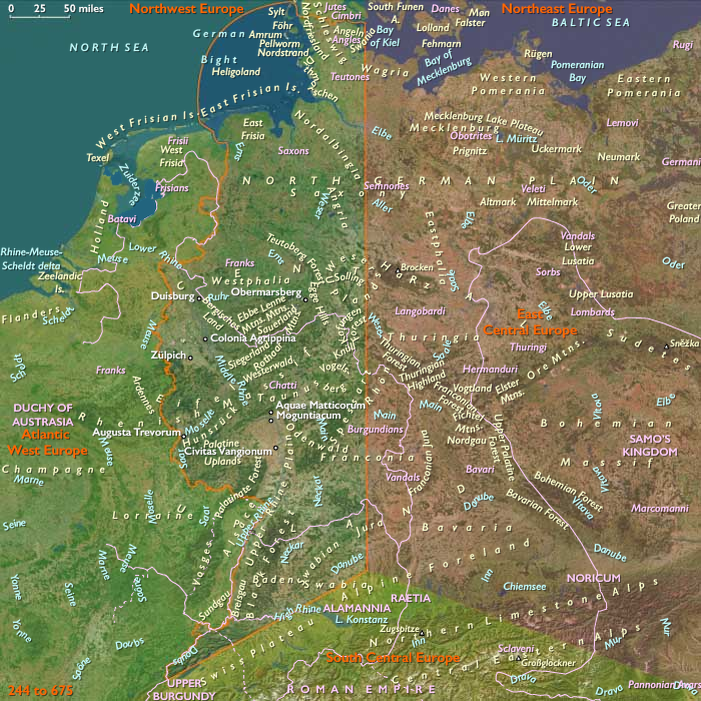
The Agri Decumantes, the area of southwestern Germany now known as Alemannia (and later known as Swabia, for the Suebi (Suevi) who, with the Alemanni, had seized the area from Rome in the fourth century), passes under Frankish control around this time.
People
Groups
Topics
Commodoties
Subjects
Regions
Subregions
Related Events
Filter results
Showing 10 events out of 58280 total
Yuan Ying and Xiao Baoyin follow up by attacking the Liang fortress Zhongli in modern Chuzhou, Anhui), but are dealt a crushing defeat by the Liang general Wei Rui in spring 507.
The two states largely stop their military activities against each other after this point.
The Germanic Thuringii had appeared after about 350 and had been conquered by the Huns in the second quarter of the fifth century; examination of Thuringian grave sites reveal cranial features which suggest the strong presence of Hunnic women or slaves, perhaps indicating that many Thuringians took Hunnic wives or Hunnic slaves following the collapse of the Hunnic Empire. (Schutz, Herbert. The Germanic Realms in Pre-Carolingian Central Europe, 400–750. American University Studies, Series IX: History, Vol. 196; p. 411. New York: Peter Lang, 2000.)
There is also evidence from jewelry found in graves that the Thuringians sought marriages with Ostrogothic and Lombard women.
The Thrungiii had by 500 established a large kingdom stretching from the Harz mountains to the Danube.
Hermanafrid, king of the Thuringii, marries Amalaberga, the daughter of Amalafrida, daughter of Theodemir, king of the Ostrogoths.
Her father is unknown; her uncle is Theodoric the Great.
He begins his rule in 507, shared with his brothers Baderic and Bertachar.
Anastasius, alarmed by the depredations of Slavs and Bulgars in Thrace, builds the Anastasian Wall from the Black Sea to Propontis, across the narrow peninsula near Constantinople.
Anastasius completes the strategic fortress at Dara, raising the city walls to thirty feet (ten meters) to the disregard of Persian protests.
A sporting event is held on July 9, 507 at Daphne, near Antioch, in the form of a chariot race between two parties, the Greens and the Whites.
The supporters of the Greens attack the local synagogue for no apparent reason, killing the Jews inside.
Alaric has endeavored strictly to maintain the treaty which his father had concluded with the Franks.
The Frankish king Clovis I, however, desirous of obtaining the Gothic province in Gaul, finds a pretext for war in Alaric’s Arianism.
The intervention of Theodoric, king of the Ostrogoths and father-in-law of Alaric, proves unavailing.
As a consequence of their defeat at Vouillé, the Visigoths lose all their possessions in Gaul to the Franks, except Septimania (i.e.
the western region of Gallia Narbonensis, which includes the contemporary Arles and the Provence).
The Franks capture Toulouse.
Alaric is succeeded by his eldest son, the illegitimate Gesalec, because his legitimate son Amalaric is still a child.
Gesalec establishes his residence at Narbonne and is supported by an alliance with the Ostrogothic king Theodoric the Great.
Clovis’s defeat of the Visigoths at Vouillé in 507 extends Frankish rule to the whole southern region of Aquitaine, including Poitou and Saintonge, to the Pyrenees.
He now controls all of Gaul except Burgundy, Provence, and Septimania.
Gundobad and the Frankish-Visigothic Conflict at Vouillé (507 CE)
As tensions between Clovis I of the Franks and Alaric II of the Visigoths escalate, efforts are made to prevent war. King Theoderic the Great, ruler of the Ostrogoths, sends letters to several monarchs, including Gundobad, king of the Burgundians, urging peace and offering to mediate between Clovis and Alaric.
Despite these diplomatic efforts, war proves inevitable, culminating in the Battle of Vouillé (507 CE).
Gundobad's Alleged Support for Clovis
- According to Isidore of Seville, Gundobad supports Clovis at Vouillé, though it is unclear whether this support is military or diplomatic.
- The Burgundians and the Franks had been traditional rivals, but Clovis may have secured an alliance with Gundobad, either through mutual interest or the threat of Visigothic expansion.
- If Gundobad assisted Clovis, it suggests that Burgundy preferred Frankish rule over Visigothic control of Gaul.
Armorican Support for Clovis
- Clovis appears to have secured the backing of the Armoricans, a coalition of:
- Gallo-Romans
- Alans (Iranian steppe warriors settled by Rome)
- Bretons (Romano-British refugees in Armorica)
- These groups, already resisting Visigothic dominance, help Clovis defeat the Visigoths and expand Frankish power.
The Battle of Vouillé and Its Aftermath
- In 507 CE, Clovis and Alaric II meet in battle at Vouillé, near Poitiers.
- Clovis achieves a decisive victory, and Alaric II is slain, allegedly by Clovis himself.
- The Visigoths retreat into Hispania, effectively losing control over Gaul, except for a small foothold in Septimania.
- Most of Aquitaine is annexed into the Frankish kingdom, making Clovis the dominant ruler in Gaul.
Consequences of the Battle
- The Visigoths are permanently confined to Spain, where they establish a new capital in Toledo.
- Clovis’ new territory nearly doubles his kingdom, extending Frankish control south to the Pyrenees.
- This victory cements Clovis’ status as the most powerful ruler in post-Roman Western Europe.
By aligning with Gundobad and securing the support of the Armoricans, Clovis strengthens his realm, setting the stage for the Frankish Kingdom to become the dominant power in medieval Europe.
Clovis' Pursuit of the Visigoths and the Annexation of Aquitaine (507–508 CE)
Following his decisive victory at the Battle of Vouillé (507 CE), Clovis I continues his campaign against the Visigothic Kingdom of Toulouse, seeking to eliminate their presence in Gaul altogether.
The Frankish Advance into Aquitaine
- After defeating and killing King Alaric II, Clovis presses southward, capturing key cities including Angoulême, a strategic stronghold in Aquitaine.
- The Visigothic resistance collapses, forcing the surviving Visigoths to retreat further south rather than be subjugated by the Franks.
The Visigothic Retreat to Septimania
- Rather than surrendering to Frankish rule, the remaining Visigoths regroup in Septimania, the narrow coastal strip between the Pyrenees and the Rhône River.
- They establish Narbonne as their new regional center, preserving their last foothold in Gaul.
- Visigothic Hispania, centered in Toledo, becomes the new political heart of the kingdom, shifting the kingdom’s focus away from Gaul.
Clovis Annexes Aquitaine
- With the Visigoths confined to Septimania, Clovis incorporates all of Aquitaine into his kingdom.
- This dramatically expands Frankish territory, bringing former Roman cities, trade routes, and infrastructure under his control.
- The Gallo-Roman elite in Aquitaine, many of whom were already disillusioned with Arian Visigothic rule, welcome Clovis as a Catholic king, strengthening his legitimacy.
The Aftermath and Long-Term Consequences
- The Franks are now the dominant power in Gaul, having eliminated Visigothic authority north of Septimania.
- Clovis' expansion into Aquitaine ensures that the Franks control most of the former Roman province of Gallia.
- The Visigoths, now centered in Spain, shift their focus southward, marking the beginning of their Iberian dominance.
This conquest cements Clovis' position as the ruler of Gaul, and by 508 CE, he has effectively replaced the Visigoths as the strongest kingdom in Western Europe.
