
The rise of Al Saud is closely …
Years: 1732 - 1743
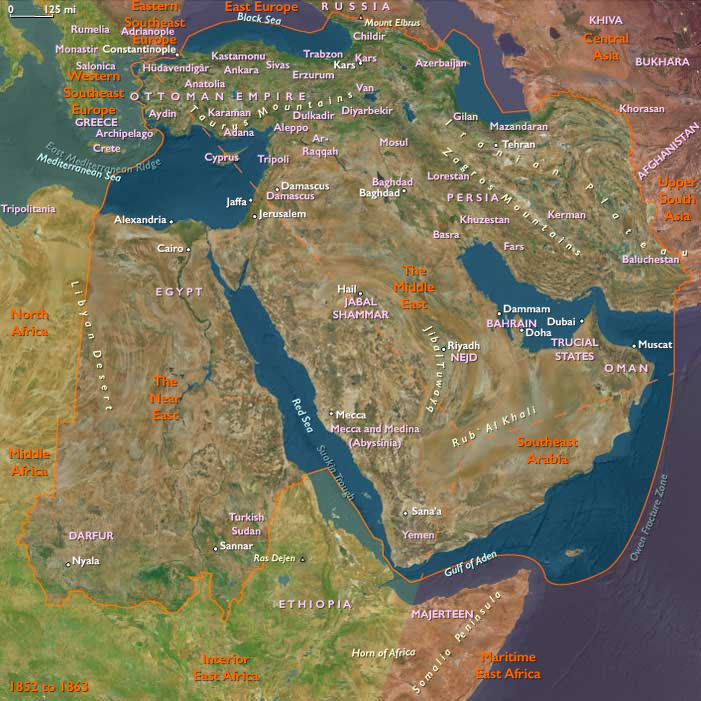
The rise of Al Saud is closely linked with Muhammad ibn Abd al Wahhab (1703-87), a Muslim scholar whose ideas form the basis of the Wahhabi movement.
He grew up in Uyaynah, an oasis in southern Najd, where with his grandfather he studied Hanbali Is- lamic law, one of the strictest Muslim legal schools.
While still a young man, he left Uyaynah to study with other teachers, the usual way to pursue higher education in the Islamic world.
He studied in Medina and then went to Iraq and to Iran.
Muhammad ibn Abd al Wahhab's ideas must be considered in the context of Islamic practice to understand their significance.
There is a difference between the established rituals clearly defined in religious texts that all Muslims perform and popular Islam.
The latter refers to local practice that is not universal.
The Shia practice of visiting shrines is an example of a popular practice.
The Shia had continued to revere the imams even after their death and so visited their graves to ask favors of the imams buried there.
Over time, Shia scholars had rationalized the practice and it has become established.
Some of the Arabian tribes have come to attribute the same sort of power that the Shia recognize in the tomb of an imam to natural objects such as trees and rocks.
Such beliefs are particularly disturbing to Muhammad ibn Abd al Wahhab.
He returns in the late 1730s to the Najdi town of Huraymila and begins to write and preach against both Shia and local popular practices.
He focuses on the Muslim principle that there is only one God and that God does not share his power with anyone—not imams, and certainly not trees or rocks.
From this unitarian principle, his students begin to refer to themselves as muwahhidun (unitarians). Their detractors refer to them as "Wahhabis"—or "followers of Muhammad ibn Abd al Wahhab," which has a pejorative connotation.
The idea of a unitary god is not new.
Muhammad ibn Abd al Wahhab, however, attaches political importance to it.
He directs his attack against the Shia.
He also seeks out local leaders, trying to convince them that his teaching is an Islamic issue.
He expands his message to include strict adherence to the principles of Islamic law.
He refers to himself as a "reformer" and looks for a political figure who might give his ideas a wider audience.
Locations
People
Groups
Subjects
Regions
Subregions
Years: 1732 - 1743
Locations
People
Groups
Subjects
Regions
Subregions