
The world had paid the Al Saud …
Years: 1804 - 1815
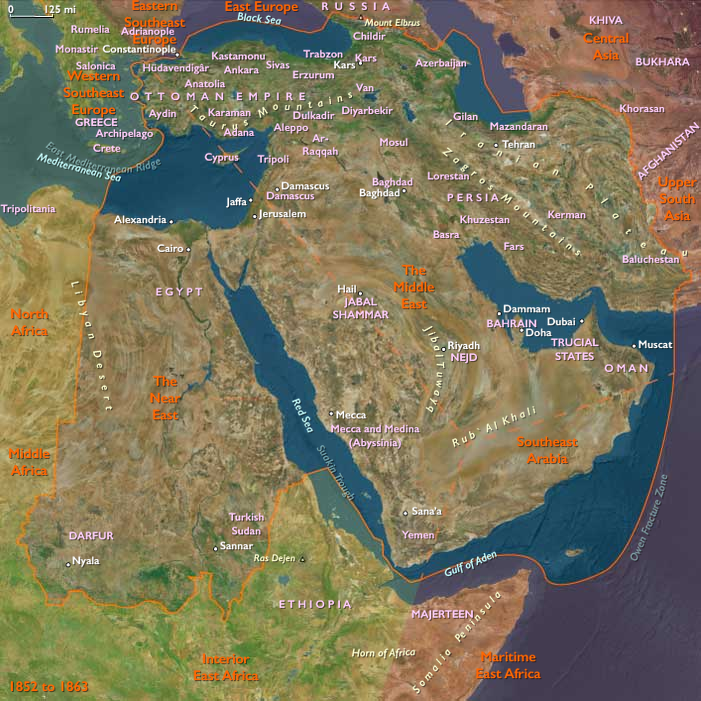
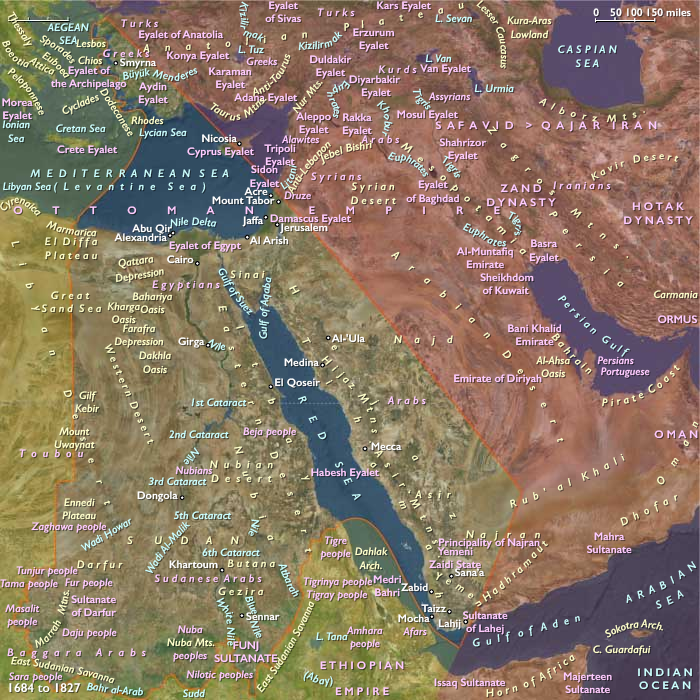
The popular and Shia practices to which the Wahhabis object are important to other Muslims, the majority of whom are alarmed that shrines are destroyed and access to the holy cities restricted.
Moreover, rule over the Hijaz is an important symbol.
The Ottoman Turks, the most important political force in the Islamic world at the time, refuse to concede rule over the Hijaz to local leaders.
The Ottomans at the beginning of the nineteenth century are not in a position to recover the Hijaz, because their forces are weak and overextended.
Accordingly, the Ottomans delegate the recapture of the Hijaz to their most ambitious client, Muhammad Ali, the semi-independent commander of their garrison in Egypt.
Muhammad Ali, in turn, hands the job to his son Tusun, who leads a force to the Hijaz in 1816; Muhammad Ali later joins his son to command the force in person.
Muhammad ibn Abd al Wahhab had meanwhile, died in 1792, and Abd al Aziz died shortly before the capture of Mecca.
The movement had continued, however, to recognize the leadership of the Al Saud and so followed Abd al Aziz's son, Saud, until 1814; after Saud died in 1814, his son, Abd Allah, ruled.
Accordingly, it is Abdullah bin Saud bin Abdul-Aziz who faces the invading Egyptian army.
Tusun's forces take Mecca and Medina almost immediately.
Abdullah chooses this time to retreat to the family's strongholds in Najd.
Locations
People
- Abdul Aziz bin Muhammad bin Saud
- Abdullah bin Saud
- Muhammad Ali of Egypt
- Muhammad ibn ʿAbd al-Wahhab
- Saud bin Abdul-Aziz bin Muhammad bin Saud
- Tusun Pasha
Groups
- Arab people
- Islam
- Muslims, Sunni
- Muslims, Shi'a
- Ottoman Empire
- Diriyah, Emirate of
- Egypt, (Ottoman) Viceroyalty of
Subjects
Regions
Subregions
Related Events
Filter results
Showing 10 events out of 22484 total
Northwest Europe (1804–1815): Napoleonic Wars, Industrial Consolidation, and Cultural Refinement
The Napoleonic Wars and Britain’s Maritime Supremacy
Between 1804 and 1815, Northwest Europe was dramatically reshaped by the Napoleonic Wars, triggered when Napoleon Bonaparte crowned himself Emperor of France in 1804. Britain, Napoleon’s most persistent adversary, relied heavily on naval supremacy to counter French dominance. This maritime power was decisively demonstrated at the Battle of Trafalgar (1805), where Admiral Horatio Nelson secured British naval superiority at the cost of his life. Britain's maritime blockade severely constrained French trade, contributing significantly to Napoleon’s eventual downfall.
The wars culminated in 1815 at the Battle of Waterloo, where British forces under the Duke of Wellington, alongside Prussian troops under Marshal Blücher, defeated Napoleon decisively, ending French dominance and affirming Britain's strategic primacy in Europe.
Industrial Expansion and Technological Refinement
The British Industrial Revolution accelerated dramatically during this era. Innovators such as Richard Trevithick, whose successful railway steam locomotive debuted in 1804, transformed transportation and industry. Coal mining, iron production, and textile manufacturing thrived, elevating living standards and promoting rapid urbanization.
Edmund Cartwright’s Power Loom and Textile Mechanization
Textile mechanization advanced significantly, building upon earlier developments by Edmund Cartwright. By 1803, critical improvements from William Radcliffe and Thomas Johnson solved earlier technical challenges, making power looms commercially viable. Cartwright received parliamentary recognition in 1809 with a £10,000 grant, acknowledging his contributions. The resulting factory-scale weaving dramatically increased textile productivity, reinforcing Britain's global dominance in textile manufacturing.
Marine Chronometers: Revolutionizing Navigation
Marine chronometers became essential to maritime trade during this period. Initially expensive—early chronometers costing nearly 30% of a ship’s value—their affordability increased dramatically by the early 1800s. Innovations by makers like John Arnold and Thomas Earnshaw significantly reduced costs, bringing chronometers within reach of the merchant marine. By this period, prices ranged from £25 to £100, representing approximately half a year's to two years' wages for skilled workers.
Though production volumes remained relatively modest, the exceptional durability of chronometers allowed few replacements to meet growing demand. Lower-cost deck chronometers, slightly less accurate but sufficiently reliable for merchant use, became common. By the early nineteenth century, navigating without a chronometer was considered irresponsible, significantly reducing maritime accidents and boosting global trade and insurance confidence.
James Watt’s Steam Engine Legacy
Steam engine innovations by James Watt became deeply embedded in British industry. Watt’s inventions—double-acting engines, parallel-motion mechanisms, centrifugal governors, and throttle valves—dramatically improved efficiency and reliability. Although Watt restricted steam pressures due to safety concerns, subsequent improvements gradually overcame limitations, making steam engines central to Britain's factories, mines, and mills.
Economic Liberalism and the Influence of Adam Smith
The economic philosophies articulated by Adam Smith in The Wealth of Nations (1776) remained influential. Smith’s ideas of free trade and limited government intervention underpinned Britain’s wartime economic strategies, sustaining industrial growth and enabling wartime prosperity. British prosperity was thus increasingly built upon these liberal economic principles.
Cultural Elegance and the Rise of Beau Brummell
In early nineteenth-century Britain, cultural sophistication and fashion reached new heights, epitomized by Beau Brummell, the celebrated dandy and recognized arbiter of style. A bachelor residing in Mayfair, Brummell set the standard as the best-dressed, best-mannered English gentleman in Europe, influencing fashion and manners profoundly. His sartorial meticulousness became legendary: coats, waistcoats, and breeches were each crafted by different specialist tailors, ensuring impeccable fit. His elaborate neckcloths required hours of attention by his valet, reflecting a level of elegance and precision never before seen.
Brummell's unmatched influence extended into the highest circles, notably shaping the attire of his close associate George, Prince of Wales (Regent from 1811, later King George IV), who emulated Brummell’s style. However, Brummell's extravagant lifestyle—marked by excessive gambling and relentless spending—exhausted his inherited fortune. Additionally, his acerbic wit eventually alienated even his royal patron. A decisive quarrel with the Prince Regent in 1812 signaled the beginning of Brummell’s decline. Although he initially retained social standing, mounting debts marked the decline of his influence.
East India Company: Global Economic Peak
The East India Company reached peak influence during this era, driven by the insatiable British demand for raw materials and commodities necessary for its industrial economy and wartime efforts. The Company's vast trade networks sustained Britain's global economic dominance, supplying critical resources such as textiles, spices, cotton, and indigo, and underpinning Britain's wartime finances.
Romantic Movement and Artistic Flourishing
Britain’s cultural scene flourished with Romantic literature, including influential works by William Wordsworth, Samuel Taylor Coleridge, Lord Byron, Percy Bysshe Shelley, and John Keats. Artists such as Thomas Lawrence succeeded earlier masters like Reynolds and Gainsborough, capturing the refined elegance of Britain’s ruling class.
Ireland: Union and Persistent Tensions
Ireland remained unsettled following the Acts of Union (1801), with economic hardships exacerbated by war. Tensions continued to simmer, driven by political disenfranchisement and poverty, sowing seeds for future unrest.
Denmark-Norway: Neutrality Shattered
Denmark-Norway’s cautious neutrality ended abruptly in 1807 when Britain bombarded Copenhagen to prevent its fleet from falling into French hands. Forced into an alliance with France, Denmark-Norway suffered economically from British blockades, ultimately leading to Denmark’s cession of Norway to Sweden in 1814, reshaping the geopolitical landscape.
Financial Innovations
British financial services continued to evolve, with robust actuarial methods securing the growing life insurance industry, underpinning middle-class financial security and investments in Britain's expanding industrial and economic sectors.
Maritime Exploration and Strategic Mapping
Britain continued maritime exploration and improved navigation methods during this era, driven by accurate chronometer-based longitude measurements. Admiralty charts facilitated safer maritime trade routes and strengthened Britain's strategic global dominance.
From 1804 to 1815, Northwest Europe experienced transformative changes driven by the Napoleonic Wars, industrial innovations in steam power, textile mechanization, and maritime navigation, as well as the rise of cultural refinement exemplified by figures such as Beau Brummell. Britain's victories at Trafalgar and Waterloo, combined with cultural and economic developments, secured its position as the leading global power, setting the stage for continued nineteenth-century expansion and influence.
Northwest Europe (1804–1815): Napoleonic Wars, Industrial Consolidation, and Cultural Refinement
The Napoleonic Wars and Britain’s Maritime Supremacy
Between 1804 and 1815, Northwest Europe was dramatically reshaped by the Napoleonic Wars, triggered when Napoleon Bonaparte crowned himself Emperor of France in 1804. Britain, Napoleon’s most persistent adversary, relied heavily on naval supremacy to counter French dominance. This maritime power was decisively demonstrated at the Battle of Trafalgar (1805), where Admiral Horatio Nelson secured British naval superiority at the cost of his life. Britain's maritime blockade severely constrained French trade, contributing significantly to Napoleon’s eventual downfall.
The wars culminated in 1815 at the Battle of Waterloo, where British forces under the Duke of Wellington, alongside Prussian troops under Marshal Blücher, defeated Napoleon decisively, ending French dominance and affirming Britain's strategic primacy in Europe.
Industrial Expansion and Technological Refinement
The British Industrial Revolution accelerated dramatically during this era. Innovators such as Richard Trevithick, whose successful railway steam locomotive debuted in 1804, transformed transportation and industry. Coal mining, iron production, and textile manufacturing thrived, elevating living standards and promoting rapid urbanization.
Edmund Cartwright’s Power Loom and Textile Mechanization
Textile mechanization advanced significantly, building upon earlier developments by Edmund Cartwright. By 1803, critical improvements from William Radcliffe and Thomas Johnson solved earlier technical challenges, making power looms commercially viable. Cartwright received parliamentary recognition in 1809 with a £10,000 grant, acknowledging his contributions. The resulting factory-scale weaving dramatically increased textile productivity, reinforcing Britain's global dominance in textile manufacturing.
Marine Chronometers: Revolutionizing Navigation
Marine chronometers became essential to maritime trade during this period. Initially expensive—early chronometers costing nearly 30% of a ship’s value—their affordability increased dramatically by the early 1800s. Innovations by makers like John Arnold and Thomas Earnshaw significantly reduced costs, bringing chronometers within reach of the merchant marine. By this period, prices ranged from £25 to £100, representing approximately half a year's to two years' wages for skilled workers.
Though production volumes remained relatively modest, the exceptional durability of chronometers allowed few replacements to meet growing demand. Lower-cost deck chronometers, slightly less accurate but sufficiently reliable for merchant use, became common. By the early nineteenth century, navigating without a chronometer was considered irresponsible, significantly reducing maritime accidents and boosting global trade and insurance confidence.
James Watt’s Steam Engine Legacy
Steam engine innovations by James Watt became deeply embedded in British industry. Watt’s inventions—double-acting engines, parallel-motion mechanisms, centrifugal governors, and throttle valves—dramatically improved efficiency and reliability. Although Watt restricted steam pressures due to safety concerns, subsequent improvements gradually overcame limitations, making steam engines central to Britain's factories, mines, and mills.
Economic Liberalism and the Influence of Adam Smith
The economic philosophies articulated by Adam Smith in The Wealth of Nations (1776) remained influential. Smith’s ideas of free trade and limited government intervention underpinned Britain’s wartime economic strategies, sustaining industrial growth and enabling wartime prosperity. British prosperity was thus increasingly built upon these liberal economic principles.
Cultural Elegance and the Rise of Beau Brummell
In early nineteenth-century Britain, cultural sophistication and fashion reached new heights, epitomized by Beau Brummell, the celebrated dandy and recognized arbiter of style. A bachelor residing in Mayfair, Brummell set the standard as the best-dressed, best-mannered English gentleman in Europe, influencing fashion and manners profoundly. His sartorial meticulousness became legendary: coats, waistcoats, and breeches were each crafted by different specialist tailors, ensuring impeccable fit. His elaborate neckcloths required hours of attention by his valet, reflecting a level of elegance and precision never before seen.
Brummell's unmatched influence extended into the highest circles, notably shaping the attire of his close associate George, Prince of Wales (Regent from 1811, later King George IV), who emulated Brummell’s style. However, Brummell's extravagant lifestyle—marked by excessive gambling and relentless spending—exhausted his inherited fortune. Additionally, his acerbic wit eventually alienated even his royal patron. A decisive quarrel with the Prince Regent in 1812 signaled the beginning of Brummell’s decline. Although he initially retained social standing, mounting debts marked the decline of his influence.
East India Company: Global Economic Peak
The East India Company reached peak influence during this era, driven by the insatiable British demand for raw materials and commodities necessary for its industrial economy and wartime efforts. The Company's vast trade networks sustained Britain's global economic dominance, supplying critical resources such as textiles, spices, cotton, and indigo, and underpinning Britain's wartime finances.
Romantic Movement and Artistic Flourishing
Britain’s cultural scene flourished with Romantic literature, including influential works by William Wordsworth, Samuel Taylor Coleridge, Lord Byron, Percy Bysshe Shelley, and John Keats. Artists such as Thomas Lawrence succeeded earlier masters like Reynolds and Gainsborough, capturing the refined elegance of Britain’s ruling class.
Ireland: Union and Persistent Tensions
Ireland remained unsettled following the Acts of Union (1801), with economic hardships exacerbated by war. Tensions continued to simmer, driven by political disenfranchisement and poverty, sowing seeds for future unrest.
Denmark-Norway: Neutrality Shattered
Denmark-Norway’s cautious neutrality ended abruptly in 1807 when Britain bombarded Copenhagen to prevent its fleet from falling into French hands. Forced into an alliance with France, Denmark-Norway suffered economically from British blockades, ultimately leading to Denmark’s cession of Norway to Sweden in 1814, reshaping the geopolitical landscape.
Financial Innovations
British financial services continued to evolve, with robust actuarial methods securing the growing life insurance industry, underpinning middle-class financial security and investments in Britain's expanding industrial and economic sectors.
Maritime Exploration and Strategic Mapping
Britain continued maritime exploration and improved navigation methods during this era, driven by accurate chronometer-based longitude measurements. Admiralty charts facilitated safer maritime trade routes and strengthened Britain's strategic global dominance.
From 1804 to 1815, Northwest Europe experienced transformative changes driven by the Napoleonic Wars, industrial innovations in steam power, textile mechanization, and maritime navigation, as well as the rise of cultural refinement exemplified by figures such as Beau Brummell. Britain's victories at Trafalgar and Waterloo, combined with cultural and economic developments, secured its position as the leading global power, setting the stage for continued nineteenth-century expansion and influence.
Northwest Europe (1804–1815): Napoleonic Wars, Industrial Consolidation, and Cultural Refinement
The Napoleonic Wars and Britain’s Maritime Supremacy
Between 1804 and 1815, Northwest Europe was dramatically reshaped by the Napoleonic Wars, triggered when Napoleon Bonaparte crowned himself Emperor of France in 1804. Britain, Napoleon’s most persistent adversary, relied heavily on naval supremacy to counter French dominance. This maritime power was decisively demonstrated at the Battle of Trafalgar (1805), where Admiral Horatio Nelson secured British naval superiority at the cost of his life. Britain's maritime blockade severely constrained French trade, contributing significantly to Napoleon’s eventual downfall.
The wars culminated in 1815 at the Battle of Waterloo, where British forces under the Duke of Wellington, alongside Prussian troops under Marshal Blücher, defeated Napoleon decisively, ending French dominance and affirming Britain's strategic primacy in Europe.
Industrial Expansion and Technological Refinement
The British Industrial Revolution accelerated dramatically during this era. Innovators such as Richard Trevithick, whose successful railway steam locomotive debuted in 1804, transformed transportation and industry. Coal mining, iron production, and textile manufacturing thrived, elevating living standards and promoting rapid urbanization.
Edmund Cartwright’s Power Loom and Textile Mechanization
Textile mechanization advanced significantly, building upon earlier developments by Edmund Cartwright. By 1803, critical improvements from William Radcliffe and Thomas Johnson solved earlier technical challenges, making power looms commercially viable. Cartwright received parliamentary recognition in 1809 with a £10,000 grant, acknowledging his contributions. The resulting factory-scale weaving dramatically increased textile productivity, reinforcing Britain's global dominance in textile manufacturing.
Marine Chronometers: Revolutionizing Navigation
Marine chronometers became essential to maritime trade during this period. Initially expensive—early chronometers costing nearly 30% of a ship’s value—their affordability increased dramatically by the early 1800s. Innovations by makers like John Arnold and Thomas Earnshaw significantly reduced costs, bringing chronometers within reach of the merchant marine. By this period, prices ranged from £25 to £100, representing approximately half a year's to two years' wages for skilled workers.
Though production volumes remained relatively modest, the exceptional durability of chronometers allowed few replacements to meet growing demand. Lower-cost deck chronometers, slightly less accurate but sufficiently reliable for merchant use, became common. By the early nineteenth century, navigating without a chronometer was considered irresponsible, significantly reducing maritime accidents and boosting global trade and insurance confidence.
James Watt’s Steam Engine Legacy
Steam engine innovations by James Watt became deeply embedded in British industry. Watt’s inventions—double-acting engines, parallel-motion mechanisms, centrifugal governors, and throttle valves—dramatically improved efficiency and reliability. Although Watt restricted steam pressures due to safety concerns, subsequent improvements gradually overcame limitations, making steam engines central to Britain's factories, mines, and mills.
Economic Liberalism and the Influence of Adam Smith
The economic philosophies articulated by Adam Smith in The Wealth of Nations (1776) remained influential. Smith’s ideas of free trade and limited government intervention underpinned Britain’s wartime economic strategies, sustaining industrial growth and enabling wartime prosperity. British prosperity was thus increasingly built upon these liberal economic principles.
Cultural Elegance and the Rise of Beau Brummell
In early nineteenth-century Britain, cultural sophistication and fashion reached new heights, epitomized by Beau Brummell, the celebrated dandy and recognized arbiter of style. A bachelor residing in Mayfair, Brummell set the standard as the best-dressed, best-mannered English gentleman in Europe, influencing fashion and manners profoundly. His sartorial meticulousness became legendary: coats, waistcoats, and breeches were each crafted by different specialist tailors, ensuring impeccable fit. His elaborate neckcloths required hours of attention by his valet, reflecting a level of elegance and precision never before seen.
Brummell's unmatched influence extended into the highest circles, notably shaping the attire of his close associate George, Prince of Wales (Regent from 1811, later King George IV), who emulated Brummell’s style. However, Brummell's extravagant lifestyle—marked by excessive gambling and relentless spending—exhausted his inherited fortune. Additionally, his acerbic wit eventually alienated even his royal patron. A decisive quarrel with the Prince Regent in 1812 signaled the beginning of Brummell’s decline. Although he initially retained social standing, mounting debts marked the decline of his influence.
East India Company: Global Economic Peak
The East India Company reached peak influence during this era, driven by the insatiable British demand for raw materials and commodities necessary for its industrial economy and wartime efforts. The Company's vast trade networks sustained Britain's global economic dominance, supplying critical resources such as textiles, spices, cotton, and indigo, and underpinning Britain's wartime finances.
Romantic Movement and Artistic Flourishing
Britain’s cultural scene flourished with Romantic literature, including influential works by William Wordsworth, Samuel Taylor Coleridge, Lord Byron, Percy Bysshe Shelley, and John Keats. Artists such as Thomas Lawrence succeeded earlier masters like Reynolds and Gainsborough, capturing the refined elegance of Britain’s ruling class.
Ireland: Union and Persistent Tensions
Ireland remained unsettled following the Acts of Union (1801), with economic hardships exacerbated by war. Tensions continued to simmer, driven by political disenfranchisement and poverty, sowing seeds for future unrest.
Denmark-Norway: Neutrality Shattered
Denmark-Norway’s cautious neutrality ended abruptly in 1807 when Britain bombarded Copenhagen to prevent its fleet from falling into French hands. Forced into an alliance with France, Denmark-Norway suffered economically from British blockades, ultimately leading to Denmark’s cession of Norway to Sweden in 1814, reshaping the geopolitical landscape.
Financial Innovations
British financial services continued to evolve, with robust actuarial methods securing the growing life insurance industry, underpinning middle-class financial security and investments in Britain's expanding industrial and economic sectors.
Maritime Exploration and Strategic Mapping
Britain continued maritime exploration and improved navigation methods during this era, driven by accurate chronometer-based longitude measurements. Admiralty charts facilitated safer maritime trade routes and strengthened Britain's strategic global dominance.
From 1804 to 1815, Northwest Europe experienced transformative changes driven by the Napoleonic Wars, industrial innovations in steam power, textile mechanization, and maritime navigation, as well as the rise of cultural refinement exemplified by figures such as Beau Brummell. Britain's victories at Trafalgar and Waterloo, combined with cultural and economic developments, secured its position as the leading global power, setting the stage for continued nineteenth-century expansion and influence.
Northwest Europe (1804–1815): Napoleonic Wars, Industrial Consolidation, and Cultural Refinement
The Napoleonic Wars and Britain’s Maritime Supremacy
Between 1804 and 1815, Northwest Europe was dramatically reshaped by the Napoleonic Wars, triggered when Napoleon Bonaparte crowned himself Emperor of France in 1804. Britain, Napoleon’s most persistent adversary, relied heavily on naval supremacy to counter French dominance. This maritime power was decisively demonstrated at the Battle of Trafalgar (1805), where Admiral Horatio Nelson secured British naval superiority at the cost of his life. Britain's maritime blockade severely constrained French trade, contributing significantly to Napoleon’s eventual downfall.
The wars culminated in 1815 at the Battle of Waterloo, where British forces under the Duke of Wellington, alongside Prussian troops under Marshal Blücher, defeated Napoleon decisively, ending French dominance and affirming Britain's strategic primacy in Europe.
Industrial Expansion and Technological Refinement
The British Industrial Revolution accelerated dramatically during this era. Innovators such as Richard Trevithick, whose successful railway steam locomotive debuted in 1804, transformed transportation and industry. Coal mining, iron production, and textile manufacturing thrived, elevating living standards and promoting rapid urbanization.
Edmund Cartwright’s Power Loom and Textile Mechanization
Textile mechanization advanced significantly, building upon earlier developments by Edmund Cartwright. By 1803, critical improvements from William Radcliffe and Thomas Johnson solved earlier technical challenges, making power looms commercially viable. Cartwright received parliamentary recognition in 1809 with a £10,000 grant, acknowledging his contributions. The resulting factory-scale weaving dramatically increased textile productivity, reinforcing Britain's global dominance in textile manufacturing.
Marine Chronometers: Revolutionizing Navigation
Marine chronometers became essential to maritime trade during this period. Initially expensive—early chronometers costing nearly 30% of a ship’s value—their affordability increased dramatically by the early 1800s. Innovations by makers like John Arnold and Thomas Earnshaw significantly reduced costs, bringing chronometers within reach of the merchant marine. By this period, prices ranged from £25 to £100, representing approximately half a year's to two years' wages for skilled workers.
Though production volumes remained relatively modest, the exceptional durability of chronometers allowed few replacements to meet growing demand. Lower-cost deck chronometers, slightly less accurate but sufficiently reliable for merchant use, became common. By the early nineteenth century, navigating without a chronometer was considered irresponsible, significantly reducing maritime accidents and boosting global trade and insurance confidence.
James Watt’s Steam Engine Legacy
Steam engine innovations by James Watt became deeply embedded in British industry. Watt’s inventions—double-acting engines, parallel-motion mechanisms, centrifugal governors, and throttle valves—dramatically improved efficiency and reliability. Although Watt restricted steam pressures due to safety concerns, subsequent improvements gradually overcame limitations, making steam engines central to Britain's factories, mines, and mills.
Economic Liberalism and the Influence of Adam Smith
The economic philosophies articulated by Adam Smith in The Wealth of Nations (1776) remained influential. Smith’s ideas of free trade and limited government intervention underpinned Britain’s wartime economic strategies, sustaining industrial growth and enabling wartime prosperity. British prosperity was thus increasingly built upon these liberal economic principles.
Cultural Elegance and the Rise of Beau Brummell
In early nineteenth-century Britain, cultural sophistication and fashion reached new heights, epitomized by Beau Brummell, the celebrated dandy and recognized arbiter of style. A bachelor residing in Mayfair, Brummell set the standard as the best-dressed, best-mannered English gentleman in Europe, influencing fashion and manners profoundly. His sartorial meticulousness became legendary: coats, waistcoats, and breeches were each crafted by different specialist tailors, ensuring impeccable fit. His elaborate neckcloths required hours of attention by his valet, reflecting a level of elegance and precision never before seen.
Brummell's unmatched influence extended into the highest circles, notably shaping the attire of his close associate George, Prince of Wales (Regent from 1811, later King George IV), who emulated Brummell’s style. However, Brummell's extravagant lifestyle—marked by excessive gambling and relentless spending—exhausted his inherited fortune. Additionally, his acerbic wit eventually alienated even his royal patron. A decisive quarrel with the Prince Regent in 1812 signaled the beginning of Brummell’s decline. Although he initially retained social standing, mounting debts marked the decline of his influence.
East India Company: Global Economic Peak
The East India Company reached peak influence during this era, driven by the insatiable British demand for raw materials and commodities necessary for its industrial economy and wartime efforts. The Company's vast trade networks sustained Britain's global economic dominance, supplying critical resources such as textiles, spices, cotton, and indigo, and underpinning Britain's wartime finances.
Romantic Movement and Artistic Flourishing
Britain’s cultural scene flourished with Romantic literature, including influential works by William Wordsworth, Samuel Taylor Coleridge, Lord Byron, Percy Bysshe Shelley, and John Keats. Artists such as Thomas Lawrence succeeded earlier masters like Reynolds and Gainsborough, capturing the refined elegance of Britain’s ruling class.
Ireland: Union and Persistent Tensions
Ireland remained unsettled following the Acts of Union (1801), with economic hardships exacerbated by war. Tensions continued to simmer, driven by political disenfranchisement and poverty, sowing seeds for future unrest.
Denmark-Norway: Neutrality Shattered
Denmark-Norway’s cautious neutrality ended abruptly in 1807 when Britain bombarded Copenhagen to prevent its fleet from falling into French hands. Forced into an alliance with France, Denmark-Norway suffered economically from British blockades, ultimately leading to Denmark’s cession of Norway to Sweden in 1814, reshaping the geopolitical landscape.
Financial Innovations
British financial services continued to evolve, with robust actuarial methods securing the growing life insurance industry, underpinning middle-class financial security and investments in Britain's expanding industrial and economic sectors.
Maritime Exploration and Strategic Mapping
Britain continued maritime exploration and improved navigation methods during this era, driven by accurate chronometer-based longitude measurements. Admiralty charts facilitated safer maritime trade routes and strengthened Britain's strategic global dominance.
From 1804 to 1815, Northwest Europe experienced transformative changes driven by the Napoleonic Wars, industrial innovations in steam power, textile mechanization, and maritime navigation, as well as the rise of cultural refinement exemplified by figures such as Beau Brummell. Britain's victories at Trafalgar and Waterloo, combined with cultural and economic developments, secured its position as the leading global power, setting the stage for continued nineteenth-century expansion and influence.
Northwest Europe (1804–1815): Napoleonic Wars, Industrial Consolidation, and Cultural Refinement
The Napoleonic Wars and Britain’s Maritime Supremacy
Between 1804 and 1815, Northwest Europe was dramatically reshaped by the Napoleonic Wars, triggered when Napoleon Bonaparte crowned himself Emperor of France in 1804. Britain, Napoleon’s most persistent adversary, relied heavily on naval supremacy to counter French dominance. This maritime power was decisively demonstrated at the Battle of Trafalgar (1805), where Admiral Horatio Nelson secured British naval superiority at the cost of his life. Britain's maritime blockade severely constrained French trade, contributing significantly to Napoleon’s eventual downfall.
The wars culminated in 1815 at the Battle of Waterloo, where British forces under the Duke of Wellington, alongside Prussian troops under Marshal Blücher, defeated Napoleon decisively, ending French dominance and affirming Britain's strategic primacy in Europe.
Industrial Expansion and Technological Refinement
The British Industrial Revolution accelerated dramatically during this era. Innovators such as Richard Trevithick, whose successful railway steam locomotive debuted in 1804, transformed transportation and industry. Coal mining, iron production, and textile manufacturing thrived, elevating living standards and promoting rapid urbanization.
Edmund Cartwright’s Power Loom and Textile Mechanization
Textile mechanization advanced significantly, building upon earlier developments by Edmund Cartwright. By 1803, critical improvements from William Radcliffe and Thomas Johnson solved earlier technical challenges, making power looms commercially viable. Cartwright received parliamentary recognition in 1809 with a £10,000 grant, acknowledging his contributions. The resulting factory-scale weaving dramatically increased textile productivity, reinforcing Britain's global dominance in textile manufacturing.
Marine Chronometers: Revolutionizing Navigation
Marine chronometers became essential to maritime trade during this period. Initially expensive—early chronometers costing nearly 30% of a ship’s value—their affordability increased dramatically by the early 1800s. Innovations by makers like John Arnold and Thomas Earnshaw significantly reduced costs, bringing chronometers within reach of the merchant marine. By this period, prices ranged from £25 to £100, representing approximately half a year's to two years' wages for skilled workers.
Though production volumes remained relatively modest, the exceptional durability of chronometers allowed few replacements to meet growing demand. Lower-cost deck chronometers, slightly less accurate but sufficiently reliable for merchant use, became common. By the early nineteenth century, navigating without a chronometer was considered irresponsible, significantly reducing maritime accidents and boosting global trade and insurance confidence.
James Watt’s Steam Engine Legacy
Steam engine innovations by James Watt became deeply embedded in British industry. Watt’s inventions—double-acting engines, parallel-motion mechanisms, centrifugal governors, and throttle valves—dramatically improved efficiency and reliability. Although Watt restricted steam pressures due to safety concerns, subsequent improvements gradually overcame limitations, making steam engines central to Britain's factories, mines, and mills.
Economic Liberalism and the Influence of Adam Smith
The economic philosophies articulated by Adam Smith in The Wealth of Nations (1776) remained influential. Smith’s ideas of free trade and limited government intervention underpinned Britain’s wartime economic strategies, sustaining industrial growth and enabling wartime prosperity. British prosperity was thus increasingly built upon these liberal economic principles.
Cultural Elegance and the Rise of Beau Brummell
In early nineteenth-century Britain, cultural sophistication and fashion reached new heights, epitomized by Beau Brummell, the celebrated dandy and recognized arbiter of style. A bachelor residing in Mayfair, Brummell set the standard as the best-dressed, best-mannered English gentleman in Europe, influencing fashion and manners profoundly. His sartorial meticulousness became legendary: coats, waistcoats, and breeches were each crafted by different specialist tailors, ensuring impeccable fit. His elaborate neckcloths required hours of attention by his valet, reflecting a level of elegance and precision never before seen.
Brummell's unmatched influence extended into the highest circles, notably shaping the attire of his close associate George, Prince of Wales (Regent from 1811, later King George IV), who emulated Brummell’s style. However, Brummell's extravagant lifestyle—marked by excessive gambling and relentless spending—exhausted his inherited fortune. Additionally, his acerbic wit eventually alienated even his royal patron. A decisive quarrel with the Prince Regent in 1812 signaled the beginning of Brummell’s decline. Although he initially retained social standing, mounting debts marked the decline of his influence.
East India Company: Global Economic Peak
The East India Company reached peak influence during this era, driven by the insatiable British demand for raw materials and commodities necessary for its industrial economy and wartime efforts. The Company's vast trade networks sustained Britain's global economic dominance, supplying critical resources such as textiles, spices, cotton, and indigo, and underpinning Britain's wartime finances.
Romantic Movement and Artistic Flourishing
Britain’s cultural scene flourished with Romantic literature, including influential works by William Wordsworth, Samuel Taylor Coleridge, Lord Byron, Percy Bysshe Shelley, and John Keats. Artists such as Thomas Lawrence succeeded earlier masters like Reynolds and Gainsborough, capturing the refined elegance of Britain’s ruling class.
Ireland: Union and Persistent Tensions
Ireland remained unsettled following the Acts of Union (1801), with economic hardships exacerbated by war. Tensions continued to simmer, driven by political disenfranchisement and poverty, sowing seeds for future unrest.
Denmark-Norway: Neutrality Shattered
Denmark-Norway’s cautious neutrality ended abruptly in 1807 when Britain bombarded Copenhagen to prevent its fleet from falling into French hands. Forced into an alliance with France, Denmark-Norway suffered economically from British blockades, ultimately leading to Denmark’s cession of Norway to Sweden in 1814, reshaping the geopolitical landscape.
Financial Innovations
British financial services continued to evolve, with robust actuarial methods securing the growing life insurance industry, underpinning middle-class financial security and investments in Britain's expanding industrial and economic sectors.
Maritime Exploration and Strategic Mapping
Britain continued maritime exploration and improved navigation methods during this era, driven by accurate chronometer-based longitude measurements. Admiralty charts facilitated safer maritime trade routes and strengthened Britain's strategic global dominance.
From 1804 to 1815, Northwest Europe experienced transformative changes driven by the Napoleonic Wars, industrial innovations in steam power, textile mechanization, and maritime navigation, as well as the rise of cultural refinement exemplified by figures such as Beau Brummell. Britain's victories at Trafalgar and Waterloo, combined with cultural and economic developments, secured its position as the leading global power, setting the stage for continued nineteenth-century expansion and influence.
Northwest Europe (1804–1815): Napoleonic Wars, Industrial Consolidation, and Cultural Refinement
The Napoleonic Wars and Britain’s Maritime Supremacy
Between 1804 and 1815, Northwest Europe was dramatically reshaped by the Napoleonic Wars, triggered when Napoleon Bonaparte crowned himself Emperor of France in 1804. Britain, Napoleon’s most persistent adversary, relied heavily on naval supremacy to counter French dominance. This maritime power was decisively demonstrated at the Battle of Trafalgar (1805), where Admiral Horatio Nelson secured British naval superiority at the cost of his life. Britain's maritime blockade severely constrained French trade, contributing significantly to Napoleon’s eventual downfall.
The wars culminated in 1815 at the Battle of Waterloo, where British forces under the Duke of Wellington, alongside Prussian troops under Marshal Blücher, defeated Napoleon decisively, ending French dominance and affirming Britain's strategic primacy in Europe.
Industrial Expansion and Technological Refinement
The British Industrial Revolution accelerated dramatically during this era. Innovators such as Richard Trevithick, whose successful railway steam locomotive debuted in 1804, transformed transportation and industry. Coal mining, iron production, and textile manufacturing thrived, elevating living standards and promoting rapid urbanization.
Edmund Cartwright’s Power Loom and Textile Mechanization
Textile mechanization advanced significantly, building upon earlier developments by Edmund Cartwright. By 1803, critical improvements from William Radcliffe and Thomas Johnson solved earlier technical challenges, making power looms commercially viable. Cartwright received parliamentary recognition in 1809 with a £10,000 grant, acknowledging his contributions. The resulting factory-scale weaving dramatically increased textile productivity, reinforcing Britain's global dominance in textile manufacturing.
Marine Chronometers: Revolutionizing Navigation
Marine chronometers became essential to maritime trade during this period. Initially expensive—early chronometers costing nearly 30% of a ship’s value—their affordability increased dramatically by the early 1800s. Innovations by makers like John Arnold and Thomas Earnshaw significantly reduced costs, bringing chronometers within reach of the merchant marine. By this period, prices ranged from £25 to £100, representing approximately half a year's to two years' wages for skilled workers.
Though production volumes remained relatively modest, the exceptional durability of chronometers allowed few replacements to meet growing demand. Lower-cost deck chronometers, slightly less accurate but sufficiently reliable for merchant use, became common. By the early nineteenth century, navigating without a chronometer was considered irresponsible, significantly reducing maritime accidents and boosting global trade and insurance confidence.
James Watt’s Steam Engine Legacy
Steam engine innovations by James Watt became deeply embedded in British industry. Watt’s inventions—double-acting engines, parallel-motion mechanisms, centrifugal governors, and throttle valves—dramatically improved efficiency and reliability. Although Watt restricted steam pressures due to safety concerns, subsequent improvements gradually overcame limitations, making steam engines central to Britain's factories, mines, and mills.
Economic Liberalism and the Influence of Adam Smith
The economic philosophies articulated by Adam Smith in The Wealth of Nations (1776) remained influential. Smith’s ideas of free trade and limited government intervention underpinned Britain’s wartime economic strategies, sustaining industrial growth and enabling wartime prosperity. British prosperity was thus increasingly built upon these liberal economic principles.
Cultural Elegance and the Rise of Beau Brummell
In early nineteenth-century Britain, cultural sophistication and fashion reached new heights, epitomized by Beau Brummell, the celebrated dandy and recognized arbiter of style. A bachelor residing in Mayfair, Brummell set the standard as the best-dressed, best-mannered English gentleman in Europe, influencing fashion and manners profoundly. His sartorial meticulousness became legendary: coats, waistcoats, and breeches were each crafted by different specialist tailors, ensuring impeccable fit. His elaborate neckcloths required hours of attention by his valet, reflecting a level of elegance and precision never before seen.
Brummell's unmatched influence extended into the highest circles, notably shaping the attire of his close associate George, Prince of Wales (Regent from 1811, later King George IV), who emulated Brummell’s style. However, Brummell's extravagant lifestyle—marked by excessive gambling and relentless spending—exhausted his inherited fortune. Additionally, his acerbic wit eventually alienated even his royal patron. A decisive quarrel with the Prince Regent in 1812 signaled the beginning of Brummell’s decline. Although he initially retained social standing, mounting debts marked the decline of his influence.
East India Company: Global Economic Peak
The East India Company reached peak influence during this era, driven by the insatiable British demand for raw materials and commodities necessary for its industrial economy and wartime efforts. The Company's vast trade networks sustained Britain's global economic dominance, supplying critical resources such as textiles, spices, cotton, and indigo, and underpinning Britain's wartime finances.
Romantic Movement and Artistic Flourishing
Britain’s cultural scene flourished with Romantic literature, including influential works by William Wordsworth, Samuel Taylor Coleridge, Lord Byron, Percy Bysshe Shelley, and John Keats. Artists such as Thomas Lawrence succeeded earlier masters like Reynolds and Gainsborough, capturing the refined elegance of Britain’s ruling class.
Ireland: Union and Persistent Tensions
Ireland remained unsettled following the Acts of Union (1801), with economic hardships exacerbated by war. Tensions continued to simmer, driven by political disenfranchisement and poverty, sowing seeds for future unrest.
Denmark-Norway: Neutrality Shattered
Denmark-Norway’s cautious neutrality ended abruptly in 1807 when Britain bombarded Copenhagen to prevent its fleet from falling into French hands. Forced into an alliance with France, Denmark-Norway suffered economically from British blockades, ultimately leading to Denmark’s cession of Norway to Sweden in 1814, reshaping the geopolitical landscape.
Financial Innovations
British financial services continued to evolve, with robust actuarial methods securing the growing life insurance industry, underpinning middle-class financial security and investments in Britain's expanding industrial and economic sectors.
Maritime Exploration and Strategic Mapping
Britain continued maritime exploration and improved navigation methods during this era, driven by accurate chronometer-based longitude measurements. Admiralty charts facilitated safer maritime trade routes and strengthened Britain's strategic global dominance.
From 1804 to 1815, Northwest Europe experienced transformative changes driven by the Napoleonic Wars, industrial innovations in steam power, textile mechanization, and maritime navigation, as well as the rise of cultural refinement exemplified by figures such as Beau Brummell. Britain's victories at Trafalgar and Waterloo, combined with cultural and economic developments, secured its position as the leading global power, setting the stage for continued nineteenth-century expansion and influence.
The English gentleman becomes established as the best dressed, best mannered in Europe, the lead being set by such dandies as Mayfair bachelor Beau Brummell, deemed the leader of fashion at the beginning of the nineteenth century.
His friend George, Prince of Wales (regent from 1811 and later King George IV), copies his clothes.
Brummell is so concerned with fit that he has his coat made by one tailor, his waistcoat by another, and his breeches by a third.
The neckcloth is so elaborate and voluminous that Brummell's valet sometimes spends a whole morning getting it to sit properly.
As the recognized arbiter of fashion and a frequenter of all society's gatherings, Brummell's influence is unchallenged, but eventually gambling and extravagance exhaust his inherited fortune, while his tongue proves too sharp for his royal patron.
They quarrel in 1812, and, although the thirty-four-year-old Brummell does not immediately lose his place in society, his debts increase.
The Congress of Vienna creates the Kingdom of Poland (Russian Poland), to which Alexander grants a constitution.
Thus, Alexander I becomes the constitutional monarch of Poland while remaining the autocratic tsar of Russia.
He is also the limited monarch of Finland, which had been annexed in 1809 and awarded autonomous status.
In 1813 Russia gains territory in the Baku area of the Caucasus at the expense of Persia.
The empire is by now firmly ensconced in Alaska also.
Northeast Asia (1804–1815 CE)
Expansion, Exploration, and Economic Intensification
Between 1804 and 1815, Northeast Asia saw the continued expansion of Russian influence, facilitated by the economic activities of the Russian-American Company and ongoing maritime fur trading. The company, founded in 1799, solidified its position in the region, using Kamchatka and the Aleutian Islands as pivotal points in its extensive trade networks.
Petropavlovsk-Kamchatsky increasingly became an essential administrative and logistical center due to its strategic position and superior port facilities, overshadowing the older port of Okhotsk. Nevertheless, Okhotsk continued its critical role as the main supply route for the Kamchatka Peninsula and Russian settlements in North America, despite persistent challenges posed by its harsh climate and limited agricultural productivity.
The harbor at Okhotsk was ice-free from May to November, but the sailing season was restricted to only four months, June through September. The town, located on a low, narrow spit blocking the mouths of two rivers, faced significant logistical difficulties. Most of the harbor became a mud flat during low water, limiting access for large ships to high tides and favorable winds. Ice-choked waters during the spring breakup frequently caused flooding—20 incidents recorded between 1723 and 1813—and high surf posed additional hazards. In 1810, the Okhota River, blocked by ice, cut a new channel through the spit and isolated the town site. Consequently, the town was relocated in 1815 to a new site east of the harbor mouth, requiring goods to be unloaded and ferried across the harbor. This shallow harbor necessitated that Yakut laborers wade with heavy loads from shore to barge, and freshwater supplies had to be transported from two and a half miles away.
Russian exploratory ventures during this era included detailed mapping of coastal areas, improving navigation and bolstering trade routes. These expeditions contributed significantly to geographic knowledge and facilitated safer and more efficient maritime operations across the northern Pacific.
The exploitation of fur-bearing animals, particularly sea otters and fur seals, continued to intensify, placing significant pressure on local ecosystems. Furs gathered in these regions were transported via Okhotsk and Petropavlovsk, destined primarily for trade with China through the border trading post at Kyakhta, underscoring the global significance of this regional trade.
Russian encroachments from the north prompted the Tokugawa shogunate to extend direct rule to Hokkaidō, Sakhalin, and the Kuriles in 1807, though Japan continued its broader policy of exclusion.
Intercultural exchanges also marked this period. Russian interactions with indigenous peoples, including the Ainu, Itelmen, and Chukchi, ranged from cooperative trade alliances to occasional conflict, driven by Russian economic ambitions and indigenous resistance to territorial encroachments.
Throughout this period, the Russian Empire steadily consolidated its administrative infrastructure in Northeast Asia, laying the foundations for further territorial and economic expansion. This included establishing additional fortified settlements and trade outposts, which became instrumental in maintaining control over the region's vast and challenging landscape.
William F. Sturgis was born in Barnstable, Massachusetts, to Hannah Mills and William E. Sturgis, a ship master and lineal descendant from Edward Sturgis of Yarmouth, Massachusetts, the first Sturgis in America (arrived 1630).
He had joined the counting house of his uncle Russell Sturgis (1750–1826) in 1796, and less than two years later had become connected with James and Thomas Handasyd Perkins's maritime fur trade between the Pacific Northwest coast and China.
Upon his father's death in 1797, he had gone to sea to support the family as assistant trader on the Eliza, then as chief mate of the Ulysses.
He had then served under Captain Charles Derby on the Caroline until Derby died and Sturgis took command.
The Caroline sails in 1804 from the Columbia River to Kaigahnee, just south of Prince of Wales Island, Alaska, the homeland of the Kaigani Haida people, from whom he acquires some twenty-five hundred sea otter skins that net seventy-three thousand and thirty-four dollars.
Years: 1804 - 1815
Locations
People
- Abdul Aziz bin Muhammad bin Saud
- Abdullah bin Saud
- Muhammad Ali of Egypt
- Muhammad ibn ʿAbd al-Wahhab
- Saud bin Abdul-Aziz bin Muhammad bin Saud
- Tusun Pasha
Groups
- Arab people
- Islam
- Muslims, Sunni
- Muslims, Shi'a
- Ottoman Empire
- Diriyah, Emirate of
- Egypt, (Ottoman) Viceroyalty of
Subjects
Regions
Subregions