The Arawaks have reached the Greater Antilles …
Years: 196 - 207
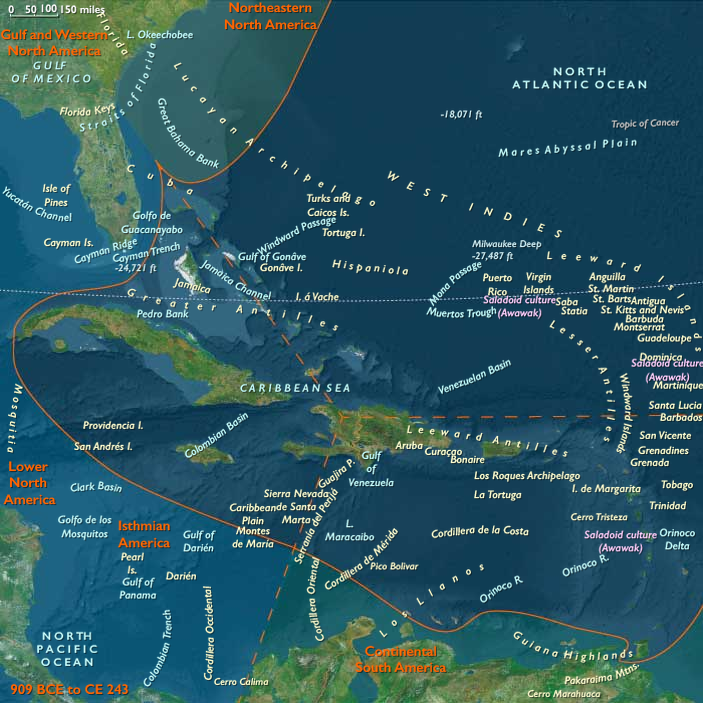
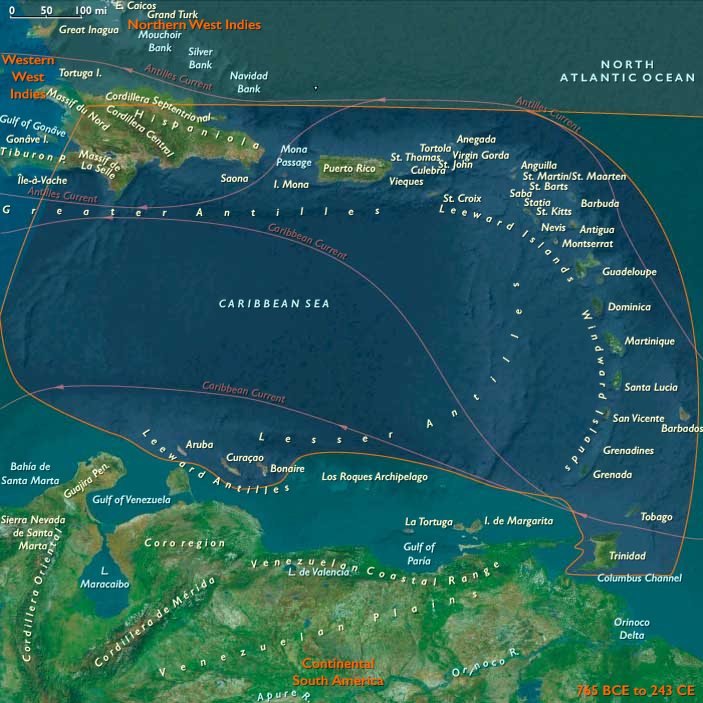
The Arawaks have reached the Greater Antilles (specifically, Puerto Rico) by 200, and have begun to either intermingle with or displace the simple gatherer-society of the Ciboneys.
Locations
Groups
Topics
Subjects
Regions
Subregions
Related Events
Filter results
Showing 10 events out of 24 total
The beginning of Finland's nearly seven hundred-year association with the Kingdom of Sweden is traditionally connected with the year 1154 and the hypothesized introduction of Christianity by Sweden's King Erik.
However, archaeological evidence points to prior Christian influences in southwestern and southeastern Finland and include both western and eastern Christian artifacts.
For example, Finland had been mentioned together with Estonia in a list of Swedish provinces drawn up for the pope in 1120, apparently as a Swedish missionary area.
Sweden's sudden determination to take over Finland has not been explained, but for one reason or another Finland is high on Birger Jarl's agenda.
Finland has become an integrated part of Sweden since there was a lot of exchange between the regions, especially via the Åland archipelago.
During this time, it is easier to travel by sea than by land.
Birger Jarl seems to have headed for Finland just after having both crushed the Folkung uprising of 1247-1248 and finalized the Treaty of Lödöse with Norway earlier in the summer of 1249.
Sweden's previous attempts to gain a foothold in Estonia in 1220 may have urged Sweden to settle for what is still available.
Eric's Chronicle also points out the threat from Russians, mentioning that the "Russian king" had now lost the conquered land.
All details of the crusade are from Eric's Chronicle, which is largely propagandist in nature, written amidst internal unrest and war against Novgorod.
The chronicle has caused a long controversy on the actual target of the expedition, since it presents Tavastians (taffwesta) as the Swedish opponents.
Based on this, it is usually assumed that the target of the crusade was also Tavastia, even though that is not explicitly said in the chronicle.
Tavastians are known to have rebelled against the church in the 1230s, which had resulted in a papal demand for a crusade against them in a letter in 1237.
According to the chronicle, the expedition was prepared in Sweden and then conducted over sea to a land on the coast, where the enemy was waiting.
Since Tavastia was inland, this contradiction was later explained so that there was a Tavastian port somewhere on the coast that was the primary target of the attack.
The Chronicle also mentions that a castle called "taffwesta borg" was established after the war.
There have been many attempts to identify the castle with either Häme Castle or Hakoinen Castle in central Tavastia, but neither has been indisputably dated to such an early period.
The first Swedish garrisons in Finland seem to have been not far from Turku and Koroinen, the fortified church-residence of the early bishops, along the Oxen Way to central Tavastia.
Pope Innocent IV, probably related to preventing other parties from getting involved in the conflict, takes Finland under his special protection in August, 1249, without , however, mentioning Sweden in any way.
Finland's bishop Thomas, probably a Dominican monk, had resigned already in 1245 and died three years later in a Dominican convent in Gotland.
The seat being vacant, the diocese had probably been under the direct command of the papal legate William of Modena, whose last orders to Finnish priests were given in June, 1248.
Swedish Bero had eventually been appointed as the new bishop in 1248/9, presumably soon after William's visit to Sweden for an important church meeting at Skänninge that ended on March 1, 1248.
The so-called "Palmsköld booklet" from 1448 notes that it was Bero who gave Finns' tax to the Swedish king.
Bero comes directly from the Swedish court, as will his two successors.
It seems that Swedish bishops also hold all secular power in Finland until the 1280s nd the establishment of the position of the Duke of Finland.
In 1249, the situation is also seen clear enough to have the first Dominican convent established in Finland.
There had been no monasteries in Finland before this.
The convent is situated next to the bishop's fortification in Koroinen, and will remain here until the end of the century.

The expedition to Finland seems to have cost Birger the Swedish crown as an unexpected side effect.
As King Eric died in 1250 and Birger was still absent from Sweden, the rebellious Swedish lords selected Birger's underaged son Valdemar as the new king instead of the powerful jarl himself.
Sources from 1249 onward generally regard Finland as a part of Sweden.
Diocese of Finland is first listed among the Swedish dioceses in 1253.
The first reliable mention in Russian chronicles of Finns being a part of Swedish forces is from 1256.
However, very little is known about the situation in Finland during the following decades.
Reason for this is partly the fact that Finland was now ruled from Turku and most of the documentation remained there.
As the Novgorod forces burned the city in 1318 during the Swedish-Novgorodian Wars, very little remained about what had happened in the previous century.
Turku, situated at the mouth of the Aurajoki River on the Gulf of Bothnia, about one hundred miles (one hundred and sixty kilometers) northwest of Helsinki, had begun as a trading center just north of its present location and moved south during the thirteenth century; it begins to grow around its castles and cathedral, on which construction begins in 1290.
The oldest city in Finland, it will quickly became the most important city in Finland, a status it will retain for hundreds of years.
The church parishes double as units of local administration, and the church plays the leading role in fostering an educated Finnish leadership and the development of the Finnish language.
For example, the general requirement that parish priests use the indigenous language helps to maintain the speaking of Finnish.
Turku (Swedish, Abo), encompassing the whole country, is the only diocese, and the bishop of Turku is the head of the Finnish church.
The first Finn had been named bishop in 129, and thereafter all incumbents have been native-born.
The southwestern seaport city of Turku, the seat of the bishopric, becomes the administrative capital of Finland.
Turku is also the center of Finland's mercantile life, which is dominated by German merchants of the Hanseatic League.
Finland's main exports at this time are various furs; the trade in naval stores is just beginning.
The only other city of importance at this time Is Viipuri (Swedish, Vyborg), which is significant both as a Hanseatic trade center and as a military bastion that anchors Finland's eastern defenses against the Russians.
The late fifteenth century has witnessed the steady expansion of the power of the Grand Duchy of Muscovy, which will eventually become the basis for the Russian Empire.
In 1478 Grand Duke Ivan III subdues Novgorod and thus brings Muscovite power directly to the border of Finland.
In 1493 Denmark and Muscovy conclude a treaty of alliance aimed at embroiling Sweden in a two-front war, and in 1495 Muscovite forces invade Finland.
Although the fortress city of Viipuri holds out, the Muscovites avoid the city, and, almost unchecked, devastate large areas of Finland's borderlands and interior.
The Swedes make peace with Muscovy in 1497, and the borders of 1323 are reaffirmed, but the Swedish-Finnish nobility has to defend Finland without much direct assistance from Sweden.
Vasa becomes king of Sweden, as Gustav I Vasa, and he founds a dynasty that will rule Sweden-Finland for more than a century.
He is generally credited with establishing the modern Swedish state.
Under his rule, Finland remains integrated with the Swedish state, and the Swedish-Finnish nobility retains its primacy over local affairs.
Sweden and Denmark have been in a state of war against each other from 1451.
A growing opposition against Charles VIII Knutsson has emerged in Sweden because of the devastating conflict.
The Swedish church, which opposes Charles's efforts to concentrate royal and secular power, is his strongest opponent.
Other opponents include the family group of Oxenstierna and Vasa (House), which had been in the opposing side in the election of the king in 1449 and lost.
A rebellion led by Jöns Bengtsson (Oxenstierna), Archbishop of Sweden, and a nobleman, Erik Axelsson Tott, in 1457 deposes Charles, who goes into exile to Danzig (Gdańsk).
The two leaders of the revolt name themselves co-regents, and organize the election of Christian I of Denmark and Norway as king of Sweden (firstly in Turku, later in Stockholm), thus reestablishing the Kalmar Union.
Its emphasis on religious instruction in the vernacular languages supports an increase in literacy, especially after the Ecclesiastical Law of 1686 confirms royal control over the Lutheran Church of Sweden-Finland and charges it with teaching the catechism to each church member.
Another benefit of the Reformation is the founding of Åbo Academy in 1640 to provide theological training for Finnish clergymen.
Åbo Academy is the precursor of the University of Helsinki, which will later become the center of higher education in Finland and the focus of Finland's cultural life.
Agricola had studied under Luther at Wittenberg, and, recognizing the centrality of the Bible in the Reformation, he has undertaken to translate the Bible into Finnish.
Agricola' s translation of the New Testament is published in 1548.
He writes other religious works and translates parts of the Old Testament as well.
Because Finnish had not appeared previously in print, Agricola is regarded as the father of the Finnish literary language.
After 1554 he serves as the bishop of Turku, the highest office of the Finnish church.