
The Archbishopric of Hamburg, created in 843, …
Years: 843 - 843
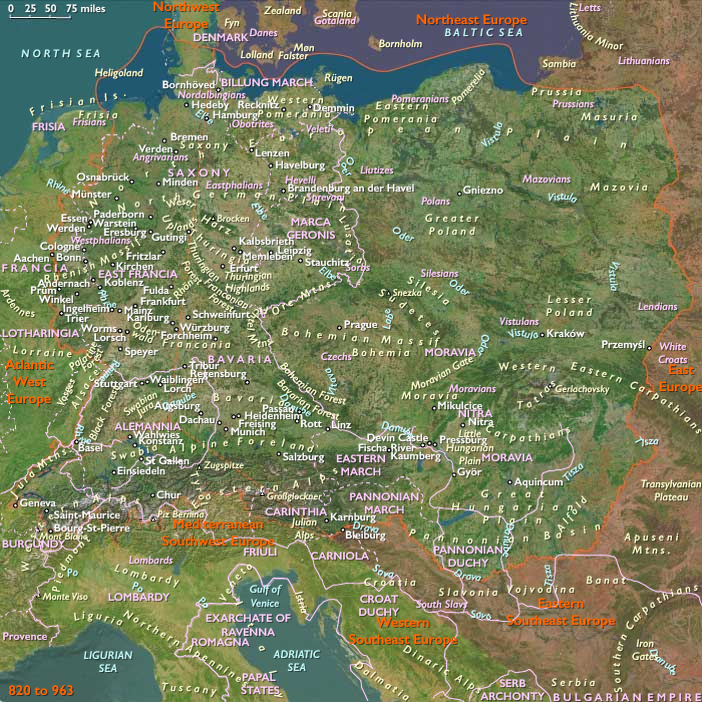
The Archbishopric of Hamburg, created in 843, is charged with the mission of Christianizing Scandinavia.
Locations
People
Groups
- Polytheism (“paganism”)
- Franks
- Christianity, Chalcedonian
- Francia (Carolingians)
- Frankish, or Carolingian (Roman) Empire
- Danes (Scandinavians)
- Hamburg, Archbishopric of, and Bremen, Bishopric of
Topics
Subjects
Regions
Subregions

Related Events
Filter results
Showing 10 events out of 77 total
Broad Overview of High Medieval Atlantic West Europe (1108–1251 CE): Northern & Western France and the Low Countries
From 1108 to 1251, Atlantic West Europe—which includes northern and western France as well as the Low Countries (modern Netherlands, Belgium, and Luxembourg)—underwent profound transformations in political power, economic expansion, military conflicts, and cultural development.
This period saw:
- The consolidation of Capetian power in France, particularly under Philip II Augustus (r. 1180–1223) and Louis IX (r. 1226–1270).
- The decline of Plantagenet (Angevin) control in western France, culminating in the loss of Normandy, Anjou, and Poitou to the French Crown (1204–1259).
- The economic rise of the Low Countries, especially in Flanders, Brabant, and Holland, as centers of textile production and trade.
- The growing power of Burgundy, Champagne, and Lorraine, balancing between French royal authority and the Holy Roman Empire.
1. Political and Military Developments
The Capetian Expansion and the Decline of the Angevin Empire
- Philip II Augustus (r. 1180–1223) decisively defeated John of England, reclaiming Normandy, Anjou, Maine, and Poitou (1204).
- The Battle of Bouvines (1214), where Philip defeated an English-Flemish-Imperial coalition, solidified French dominance in the north.
- The Battle of Taillebourg (1242) further weakened English influence in Gascony and Poitou.
- Despite these victories, Gascony remained under English control, leading to ongoing Franco-English tensions.
The Low Countries: A Political and Economic Powerhouse
- Flanders and Brabant became crucial economic hubs, balancing alliances between France, England, and the Holy Roman Empire.
- The War of the Succession of Flanders (1185–1206) saw French intervention, culminating in Philip II’s victory over Count Baldwin IX of Flanders.
- Burgundy, Champagne, and Lorraine remained contested borderlands between France and the Empire, with frequent feudal conflicts.
- The Stedinger Crusade (1232–1234) in northwestern Germany saw the suppression of Frisian settlers resisting noble authority.
2. Economic and Urban Expansion
The Low Countries: The Rise of a Commercial Power
- Flanders, Brabant, and Holland became leading trade and textile centers, with major cities such as:
- Bruges and Ghent (Flanders) – Textile production and trade hubs.
- Brussels and Antwerp (Brabant) – Growing financial centers.
- Dordrecht and Haarlem (Holland) – Maritime and fishing economies.
- The Hanseatic League began expanding into Dutch and Flemish waters, increasing Baltic-North Sea trade links.
France: Regional Economic Growth
- Champagne Fairs (held in cities like Troyes and Provins) became key international trade markets, connecting merchants from Italy, Spain, and the Low Countries.
- Bordeaux and La Rochelle emerged as maritime trade centers, linking France to England and the Mediterranean.
- Wine production flourished in Gascony and Burgundy, fueling export economies.
3. Religious and Cultural Developments
Gothic Architecture and the High Middle Ages Cultural Boom
- Major cathedrals were constructed across the region, marking the height of French High Gothic and Rayonnant styles:
- Notre-Dame de Paris (begun 1163, completed c. 1240s)
- Reims Cathedral (begun 1211) – Coronation site of French kings.
- Amiens Cathedral (begun 1220) – Tallest of the High Gothic cathedrals.
- Sainte-Chapelle (1246–1248) – Built by Louis IX to house relics from Constantinople, showcasing the height of Rayonnant Gothic.
The Inquisition and Religious Tensions
- The Albigensian Crusade (1209–1229) led to the fall of the Cathar heresy in Languedoc, strengthening Capetian control over southern France.
- Pope Gregory IX formally established the Papal Inquisition in 1231, appointing Robert le Bougre ("Hammer of Heretics") as an inquisitor in Burgundy.
- In 1242, Christian zealots burned 24 cartloads of Talmud manuscripts in Paris, marking a period of increasing institutionalized anti-Jewish policies.
The Rise of Universities and Intellectual Thought
- The University of Paris became a leading center of Scholasticism, with thinkers like:
- Alexander of Hales, who introduced Aristotelian logic into theology.
- William of Auvergne, who worked to reconcile Augustine with Aristotle.
- The University of Orléans emerged around 1230, as a center of legal studies, focusing on Roman and canon law.
- Johannes de Sacrobosco’s Tractatus de Sphaera (c. 1230) became the leading astronomical text of the era.
4. The Strengthening of Monarchical Authority
France: The Rise of a Centralized State
- Philip II Augustus expanded royal justice, limiting noble autonomy.
- Louis IX (Saint Louis) sent enquêteurs (royal commissioners) in 1247 to investigate local governance, ensuring administrative accountability.
- The French monarchy increased control over taxation and trade, strengthening its financial power.
Burgundy, Champagne, and Lorraine: Balancing Between France and the Empire
- Burgundy remained a semi-independent duchy, balancing feudal allegiances between France and the Holy Roman Empire.
- The War of the Succession of Champagne (1216–1222) highlighted tensions between French royal influence and regional autonomy.
- In Lorraine, Theobald I’s rebellion against Frederick II (1218) led to a brief imperial occupation and restructuring of local power.
The Low Countries: Increasing Autonomy
- The Counts of Flanders and Holland navigated a delicate balance between England and France, using their economic power to resist complete subjugation.
- Haarlem (1245) and Delft (1246) received city rights, reflecting the increasing urban autonomy and self-governance of Dutch cities.
Conclusion: The Transformation of Atlantic West Europe by 1251
By 1251, northern and western France and the Low Countries had undergone profound transformations:
- Capetian France had become the dominant power, solidifying control over Normandy, Anjou, and Poitou while increasing royal administration.
- England had lost most of its continental holdings, retaining only Gascony, leading to a shift in its focus toward maritime power and internal governance.
- The Low Countries had risen as economic centers, with cities like Bruges, Ghent, and Antwerp becoming major trading hubs.
- Burgundy, Champagne, and Lorraine remained contested border regions, balancing imperial and French influences.
- Religious, architectural, and intellectual advancements flourished, positioning the region at the heart of medieval European culture and governance.
These changes set the stage for the Late Middle Ages, shaping the Hundred Years’ War, the continued growth of urban economies, and the increasing centralization of power in France and the Low Countries.
The Reign of Louis VI and the Capetian Expansion (1108–1137)
With the accession of Louis VI in 1108, the Capetian dynasty consolidated its hold over the Île-de-France, while extending its influence into the broader Frankish realm. Unlike his predecessors, who struggled to assert control over the powerful feudal lords, Louis VI actively engaged in campaigns to subdue rebellious vassals, particularly in regions bordering Atlantic West Europe, such as Normandy, Anjou, and Aquitaine. His reign marked a gradual strengthening of royal authority, often in alliance with the Church, which saw the king as a protector against unruly barons.
One of Louis VI's most significant conflicts was with Henry I of England, whose control over Normandy placed French royal interests in direct opposition to the Anglo-Norman realm. The battle for dominance in Normandy became a recurring struggle between the Capetians and the Angevin rulers of England, setting the stage for centuries of conflict. Although the French monarchy remained weaker than its Anglo-Norman rival, Louis VI laid the groundwork for Capetian resilience, particularly through the use of strategic marriages and alliances.
His son, Louis VII, inherited the throne in 1137, bringing with him a union that would momentarily strengthen Capetian claims—his marriage to Eleanor of Aquitaine, the most powerful noblewoman in France.
Philip II and the Collapse of the Angevin Empire (1180–1223)
The ascension of Philip II Augustus in 1180 marked a turning point in the balance of power. Unlike his predecessors, Philip II aggressively pursued policies aimed at dismantling Angevin dominance. Through careful diplomacy and military campaigns, he exploited the internal divisions among Henry II's heirs, particularly after Richard I’s death in 1199 and the succession crisis involving John of England.
Philip’s decisive victory at the Battle of Bouvines in 1214 crushed Anglo-Angevin ambitions in Normandy, permanently integrating it into the French crown. The subsequent loss of Anjou, Maine, and Touraine weakened English influence on the continent, leaving Aquitaine as the last major English holding in Atlantic West Europe.
Philip's reign also saw the expansion of royal institutions, including the bailliage system, which increased the crown’s control over provincial administration, laying the foundation for a centralized French monarchy.
The Angevin Empire and the Capetian Rivalry (1137–1189)
The marriage of Louis VII and Eleanor of Aquitaine initially seemed to bolster Capetian influence in Atlantic West Europe, as the vast territories of Aquitaine, Poitou, and Gascony fell under the French crown. However, the union was fraught with tensions, as Eleanor’s independent nature and close ties to her homeland clashed with Louis' pious and restrained character. Their marriage ended in annulment in 1152, allowing Eleanor to marry Henry Plantagenet, the soon-to-be Henry II of England. This union created the Angevin Empire, a vast territorial network spanning from England to Normandy, Anjou, and Aquitaine, posing a direct threat to Capetian authority.
Under Henry II (r. 1154–1189), the Angevin Empire became the dominant power in Western Europe. His legal reforms, administrative restructuring, and military campaigns reinforced his control over Atlantic West Europe, particularly in Brittany, Maine, and Poitou. However, Henry's ambitions clashed with both his sons and the Papacy. The assassination of Thomas Becket, Archbishop of Canterbury, in 1170 weakened Henry's standing with the Church, while internal rebellions among his sons—Richard the Lionheart, John Lackland, and Geoffrey of Brittany—destabilized the realm.
Despite these struggles, the Angevin presence in Atlantic West Europe remained formidable, setting the stage for continued conflict with the Capetians.
Atlantic West Europe (1132–1143): Dynastic Tensions, Economic Expansion, and Cultural Flourishing
Between 1132 and 1143, Atlantic West Europe—which includes the Low Countries, Brittany, Normandy, Aquitaine, Burgundy, central France, Alsace, and Franche-Comté—underwent significant changes marked by dynastic tensions, continued economic expansion, and dynamic cultural developments.
Political and Military Developments
-
France: Capetian Consolidation and Baronial Struggles
-
Louis VI (r. 1108–1137) continued to strengthen royal authority but faced persistent opposition from powerful feudal barons.
-
His successor, Louis VII (r. 1137–1180), inherited a stronger monarchy but encountered immediate challenges in maintaining royal dominance.
-
-
Normandy and England: Succession Crisis Intensifies
-
Following Henry I's death (1135), Normandy and England plunged into a succession crisis between Stephen of Blois and Matilda (daughter of Henry I), sparking the protracted conflict known as "The Anarchy."
-
-
Aquitaine: Ducal Authority and Expansion
-
William X (r. 1127–1137) maintained Aquitaine’s cultural prestige and political autonomy.
-
Upon his death, his daughter Eleanor became duchess (r. 1137–1204), significantly altering the political landscape of the region.
-
-
Brittany and Burgundy: Continued Autonomy
-
Brittany under Conan III (r. 1112–1148) preserved its autonomy, navigating diplomatic complexities between Normandy and France.
-
Burgundy, led by Duke Hugh II (r. 1103–1143), remained internally stable and retained local governance structures.
-
Economic and Social Developments
-
Expansion of Trade and Urbanization
-
Major cities like Bruges, Ghent, and Ypres continued flourishing, further integrating into broader European trade networks, especially textiles and wool trade.
-
The Champagne fairs grew increasingly influential as international commercial hubs, facilitating exchange between northern and southern Europe.
-
-
Agricultural Advances and Population Growth
-
Agricultural productivity increased due to improved farming techniques, supporting sustained population growth and greater urbanization.
-
Cultural and Intellectual Developments
-
Flourishing Scholasticism
-
Scholasticism thrived, especially at the University of Paris, attracting scholars such as Peter Abelard, whose philosophical and theological works gained widespread attention.
-
-
Literary and Troubadour Traditions
-
Eleanor of Aquitaine's accession reinforced Aquitaine's cultural prominence, fostering troubadour poetry and music, significantly influencing European literature and courtly culture.
-
Religious Developments
-
Monastic Growth and Influence
-
The expansion of the Cistercian order continued rapidly, with Clairvaux Abbey under Bernard of Clairvaux becoming particularly influential in religious and political affairs.
-
Monasteries remained crucial economic and cultural centers, promoting reform and spiritual renewal.
-
Legacy and Significance
The period from 1132 to 1143 saw intensified dynastic struggles, notably the English-Norman succession crisis, alongside ongoing economic prosperity and cultural dynamism. These developments significantly influenced the region’s political landscape, shaping Atlantic West Europe's trajectory into the High Middle Ages.
The Marriage of Eleanor of Aquitaine and the Death of Louis VI (1137 CE)
In 1137, William X, Duke of Aquitaine, nearing death, made a decisive move to secure his daughter's inheritance and the future of his duchy. Just before dying, he appointed King Louis VI of France as the guardian of his only child and heir, Eleanor of Aquitaine, and expressed his wish for her to marry the French king’s son.
This arrangement was a stunning political victory for Louis VI, as it presented an opportunity to merge the vast, independent Duchy of Aquitaine with the Capetian royal domains, vastly expanding the power of the French crown.
The Marriage of Eleanor and the Future Louis VII
- Eleanor was swiftly married on July 25, 1137, to Prince Louis, the second son of Louis VI and Adelaide of Maurienne.
- Louis had only recently become the heir after the accidental death of his older brother, Philip, in 1131.
- The union was a political masterstroke, as it theoretically placed Aquitaine under Capetian control, making the French king’s realm far larger and more powerful.
However, the Duchy of Aquitaine remained a semi-independent territory, as Eleanor was still expected to rule her lands separately from the direct administration of the French crown.
The Death of Louis VI and the Ascension of Louis VII
- Just days after the wedding, Louis VI succumbed to dysentery, dying on August 1, 1137, at Béthisy-Saint-Pierre, near Senlis and Compiègne.
- His death marked the end of a long and successful reign (1108–1137), during which he had consolidated Capetian authority, strengthened the monarchy, and defended against external and internal threats.
- His eldest surviving son, Louis VII, ascended to the throne, now ruling alongside Eleanor, whose inheritance made the Capetian dynasty vastly wealthier and more influential.
The Significance of the Union
- The marriage of Eleanor and Louis VII created the largest territorial expansion of Capetian power to date, at least on paper.
- However, the independence of Aquitaine’s nobility and Eleanor’s strong-willed personality would eventually strain the union, leading to long-term consequences for France.
- Eleanor’s remarkable life, including her eventual divorce from Louis VII and later marriage to Henry II of England, would dramatically reshape the political map of France and England for generations.
Though Louis VI died before he could witness the full effects of the union, his strategic marriage alliance with Aquitaine represented one of his greatest political achievements, securing Capetian dominance in France—at least for a time.
The Accession of Louis VII and the Influence of Eleanor of Aquitaine (1137 CE)
Following the death of Louis VI on August 1, 1137, Prince Louis ascended the throne as King Louis VII of France. He was formally interred in the Basilica of Saint-Denis, the royal necropolis of the Capetian dynasty.
Louis VII’s Early Years and Ecclesiastical Background
- Louis VII’s education had been intended for the Church, as he was originally expected to pursue an ecclesiastical career rather than kingship.
- Much of his youth was spent in Saint-Denis, where he developed a close friendship with Abbot Suger, a relationship that would prove vital in his early years as king.
- His unexpected rise to the throne following the death of his older brother Philip in 1131 meant that he had to abruptly shift from monastic studies to rulership, a transition that deeply shaped his pious and cautious nature.
The Role of Eleanor of Aquitaine: A Force at Court
- Eleanor of Aquitaine, whom Louis had married just days before his father’s death, was one of the most politically astute and ambitious women of her era.
- At court, Eleanor displayed a genius for cunning and intrigue, often meddling in royal policy in ways that undermined her husband’s authority.
- Her strong personality and political ambition would clash with Louis’ more passive and devout nature, causing long-term tensions in their marriage and governance.
Experienced Counselors: Abbot Suger and Ralph of Vermandois
Fortunately for Louis, he inherited a prosperous and well-pacified royal domain, largely due to the firm rule of his father, Louis VI. He was also aided by two of the most capable statesmen of his time:
-
Abbot Suger of Saint-Denis
- As a trusted advisor and statesman, Suger played a key role in maintaining the stability of the French monarchy.
- His deep understanding of administration, finance, and diplomacy ensured that Louis VII had a steady hand guiding royal policy.
- Suger was a proponent of Capetian prestige, overseeing the reconstruction of Saint-Denis and promoting the sacred image of the monarchy.
-
Ralph I of Vermandois (Seneschal of France)
- A first cousin of Louis VI and cousin once removed of Louis VII, Ralph was one of the most powerful nobles in France.
- As Seneschal of France, he was responsible for overseeing the royal household and military affairs, making him one of the most influential figures at court.
- His political experience helped Louis VII navigate the complex feudal landscape of medieval France.
The Foundations of Louis VII’s Reign
- Louis VII began his reign with a strong, stable kingdom, thanks to the legacy of Louis VI’s territorial consolidation and military successes.
- His reign would, however, be dominated by tensions with Eleanor, conflicts with the Papacy, and disputes with the Angevin dynasty, leading to long-term consequences for the Capetian monarchy.
- The early years of Louis VII’s rule would be marked by the continued guidance of Abbot Suger and Ralph of Vermandois, but his marriage to Eleanor would eventually drive the kingdom toward internal strife and external conflict.
While Louis VII inherited one of the strongest Capetian monarchies to date, the challenges posed by his marriage to Eleanor and the rising power of the Angevins would shape his reign in unexpected ways.
The Early Reign of Louis VII and His Conflicts with Eleanor and the Papacy (1141 CE)
From the beginning, the marriage between Louis VII of France and Eleanor of Aquitaine was doomed to failure. Their opposing personalities and cultural backgrounds created immediate tensions in the marriage.
- Louis VII, having been educated for an ecclesiastical career, was pious, austere, and reserved, traits unsuited to his spirited and ambitious wife.
- Eleanor, raised in the sophisticated and lively court of Aquitaine, found the northern French court dull and restrictive.
- She is reported to have once mockingly declared:
"I thought I had married a king, only to find I had married a monk."
This cultural and personal mismatch would later lead to one of the most famous royal divorces in history.
Political Stability and Urban Unrest
- Louis VII’s accession in 1137 was largely peaceful, with no major disturbances.
- However, there were uprisings in Orléans and Poitiers, where the burgesses attempted to establish communes.
- These communal movements, inspired by urban self-governance efforts elsewhere in France, were a challenge to Capetian royal authority, but they were suppressed without significant long-term consequences.
Conflict with Pope Innocent II Over the Archbishopric of Bourges (1141)
Despite his early peaceful succession, Louis VII soon came into violent conflict with Pope Innocent II over a major investiture dispute in 1141:
- The Archbishopric of Bourges became vacant upon the death of Alberich of Reims.
- Louis VII supported Cadurc, his chancellor, as the new archbishop.
- Pope Innocent II, however, appointed Pierre de la Châtre, leading to a direct confrontation.
Louis VII swore upon relics that Pierre would never enter Bourges as long as he lived, an unprecedented act of defiance against the Pope.
- In retaliation, Pope Innocent II placed an interdict on France, severely undermining Louis’s religious authority and damaging his reputation.
- This interdict deepened the rift between the Capetian monarchy and the Papacy, setting the stage for future conflicts with the Church.
Consequences and Long-Term Impact
- The conflict with Innocent II weakened Louis’s position and marked the first significant crisis of his reign.
- Eleanor’s discontent continued to grow, as she resented her husband’s passive, monastic approach to kingship.
- The unresolved tensions between royal authority, urban communes, and the Church foreshadowed further struggles for Capetian rule in the 12th century.
Though Louis VII’s early reign was not marked by major wars, his internal struggles—both political and personal—would shape the course of French history, particularly through his troubled marriage to Eleanor of Aquitaine and his tense relationship with the Papacy.
The Ralph of Vermandois Marital Scandal and the War with Champagne (1142–1143 CE)
In 1142, under pressure from Queen Eleanor of Aquitaine, King Louis VII of France allowed his powerful cousin Ralph I of Vermandois to repudiate his first wife, Eleanor of Blois, in favor of Petronilla of Aquitaine, Eleanor of Aquitaine’s younger sister. This politically motivated annulment triggered a diplomatic and military crisis in France, culminating in a war with Theobald II of Champagne and an excommunication from the papacy.
The Political and Familial Tensions Behind the Annulment
- Ralph of Vermandois was a high-ranking noble and seneschal of France, making his marriage alliances crucial to Capetian politics.
- His first wife, Eleanor of Blois, was the daughter of Stephen, Count of Blois, and Adela of Normandy, making her the sister of King Stephen of England.
- Eleanor of Aquitaine and her sister Petronilla sought greater power at court, and Eleanor persuaded Louis VII to arrange for Ralph to marry Petronilla.
- This required annulling Ralph’s first marriage, which was facilitated by three bishops, but their ruling was quickly overruled by Pope Innocent II.
The War with Theobald II of Champagne
- Theobald II of Champagne, Eleanor of Blois’ brother, vehemently opposed the repudiation of his sister and sought papal support to challenge it.
- Innocent II excommunicated Ralph and Petronilla, declaring their marriage illegitimate, further escalating tensions.
- In retaliation, Louis VII launched a military campaign against Theobald, attacking Champagne and its allies.
- The war led to the infamous burning of Vitry, where over 1,000 people seeking refuge in a church were burned alive, a deeply regrettable act for Louis that would later push him toward a penitential Crusade.
Resolution: Papal Intervention and the Legitimization of Ralph’s Marriage (1143 CE)
- The war and excommunication persisted until the death of Pope Innocent II in 1143.
- His successor, Pope Celestine II, took a more conciliatory approach, lifting the excommunication and sanctifying Ralph and Petronilla’s marriage.
- The conflict weakened Louis VII’s relations with the Church and the Champagne nobility, setting the stage for future tensions within the Capetian realm.
Impact of the Scandal
- Eleanor of Aquitaine’s influence over Louis VII became even more pronounced, increasing her role in shaping Capetian policies.
- The war with Champagne demonstrated Louis VII’s willingness to challenge noble autonomy, but it also alienated many powerful vassals.
- The burning of Vitry weighed heavily on Louis VII’s conscience, contributing to his later decision to lead the ill-fated Second Crusade (1147–1149).
The Ralph of Vermandois marriage scandal was more than a personal affair—it was a political crisis that entangled the French monarchy in war, excommunication, and lasting noble unrest.
The War with Champagne and the Burning of Vitry-le-François (1142–1144 CE)
The conflict between King Louis VII of France and Theobald II of Champagne was further complicated by the ongoing dispute over the Archbishopric of Bourges. Theobald had aligned himself with Pope Innocent II, deepening the rift between the Capetian monarchy and the papacy.
The war escalated dramatically, culminating in the royal army’s occupation of Champagne and one of the most notorious atrocities of Louis VII’s reign—the burning of Vitry-le-François, in which over a thousand civilians perished in the flames.
The Siege and Burning of Vitry-le-François (1143 CE)
- The royal army invaded Champagne, with Louis VII personally leading the assault.
- At Vitry-le-François, the town was besieged and set ablaze.
- More than 1,000 people, who had sought refuge in the church, were burned alive in one of the most shocking acts of the war.
- The horror of the massacre left Louis VII deeply shaken, leading to a spiritual and political crisis.
Louis VII’s Retreat and Reconciliation with the Papacy (1144 CE)
- Overcome with guilt for the massacre at Vitry, and humiliated by the Church’s condemnation, Louis VII admitted defeat in the war against Champagne.
- He withdrew his armies and returned Champagne’s lands to Theobald II, effectively ending the hostilities.
- To restore relations with the Papacy, Louis finally accepted Pierre de la Châtre as Archbishop of Bourges, bringing an end to their longstanding investiture dispute.
- As a further act of penance, Louis shunned Raoul of Vermandois and Petronilla of Aquitaine, whose marriage had originally sparked the war.
Consequences and Lasting Impact
- The burning of Vitry profoundly affected Louis VII, strengthening his desire for atonement, which later influenced his decision to lead the ill-fated Second Crusade (1147–1149).
- His defeat in Champagne and reconciliation with the Papacy marked a humbling moment for the young king, reinforcing the limits of Capetian power over rebellious nobles.
- The alienation of Eleanor of Aquitaine, due to his repudiation of Petronilla, further strained their already troubled marriage, ultimately setting the stage for their later divorce (1152).
Though Louis VII retained the French throne, the war with Champagne had exposed his military recklessness, his fraught relationship with the Papacy, and the growing influence of Eleanor in Capetian politics—all factors that would shape the rest of his reign.
Years: 843 - 843
Locations
People
Groups
- Polytheism (“paganism”)
- Franks
- Christianity, Chalcedonian
- Francia (Carolingians)
- Frankish, or Carolingian (Roman) Empire
- Danes (Scandinavians)
- Hamburg, Archbishopric of, and Bremen, Bishopric of
Topics
Subjects
Regions
Subregions