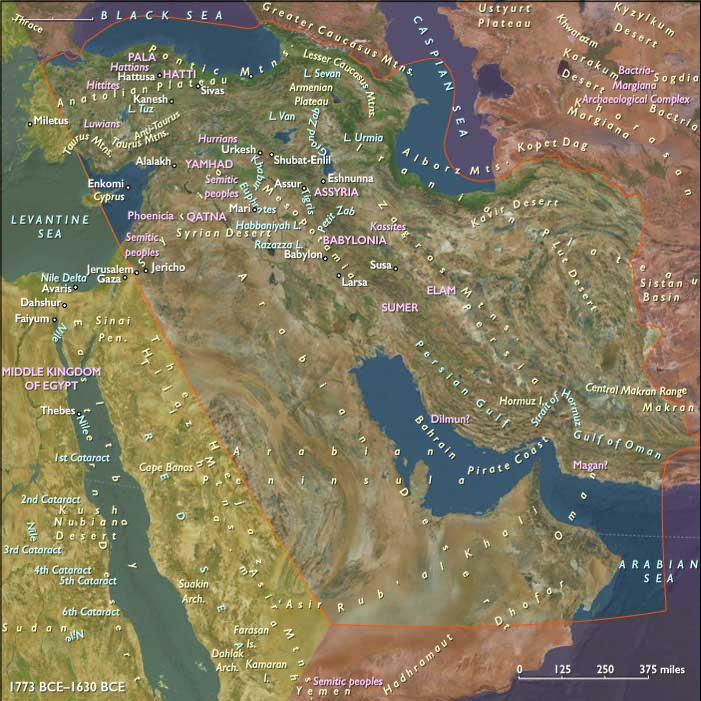
The Middle East: 1773–1630 BCE
Hammurabi's Legacy, Cultural Integration, and Expanding Influence
Hammurabi’s Legal and Cultural Innovations
The civilizing trends initiated at Sumer evolved dramatically during the reign of Hammurabi (1792–1750 BCE). His sophisticated legal principles, encapsulated in the Code of Hammurabi, reflect a highly advanced civilization, revealing social interactions extending far beyond kinship bonds. Hammurabi's laws, encompassing commerce, land tenure, marital laws, inheritance, debt, public order, and labor conditions, illustrate a diversified economy and extensive trade networks. Politically, Hammurabi's code further delineates religious authority from secular governance, signifying a maturation of Mesopotamian administrative complexity.
Babylon's Cultural and Urban Ascendancy
Babylon, capital of Babylonia, becomes the world's largest city by approximately 1770 BCE, surpassing Thebes in Egypt. Babylonian scholars significantly advance astronomy, and cuneiform evolves into a more flexible syllabic script, enhancing literacy and communication across the region. Babylonian architecture also flourishes, characterized by massive brick platforms and the iconic ziggurat structures.
Amorite Integration and Linguistic Evolution
By 1700 BCE, the Semitic Amorite language fully replaces Sumerian, though Akkadian cuneiform remains the lingua franca of the Near East, influencing other regional languages, including those of the Kassites, Hittites, Hurrians, and later Persians. Amorite culture integrates deeply with surviving Sumerian traditions, preserving administrative, architectural, and economic institutions.
Rise and Fall of Mari under Zimrilim
Mari experiences a second golden age under King Zimrilim (c. 1701 BCE), who expands the city-state’s influence along the Euphrates and Khabur valleys. Zimrilim’s extensive palace, boasting over three hundred rooms, exemplifies the prosperity of Mari, vividly decorated with murals. Despite earlier alliances, Mari is ultimately destroyed by Hammurabi around 1687 BCE, marking the end of its prominence.
Trade Networks and Regional Dynamics
Trade networks continue to evolve, illustrated by the wealth of maritime trade centers such as Dilmun, though its economic significance declines around 1800 BCE due to emerging alternative routes linking India directly with Mediterranean ports through the Red Sea. Meanwhile, Cyprus (Alashiya) becomes a key player in Mediterranean trade, exporting copper and fostering cosmopolitan settlements.
Assyrian Decline and Anatolian Transformations
In Anatolia, significant upheaval occurs around 1740 BCE when the prosperous trade city Kanesh (Kültepe) is again destroyed by fire, disrupting Assyrian trading colonies (karum) that had thrived since its re-establishment in 1798 BCE. Concurrently, the Indo-European-speaking Hittites consolidate control, adopting Akkadian cuneiform for inscriptions, notably under rulers such as Anitta of Nesa.
Hurrian Expansion and Influence
The Hurrians, originally from the Khabur River Valley and speaking a distinct agglutinative language, expand westward into northern Syria by 1725 BCE, notably into cities such as Alalakh (Tell Atchana). Their adoption of Akkadian cuneiform script integrates them further into regional culture, significantly influencing the linguistic and cultural landscapes.
Kassite Incursions and Elamite Influence
The Kassites, originating in the Zagros Mountains, begin periodic incursions into Mesopotamia around the mid-second millennium BCE. Initially repelled by Babylonian rulers like Samsu-iluna (1749–1712 BCE), their continued presence heralds future political shifts. Simultaneously, Elamite influence peaks under the Epartid dynasty (c.1900–1700 BCE)in Susa, notably under rulers like Siwe-Palar-Khuppak and Kudur-Nahhunte, before being driven back by Babylon.
Babylonian Cultural and Scientific Contributions
Babylonians excel in mathematics, capable of solving quadratic and cubic equations. Their base-60 arithmetic system greatly simplifies computations, surpassing contemporary Egyptian methods. Babylonian astrology, encapsulated in texts like the Enuma Anu Enlil, also emerges prominently during this period, emphasizing celestial phenomena and their purported influences.
Religious Developments and Urban Life
The worship of Marduk, Babylon’s chief deity, gains prominence during Hammurabi’s reign, centralizing Babylonian religious identity around the myth of creation detailed in the Enuma Elish. In daily life, Babylonians adopt garments such as ankle-length tunics and fringed shawls, influencing later cultures significantly. Veterinary practices also emerge in written records, underscoring the civilization's complexity and attention to practical needs.
This era sees an integration of diverse cultures, significant scientific advancements, and substantial political restructuring, setting the stage for subsequent empires and cultural evolution in the ancient Middle East.