
The Assyrians under Ashur-uballit stage a successful …
Years: 1353BCE - 1342BCE
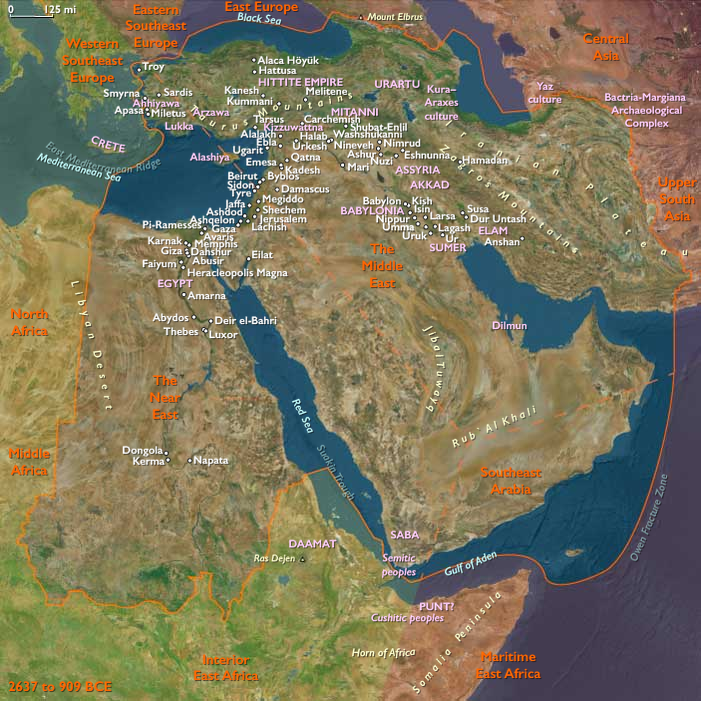
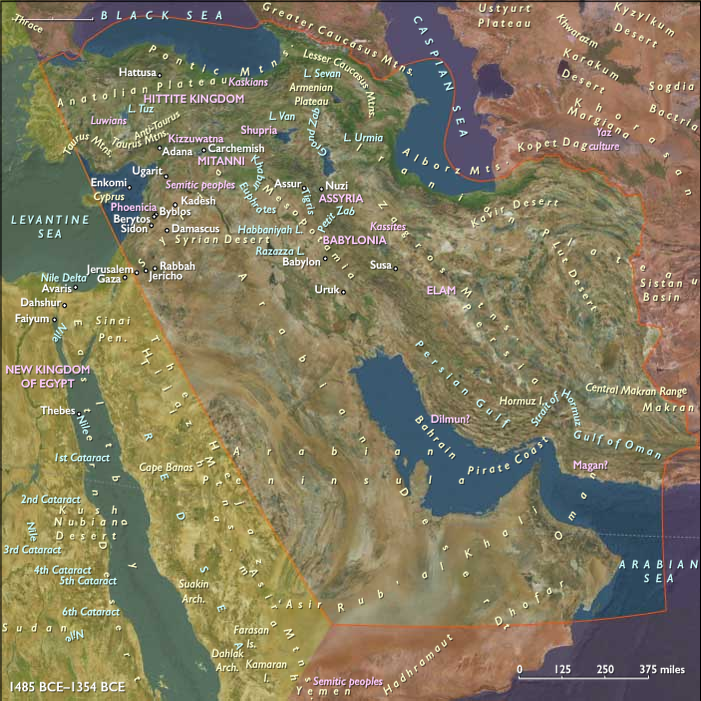
The Assyrians under Ashur-uballit stage a successful revolt against their Mitanni overlords to the west around 1350.
The Hittites simultaneously invade the Mitanni state, already weakened by the Hittite victory of 1380, ending the kingdom.
People
Groups
- Mesopotamia
- Mitanni (Hanigalbat), Kingdom of
- Hittites (Hittite Empire), (New) Kingdom of the
- Assyria, (Middle) Kingdom of
Topics
- Subboreal Period
- Hittite Conquest of Anatolia
- Hittite-Hurrian Wars
- Late Bronze Age I and II A (Near and Middle East)
- Assyrian-Hurrian Wars
- Younger Subboreal Period
Commodoties
Subjects
Regions
Subregions
Related Events
Filter results
Showing 10 events out of 138 total
The Habsburg Empire continues to expand in the east at Turkish expense, but Charles VI recognizes that defense of Austria's position in Europe requires greater economic and political centralization to foster the development of a stronger economic base.
Because he lacks a male heir, however, the continued unity of the Habsburg Empire is jeopardized.
In 1713 Charles promulgates the Pragmatic Sanction to establish the legal basis for transmission of the Habsburg lands to his daughter Maria Theresa (r. 1740-80).
The price extracted by local diets and rival European powers for approval of the Pragmatic Sanction, however, is abandonment of many centralizing reforms.
Nonetheless, Charles's concessions does not prevent the War of the Austrian Succession (1740-48) from breaking out on his death in 1740.
Prussia occupies Bohemia's Silesian duchies this same year.
Late in 1741, the elector-prince of Bavaria, Charles Albert, occupies Prague, the capital of Bohemia, with the aid of Saxon and French troops and is crowned king of Bohemia.
This paves the way for his election as Holy Roman Emperor in 1742, thus breaking the Habsburgs' three-hundred-year hold on the imperial crown.
The Prussian king, Frederick II, joined by the dukes of Bavaria and Saxony, invades the Bohemian Kingdom in 1741.
The duke of Bavaria, Charles Albert, is proclaimed king by the Czech nobility.
Although Maria-Theresa regains most of the Bohemian Kingdom and is crowned queen in Prague in 1743, all of the highly industrialized territory of Silesia except for Tesm, Opava, and Krnov is ceded to Prussia.
In attempting to make administration more rational, Maria-Theresa embarks on a policy of centralization and bureaucratization.
What remains of the Bohemian Kingdom is now merged into the Austrian provinces of the Habsburg realm.
The two separate chancelleries are abolished and replaced by a joint Austro-Bohemian chancellery.
The Czech estates are stripped of the last remnants of their political power, and their functions are assumed by imperial civil servants appointed by the queen.
The provinces of the Czech and Austrian territories are subdivided into administrative districts.
German becomes the official language.
Further reforms introduced by Maria-Theresa and Joseph II reflect such Enlightenment principles as the dissolution of feudal social structures and the curtailment of power of the Catholic Church.
Maria-Theresa nationalizes and Germanizes the education system, eliminates Jesuit control, and shifts educational emphasis from theology to the sciences.
Serfdom is modified: robota (forced labor on the lord's land) is reduced, and serfs can marry and change domiciles without the lord's consent.
Joseph II abolishes serfdom altogether.
Joseph's Edict of Toleration extends freedom of worship to Lutherans and Calvinists in 1781 .
The Austrians, however, retake Prague, and Maria Theresa is crowned queen of Bohemia in the spring of 1743.
Aided by a British diplomatic campaign, Austria also makes important military gains in Central Europe.
Thus, when Charles Albert unexpectedly dies in January 1745, his son makes peace with Austria and agreed to support the Habsburg candidate for emperor.
This enables Maria Theresa's husband, Franz (r. 1745-65), to be elected Holy Roman emperor in October 1745.
In the west, the war with France and Spain gradually settles into a military stalemate, and negotiations finally lead to the Peace of Aix-la-Chapelle in 1748.
Although Maria Theresa emerges with most of her empire intact owing largely to the early support she receives from Hungarian nobles—Austria is obliged to permanently cede Silesia, its most economically advanced territory, to Prussia.
Recognizing that the costly war with France has done more to promote British colonial interests in North America than its own interests in Central Europe, Austria abandons its partnership with Britain in favor of closer ties with France.
This reversal of alliances is sealed by the marriage of Maria Theresa's youngest daughter, Marie Antoinette, to the future Louis XVI of France.
Frederick seizes Silesia, a wealthy province that belongs to the Habsburgs and has a population of about one million inhabitants, in 1740.
Maria Theresa (r. 1740-80), the new Habsburg empress, is unable to regain possession of Silesia, which remains under Prussian control at the end of the War of the Austrian Succession (1740-48).
Frederick retains Silesia even after facing a coalition of France, Austria, and Russia during the Seven Years' War (1756-63).
Frederick expands Prussian territory still further in 1772, when, with his erstwhile enemies Russia and Austria, he takes part in the First Partition of Poland.
This last seizure is highly beneficial to Frederick because it links eastern Prussia with much of his kingdom's western holdings.
East Central Europe (1732–1743 CE): War of the Polish Succession, Pragmatic Sanction Diplomacy, and Prussian Strengthening
Between 1732 and 1743 CE, East Central Europe—including modern-day Poland, Czechia, Slovakia, Hungary, and eastern Germany and Austria east of 10°E and north of the defined boundary—experienced significant geopolitical upheaval, most notably the War of the Polish Succession (1733–1738), continued diplomatic maneuvering over the Habsburg succession, further strengthening of Prussian military and bureaucratic capabilities, and steady economic and cultural growth under Enlightenment influences. This era critically shaped the region’s political dynamics, setting the stage for subsequent pivotal mid-century conflicts.
Political and Military Developments
War of the Polish Succession (1733–1738)
-
Following the death of King Augustus II the Strong in 1733, Poland-Lithuania plunged into a succession crisis. The election of Stanisław Leszczyński, supported by France, triggered the War of the Polish Succession against Augustus II’s son, Augustus III, backed by Russia and Austria.
-
The conflict, primarily a proxy struggle among major European powers, saw Poland become a battleground for foreign armies, ultimately resulting in Augustus III’s victory (confirmed by the Treaty of Vienna, 1738), further deepening Polish political instability and dependence on external powers.
Continued Pragmatic Sanction Diplomacy and European Alignments
-
Emperor Charles VI’s persistent diplomatic efforts succeeded in formally securing acceptance of the Pragmatic Sanction by major powers, notably France, through the 1738 Treaty of Vienna, guaranteeing the succession of his daughter, Maria Theresa.
-
Despite diplomatic agreements, unresolved tensions lingered, anticipating future conflicts upon Charles VI’s death in 1740.
Death of Charles VI and the Outbreak of the War of the Austrian Succession (1740)
-
Charles VI’s death in 1740 ignited the War of the Austrian Succession, as rival powers challenged Maria Theresa’s right to inherit the Habsburg dominions.
-
Frederick II (the Great) of Prussia immediately invaded Austrian Silesia (1740–1742), initiating the First Silesian War, profoundly reshaping East Central European geopolitics.
Prussian Military Expansion and Strengthening
-
Prussia, under Frederick William I (1713–1740) and his successor Frederick II (from 1740), significantly enhanced its military strength, bureaucratic efficiency, and centralized governance, transforming the kingdom into a formidable regional power capable of challenging Habsburg authority.
Economic and Technological Developments
Regional Economic Resilience Amid Conflict
-
Despite ongoing conflicts, economic conditions across East Central Europe remained relatively robust. Urban centers such as Vienna, Prague, Leipzig, and Dresden maintained prosperity through regional trade and manufacturing.
-
Agricultural productivity continued rising, bolstered by improved cultivation methods, animal husbandry, and gradual adoption of crop rotations and new crops.
Infrastructure and Industrial Development
-
Prussian investment in infrastructure, including roads and canals, boosted regional economic efficiency, laying early foundations for industrial growth.
-
Austria and Bohemia improved river navigation and infrastructure, enhancing connectivity to broader European markets.
Cultural and Artistic Developments
Enlightenment Thought and Cultural Patronage
-
Enlightenment ideas continued influencing intellectual and cultural life, with royal courts in Vienna, Dresden, and Berlin patronizing intellectual societies, artistic circles, and educational institutions.
-
Architectural and artistic production flourished, notably in the Baroque and early Rococo styles, reflecting regional wealth and cultural sophistication.
Educational and Intellectual Advancement
-
Universities and intellectual societies in Vienna, Prague, and Berlin promoted education, science, and philosophical inquiry, significantly contributing to regional cultural vitality and intellectual exchange.
Settlement and Urban Development
Urban Growth Amid Political Turmoil
-
Urbanization continued steadily, driven by economic resilience and stable demographic conditions. Key cities—including Vienna, Prague, Dresden, Leipzig, Berlin, and Warsaw—maintained robust economic and demographic growth.
-
Infrastructure enhancements and improved urban planning further strengthened urban centers’ administrative and commercial roles across East Central Europe.
Social and Religious Developments
Aristocratic Power and Social Structures
-
Aristocratic power remained deeply entrenched, particularly in Poland-Lithuania, Hungary, and Bohemia, limiting centralized governance and reinforcing noble privileges, even as state centralization advanced in Prussia and Austria.
-
Social stability persisted despite aristocratic tensions, largely supported by economic prosperity and effective bureaucratic management.
Religious Tolerance and Continued Diversity
-
Moderate religious tolerance persisted across the region, notably in Austrian territories and Prussia, fostering social cohesion among diverse religious communities, including Protestants, Catholics, and Jewish minorities.
Long-Term Consequences and Historical Significance
The period from 1732 to 1743 CE critically reshaped East Central Europe, laying foundations for mid-century conflicts. The War of the Polish Succession deepened Poland’s vulnerability and political fragmentation, amplifying foreign influence. Diplomatic agreements surrounding the Pragmatic Sanction set the stage for major conflicts upon Charles VI’s death, leading directly to the transformative War of the Austrian Succession. Prussia’s emergence as a regional military powerhouse under Frederick II dramatically shifted the balance of power, decisively influencing subsequent geopolitical alignments. Continued economic resilience, urban expansion, and Enlightenment cultural flourishing underscored the region’s growing sophistication, providing essential foundations for future political, social, and economic developments.
Atlantic West Europe (1732–1743): Economic Stability, Enlightenment Progress, and Diplomatic Realignment
Between 1732 and 1743, Atlantic West Europe—including northern France, the Low Countries (Belgium, Netherlands, Luxembourg), and regions facing the Atlantic and English Channel—experienced sustained economic recovery, strengthened diplomatic realignments, continued Enlightenment advancements, and vibrant cultural productivity. This period marked a gradual stabilization after earlier financial shocks and laid critical foundations for future political shifts and intellectual revolutions.
Political and Military Developments
Stability Under Louis XV and the Habsburgs
-
In France, Louis XV (r.1715–1774) continued his peaceful rule, stabilizing internal governance despite growing criticism of court extravagance and administrative inefficiency. His influential chief minister, Cardinal Fleury (1726–1743), managed diplomatic affairs skillfully, maintaining general European peace while avoiding costly wars.
-
The Austrian Netherlands under Maria Theresa’s rule (1740–1780) maintained internal stability and administrative efficiency. The region prospered economically and culturally, despite ongoing diplomatic tensions related to the War of the Austrian Succession (beginning in 1740).
The War of the Austrian Succession (1740–1748)
-
The death of Emperor Charles VI in 1740 triggered succession disputes across Europe, leading to the War of the Austrian Succession (1740–1748). Though this conflict primarily impacted central Europe initially, Atlantic West Europe was drawn into diplomatic realignments and military preparations.
-
France aligned against Maria Theresa's Austrian claims, allying initially with Prussia under Frederick II. Military preparations in northern France and the Low Countries intensified, though direct fighting remained limited at this stage.
Economic Developments: Stability and Growth
Continued Recovery and Prosperity
-
After the financial instability of the early 1720s, Atlantic West Europe experienced notable economic stability. French cities like Bordeaux, Nantes, and La Rochelle thrived, driven by expanding Atlantic commerce in wine, sugar, and manufactured goods.
-
Antwerp, Amsterdam, and Brussels saw renewed trade vigor, bolstered by maritime commerce, colonial products, and strong financial institutions that regained trust after earlier crises.
Industrial Innovation and Expansion
-
Textile manufacturing in Flanders and Brabant continued to expand significantly, becoming highly efficient and increasingly mechanized. These developments positioned the region as a leading center of European textile production.
-
Shipbuilding and maritime industries along the Atlantic coast, particularly in French port cities and Dutch maritime towns, flourished, fueling broader economic prosperity and maritime dominance.
Agricultural Advancements
-
Agricultural reforms and innovations continued to spread across northern France and the Low Countries, enhancing productivity and stabilizing regional economies. Improved crop rotations, drainage methods, and livestock breeding yielded higher agricultural output, reducing periodic famines.
Intellectual and Cultural Developments
Enlightenment Ideals and Intellectual Progress
-
Enlightenment thought reached new heights. In France, figures such as Voltaire published pivotal works (Letters Concerning the English Nation, 1733), critiquing French absolutism and promoting ideals of freedom, reason, and tolerance.
-
The Low Countries became prominent intellectual hubs, with Amsterdam and Leiden continuing to attract leading thinkers, philosophers, and scientists from across Europe.
The Expansion of Scientific Inquiry
-
Scientific academies, including the Académie des Sciences in Paris and societies in Amsterdam and Brussels, sponsored research in mathematics, astronomy, chemistry, and medicine, significantly advancing European scientific knowledge.
-
Eminent scientists, including French mathematician Pierre Louis Maupertuis, significantly contributed to debates about Earth's shape through geodesic expeditions, underscoring the region’s intellectual vitality.
Religious Developments and Tolerance
Gradual Religious Moderation
-
Religious toleration continued gradual expansion, particularly in the Dutch Republic, where a relatively liberal atmosphere fostered intellectual openness. Calvinist orthodoxy softened somewhat, allowing freer exchanges of ideas.
-
In France, while formal Catholic dominance remained firm, intellectual circles increasingly criticized intolerance and superstition, advocating Enlightenment ideals of religious tolerance, as illustrated by Voltaire’s critical writings.
Cultural and Artistic Flourishing
Rococo Art and Architectural Grandeur
-
Rococo style remained culturally dominant, characterized by elaborate decoration, playful themes, and delicate aesthetics. Paris, Brussels, and Antwerp notably embraced this style, influencing architecture, interior decoration, painting, and sculpture.
-
French painters like François Boucher gained significant acclaim during this period, setting aesthetic standards for European art that emphasized opulence, elegance, and courtly sophistication.
Literary and Philosophical Influence
-
French literary circles thrived, fostering intense intellectual discourse within prominent Parisian salons hosted by figures such as Madame Geoffrin and Madame du Deffand, where Enlightenment ideals circulated widely.
-
The literary scene in the Low Countries similarly flourished, especially in Amsterdam and Brussels, featuring lively publishing and distribution networks promoting both local and international works.
Social and Urban Developments
Urban Expansion and Commercial Vitality
-
Port cities such as Amsterdam, Rotterdam, Bordeaux, and Nantes experienced significant urban expansion, reflecting prosperous maritime trade and economic buoyancy.
-
Increased wealth contributed to improved urban infrastructure, including the construction of public buildings, canals, and marketplaces, facilitating commerce and enhancing quality of life.
Rise of the Merchant Class and Social Shifts
-
The merchant and bourgeois classes in Atlantic cities became increasingly influential, gaining political leverage and fostering social mobility. Urban commercial elites invested in civic improvements, education, and cultural patronage, significantly shaping urban identities.
Continued Social Critique and Debate
-
Despite economic prosperity, Enlightenment intellectuals sharply critiqued societal inequities, aristocratic privilege, and governmental corruption. Public debates fostered awareness of social injustice, laying intellectual groundwork for future revolutionary sentiments.
Legacy and Historical Significance
The period 1732–1743 solidified the resilient economic and intellectual foundations of Atlantic West Europe, contributing decisively toward its subsequent historical trajectory:
-
Politically, this era demonstrated effective governance, diplomatic pragmatism, and preparedness for emerging European conflicts.
-
Economically, sustained recovery and industrial advancements reaffirmed the region’s economic prominence, laying groundwork for future prosperity and global commercial influence.
-
Intellectually, Enlightenment thought deepened its influence, setting crucial precedents for modern European society, politics, and culture.
-
Socially and culturally, the rise of urban merchant classes, vigorous artistic production, and intellectual vibrancy shaped urban identity and future societal developments.
Ultimately, this era reinforced Atlantic West Europe's enduring position as a leading cultural, intellectual, and economic powerhouse on the European and global stages.
Northwest Europe (1732–1743): Scientific Innovation, Maritime Expansion, and Prelude to Conflict
Britain's Maritime and Commercial Ascendancy
In the period from 1732 to 1743, Great Britain continued to consolidate its position as the leading maritime and trading nation of Europe. British commerce thrived due to the enduring dominance of the United Company of Merchants of England Trading to the East Indies, whose monopolistic privileges—secured initially until 1766 by parliamentary act in 1730—solidified its critical role in global trade. By this era, Britain’s trade with India and East Asia constituted an increasingly substantial portion of its national wealth, fueling domestic prosperity and imperial ambition.
Growing rivalry with France defined this period, as frequent colonial skirmishes broke out in North America, the Caribbean, and India. These confrontations underscored escalating tensions as both nations competed aggressively for control of lucrative colonial possessions and trading rights. The British government, deeply concerned by the financial repercussions of a potential full-scale war, sought fiscal stability through an arrangement in 1742, agreeing to extend the East India Company's exclusive trading license until 1783 in exchange for an additional loan of £1 million. This move reflected the government's heavy dependence on the company to bolster its financial position during increasingly volatile international conditions.
John Harrison and the Longitude Breakthrough
During these years, clockmaker John Harrison made critical advances toward solving the longitude problem. Harrison, determined to produce a reliable marine timepiece to determine ships’ precise east-west positions, traveled to London in 1730 seeking financial assistance to compete for the newly established Longitude Prize. After consulting with Edmond Halley, the Astronomer Royal, Harrison was referred to the renowned clockmaker George Graham, who, impressed with Harrison’s inventive genius, provided him with essential financial support to develop his concept, the "Sea Clock."
Harrison’s first marine chronometer (H1), constructed painstakingly over five years, utilized innovative wooden wheels, roller pinions, and his frictionless grasshopper escapement. Instead of a traditional pendulum—which would be unusable at sea—Harrison designed two linked dumbbell balances. In 1736, Harrison successfully tested the H1 on a voyage from London to Lisbon aboard HMS Centurion, returning on HMS Orford after the death of Captain George Proctor at Lisbon. Although the clock initially lost time outbound, it performed remarkably well on the return journey. The Orford’s captain and sailing master praised its accuracy, noting that Harrison’s clock correctly placed their landfall sixty miles west of the sailing master's own calculations.
This Lisbon trial, while not the transatlantic voyage the Board of Longitude ultimately demanded, impressed them sufficiently to award Harrison £500 for further development. Encouraged, Harrison created a second prototype (H2), completed in 1741, that was more compact and robust. However, with Britain at war with Spain during the War of the Austrian Succession, the H2 was deemed too strategically important to risk capture at sea. Harrison himself abruptly ceased development of the second clock upon discovering a significant design flaw related to the bar balances, which he realized were susceptible to inaccuracies caused by the yawing action of ships at sea, particularly when tacking or turning.
This revelation led Harrison to fundamentally alter his approach, shifting from bar balances to circular balances in a third model (H3), for which he received an additional grant of £500 from the Board of Longitude. The H3’s innovative features significantly advanced maritime chronometry, contributing directly to safer navigation in Britain's expanding empire.
Naval Expansion and Increased Rivalries
Britain’s navy underwent strategic growth during this era, essential both for maintaining its trade dominance and preparing for looming conflicts. By 1739, tensions with Spain erupted into the War of Jenkins' Ear, a maritime conflict named after a gruesome incident involving the severed ear of British captain Robert Jenkins. Though initially limited, this conflict underscored Britain’s increasingly aggressive stance in securing and protecting trade routes, notably in the Caribbean, setting a prelude for wider European hostilities to come.
The mounting hostilities with France and the persistent colonial skirmishes increasingly strained diplomatic relations, pushing Britain toward broader conflicts in subsequent decades.
The Bathing Machine: Innovations in Social Leisure
During this period, a novel invention emerged to accommodate changing social customs at Britain’s coastal resorts: the bathing machine. First referenced in 1735 in Devon and depicted clearly in an engraving from 1736 by John Setterington (now in Scarborough Public Library), these wheeled wooden structures provided privacy, enabling bathers to change from street attire into swimwear before being rolled into the sea. Although Benjamin Beale of Margate, Kent, is often credited with refining the design around 1750, earlier prototypes appeared at popular seaside towns. Initially serving the upper classes, the bathing machine reflected evolving attitudes toward leisure, modesty, and public bathing that would increasingly characterize Georgian seaside culture.
Danish-Norwegian Administrative and Economic Reforms
In Denmark-Norway, Christian VI ascended the throne in 1730, ushering in significant domestic reforms emphasizing religious and moral rigor. While continuing his predecessor Frederick IV’s centralized administrative policies, Christian VI promoted economic modernization, aiming to boost agricultural productivity and domestic trade. Efforts to strengthen naval infrastructure and merchant shipping persisted, though the kingdom remained economically overshadowed by British and Dutch commerce.
The remote North Atlantic territories—Iceland, the Faroes, Shetland, and Orkney—remained peripheral and isolated. Subsistence economies continued, with limited integration into broader European markets, despite Danish attempts to reinforce administrative control and economic improvements.
Enlightenment Culture and Intellectual Flourishing
Northwest Europe continued as a center of Enlightenment thought, literature, and scientific inquiry. In Britain, figures like Alexander Pope—whose major work, An Essay on Man, appeared between 1733 and 1734—provided philosophical insight into the nature of humanity and society, reflecting the rationalist optimism and moral questioning characteristic of the Enlightenment. Libraries, reading rooms, and scholarly circles proliferated, supported by innovative furniture designs such as the reading chair, illustrating the period’s growing devotion to intellectual refinement and scholarly leisure.
Scientific and Technological Innovations
Scientific advances continued vigorously, especially in Britain, where the Royal Society and prominent figures like John Harrison embodied the spirit of empirical experimentation. Technological innovations, notably Harrison’s marine chronometer efforts and the novel bathing machines, demonstrated practical applications of scientific knowledge. These developments significantly advanced navigation, astronomy, and mechanical engineering, reinforcing Britain's leading position in scientific progress and global commerce.
From 1732 to 1743, Northwest Europe underwent critical transformations marked by intensified maritime rivalry, particularly between Britain and France, significant scientific breakthroughs in maritime chronometry by John Harrison, and innovations in social leisure epitomized by the bathing machine. Britain strengthened its global maritime dominance, navigating diplomatic and economic challenges by extending the East India Company's privileges, while Denmark-Norway pursued incremental economic and administrative reforms. Enlightenment culture flourished, with scientific and technological advances contributing directly to Britain's capacity to sustain and expand its burgeoning global empire.
He had presented his ideas to Edmond Halley, the Astronomer Royal, who had in turn referred him to George Graham, the country's foremost clockmaker.
Graham must have been impressed by Harrison's ideas, for he has loaned him money to build a model of his "Sea clock".
As the clock was an attempt to make a seagoing version of his wooden pendulum clocks, which perform exceptionally well, he used wooden wheels, roller pinions and a version of the 'grasshopper' escapement.
Instead of a pendulum, he used two dumbbell balances, linked together.
It takes Harrison five years to build his first Sea Clock (or H1).
He demonstrates it to members of the Royal Society who speak on his behalf to the Board of Longitude.
The clock is the first proposal that the Board considers to be worthy of a sea trial.
In 1736, Harrison sails to Lisbon on HMS Centurion under the command of Captain George Proctor and returns on HMS Orford after Proctor dies at Lisbon on October 4, 1736.
The clock loses time on the outward voyage.
However, it performs well on the return trip: both the captain and the sailing master of the Orford praise the design.
The master notes that his own calculations had placed the ship sixty miles east of its true landfall which had been correctly predicted by Harrison using H1.
This had not been the transatlantic voyage demanded by the Board of Longitude, but the Board is impressed enough to grant Harrison £500 for further development.
Harrison moves on to develop H2, a more compact and rugged version.
In 1741, after three years of building and two of on-land testing, H2 is ready, but by now Britain is at war with Spain in the War of Austrian Succession and the mechanism is deemed too important to risk falling into Spanish hands.
In any event, Harrison suddenly abandons all work on this second machine when he discovers a serious design flaw in the concept of the bar balances.
He had not recognized that the period of oscillation of the bar balances could be affected by the yawing action of the ship (when the ship turned such as 'coming about' while tacking).
It is this that leads him to adopt circular balances in the Third Sea Clock (H3).
The Board grants him another £500, and while waiting for the war to end, he proceeds to work on H3.
Crown Prince Frederick's Anti-Machiavel, an idealistic refutation of Niccolò Machiavelli, whose works, such as The Prince, are considered a guideline for the behavior of a king in this age, is published anonymously in 1740, but Voltaire distributes it in Amsterdam to great popularity.
Frederick's years dedicated to the arts instead of politics had ended upon the death of Frederick William and his inheritance of the Kingdom of Prussia.
Before his ascension, Frederick had been told by d'Alembert, "The philosophers and the men of letters in every land have long looked upon you, Sire, as their leader and model."
Such devotion, however, has to be tempered by political realities.
Frederick William dies on May 31 of this year at age fifty-one and is interred at the Garrison Church in Potsdam.
Frederick II succeeds him.
Once Frederick secures the throne, he prevents his wife Elisabeth from visiting his court in Potsdam, granting her instead Schönhausen Palace and apartments at the Berliner Stadtschloss.
Frederick bestows the title of the heir to the throne, "Prince of Prussia", on his brother Augustus William; despite this, his wife remains devoted to him.
Years: 1353BCE - 1342BCE
People
Groups
- Mesopotamia
- Mitanni (Hanigalbat), Kingdom of
- Hittites (Hittite Empire), (New) Kingdom of the
- Assyria, (Middle) Kingdom of
Topics
- Subboreal Period
- Hittite Conquest of Anatolia
- Hittite-Hurrian Wars
- Late Bronze Age I and II A (Near and Middle East)
- Assyrian-Hurrian Wars
- Younger Subboreal Period
Commodoties
Subjects
Regions
Subregions