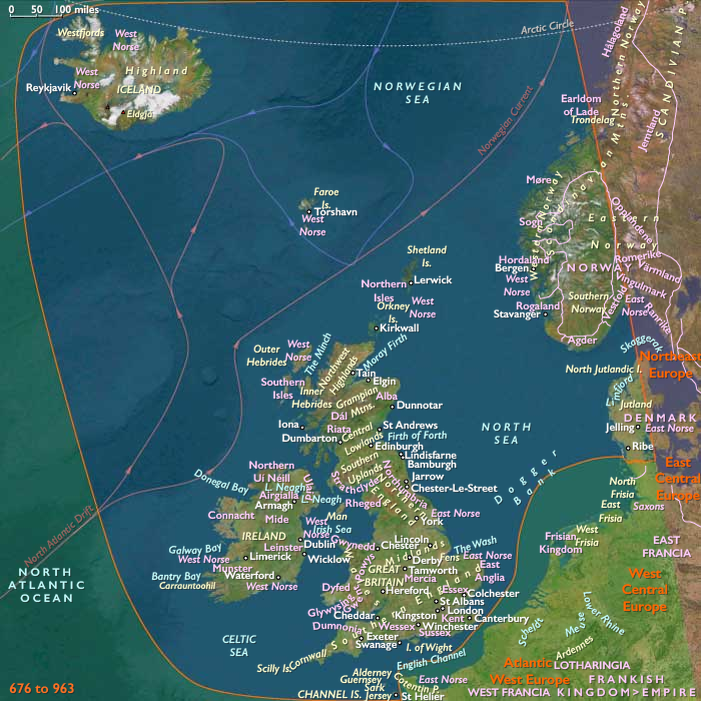
The Battle of Tempsford takes place in …
Years: 917 - 917
The Battle of Tempsford takes place in a fortified Danish burh where, following an unsuccessful attack on Bedford, the Danes are defeated in 917 by an English army led by King Edward the Elder, who kills their king and ends organized Danish resistance.
Locations
People
Groups
Topics
Commodoties
Subjects
Regions
Subregions
Related Events
Filter results
Showing 10 events out of 53332 total
Liu Yin had been named regional governor and military officer by the Tang court in 905.
Though the Tang had fallen two years later, Liu had not declared himself the founder of a new kingdom as other southern leaders had done, but merely inherited the title of Prince of Nanping in 909.
It is not until Liu Yin’s death in 917 that his brother, Liu Yan, declares the founding of a new kingdom, which he initially calls "Great Yue,” but he will change the name to Great Han in 918, because his surname Liu is the imperial surname of the Han dynasty and he claims to be a descendant of that famous dynasty.
The kingdom, in Panyu (modern-day Guangdong) and Guangxi, is often referred as the Southern Han Dynasty throughout China's history.
Petar of Serbia, although allied to Simeon, has become increasingly disgruntled by the fact that he is essentially subordinate to him.
Peter’s expansion toward the coast facilitates contacts with the Empire, by way of the strategos of Dyrrhachium.
Searching for allies against Bulgaria, Constantinople has showered Peter with gold and promises of greater independence if he will join their alliance.
Petar might have been planning an attack on Bulgaria with the Magyars, showing that his realm had stretched north to the Sava river.
However, Michael of Zachumla has forewarned Simeon of this plan, since Michael is an enemy of Peter, and a loyal vassal of Simeon.
Simeon attacks Serbia in 917 and deposes Peter, placing Pavle Branović (a grandson of Mutimir) as Prince of Serbia, subordinate to Simeon (although some scholars suggest that Symeon took control over Serbia directly at this time.)
Yusuf ibn Abi'l Saj, amir of Azerbaijan, had begun to withhold some of the annual tribute due to the caliph after the dismissal of the vizier Ibn al-Furat.
Yusuf had imprisoned a caliphal envoy in 915 or 916, although he had later released him and sent him back with presents and money.
After Ibn al-Furat regains the vizierate in 917, Yusuf conquers Zanjan, Abhar, Qazvin and Ray from the Samanids and hopes that Ibn al-Furat will smooth things over with al-Muqtadir.
The caliph, however, angrily sends an army against Yusuf, who defeats it.
The arrival of a second Abbasid army under Mu'nis al-Khadim causes Yusuf to retreat to Ardabil.
Although Ibn al-Furat attempts to persuade al-Muqtadir to recognize Yusuf as governor, the caliph refuses.
The Magyars raid Alsace in 917.
The town of Basel is called Basilea or Basilia in Latin (from Ancient Greek basileia, meaning kingship) and this name is documented from 374.
Hungarian raiders destroy the town in 917.
The Empire, after a series of successful campaigns, has stabilized its eastern borders by 917, and the generals John Bogas and Leo Phokas are able to gather additional troops from Asia Minor, to reinforce the imperial tagmata and the European thematic troops, gathering a force of some thirty thousand to sixty-two thousand men.
This is a very large army by contemporary standards, and its goal is the elimination of the Bulgarian threat from the north.
The troops are paid in advance and a fleet commanded by Romanos Lekapenos sets off to the north at the mouth of the Danube.
The Greeks had tried to pay some Pecheneg tribes to attack, but Romanus will not agree to transport them across the Danube, and instead they attack Bulgarian territory on their own.
The imperial army marches northwards and sets its camp in the vicinity of the strong fortress of Anchialus.
Leo Phokas intends to invade Moesia and meet the Pechenegs and Lekapenos's troops in Dobrudzha.
Simeon swiftly concentrates his army on the heights around the fortress.
On the morning of August 20, 917, the battle between the Bulgarians and the Greeks begins by the river Achelous near the modern village Acheloi, eight kilometers to the north of Anchialus (modern Pomorie) on Bulgaria's Black Sea coast.
The imperial generals plan to outflank the right Bulgarian wing in order to detach Simeon's troops from the Balkan Passes.
The Bulgarian ruler concentrates his most powerful forces in the two wings and leaves the center relatively weak in order to surround the enemy when the center would yield to the imperial attack.
Simeon himself is in charge of large cavalry reserves hidden behind the hills which are intended to strike the decisive blow.
The imperial attack is fierce and it is not long before the Bulgarians begin slowly to retreat.
The enemy cavalry charges the infantry in the center, killing many Bulgarians.
The Bulgarian position becomes desperate as they cannot manage to hold the heights to the south of the river and begin a hasty retreat to the north.
Elated, the imperial troops give chase and their battle formations soon begin to break, especially as a rumor spreads that their commander, Leo Phokas, has been killed.
At this point, Simeon, who has detected the disarray in the imperial formation, orders his army to stand, and, at the head of his heavy cavalry corps, attacks the imperial left wing from behind the hills.
With an irresistible onslaught, the cavalry bears down on the confused enemy, who immediately bend under their attack, panic and take to their heels.
Some imperial officers try to repulse the cavalry charge but they are also attacked by the infantry.
Tsar Simeon personally takes part in the fight, his white horse killed at the height of the battle.
The imperial army is completely routed.
Leo Phokas is saved by fleeing to Mesembria (modern Nesebar) in Bulgaria, but in the thick of the battle Constantine Lips, John Grapson and many other commanders (archontes) are cut down along with an enormous number of soldiers and officers.
By the end of the day, the Bulgarians overwhelm the defenders of Mesembria and capture the town.
Leo Phocas barely escapes by boarding a ship.
The Byzantine historian Leo the Deacon says that seventy-five years after this military catastrophe the field at Anchialus was still covered with tens of thousands of Roman skeletons.
The battle is among the bloodiest of medieval history.

The remainder of the imperial army flees all the way back to Constantinople, followed by the Bulgarians.
Several days later, Phokas is defeated once more at Katasyrtai, where the last imperial troops are routed after a night fight.
The way to Constantinople is clear.
The Empire proposes a new peace treaty, and Simeon enters the imperial city and is crowned for a second time as "Tsar" (the Slavonic title for Caesar i.e.
Emperor) "of all Bulgarians and Romans".
The Military Campaigns of Ordoño II of León
King Ordoño II of León aggressively expands and defends Christian territories against Muslim forces, fighting on multiple fronts to secure his kingdom’s dominance in the north.
Victories in Galicia and the Repulsion of Muslim Forces
In Galicia, Ordoño II leads Spanish Christian forces to defeat the Moors, preventing further Muslim encroachmentand securing the region for the Christian Reconquista.
Southern Campaigns: Sack of Mérida and Évora
Pushing southward, Ordoño II sacks Mérida and Évora, dealing a significant blow to Muslim control in the region. The local Muslim governor is ultimately forced to buy Ordoño’s retreat, demonstrating the effectiveness of his campaigns.
Eastern Campaigns: Alliance with Navarre and the Siege of San Esteban de Gormaz
To counter the powerful Emir of Córdoba, Abd-ar-Rahman III, Ordoño II forms an alliance with Sancho I Garcés, King of Navarre, strengthening Christian unity in northern Iberia.
In 912, Ordoño initiates the repopulation (repoblación) of San Esteban de Gormaz, a strategic border city between Christian and Muslim zones. This region, largely depopulated since the Muslim conquest, serves as a crucial buffer zone.
Upon learning of Ordoño’s efforts, Córdoban general Abi-Abda orders a siege of the city in 917 CE. However, Ordoño II swiftly comes to its defense, defeating the Muslim forces in September.
During the battle, Abi-Abda is captured and executed by decapitation, his head displayed on the city’s ramparts as a warning to the Moors, symbolizing the growing strength of the Christian kingdoms in Iberia.
Gyeon Hwon, king and founder of Hubaekjek, had changed the state's name to Majin in 904, and eventually to Taebong in 911; he had also transferred the capital from Songak to Cheorwon in 905.
Taebong at its peak consists of territory in the present-day provinces North Hwanghae and South Hwanghae, Gyeonggi, Gangwon-do (South Korea)/Kangwon-do (North Korea), Pyongyang, North Chungcheong and southern part of South Jeolla.
In his later reign, Gung Ye had proclaimed himself a Buddha and become a tyrant who sentenced death to anyone opposing him, including his own wife Lady Gang.
As a result, in 918 four of his own generals—Hong Yu, Bae Hyeon-gyeong, Shin Sung-gyeom and Bok Ji-gyeom—overthrow Taebong and install Wang Geon as king, Soon thereafter, the Goryeo dynasty is proclaimed, from which the name Korea derives.
The Battle of Achelous, one of the most important battles in the long Byzantine–Bulgarian Wars, has foiled Constantinople’s designs on Bulgaria, secured the concession of the Imperial title to the Bulgarian rulers, and thereby firmly established Bulgaria's role as a key player in Europe.
Simeon has also demanded that his daughter be married Constantine VII, the son of empress Zoe Karbonopsina, but Zoe had refused and allied with Serbia and Hungary against him, which had postponed the decisive assault of Constantinople.
Simeon, deciding to secure his rear, had sent an army under Marmais and Theodore Sigritsa to destroy them.
His generals had captured the Serb prince but that had given the Empire precious time to recover.
Romanos Lekapenos, born in Lakape (Laqabin) between Melitene and Samosata (hence the name), was the son of an Armenian peasant with the remarkable name of Theophylact the Unbearable.
Theophylact, as a soldier, had rescued the Emperor Basil I from the enemy in battle at Tephrike and had been rewarded by a place in the Imperial Guard.
Although he did not receive any refined education (for which he will later be abused by his son-in-law Constantine VII), Romanos had advanced through the ranks of the army during the reign of Emperor Leo VI the Wise.
In 911, he was general of the naval theme of Samos and later served as admiral of the fleet (droungarios tou ploimou).
In this capacity, he was supposed to have participated in the operations against Bulgaria on the Danube in 917, but had been unable to carry out his mission.
In the aftermath of the disastrous imperial defeat at the Battle of Acheloos, Romanos had sailed to Constantinople, where he is gradually overcoming the discredited regency of Empress Zoe and her supporter Leo Phokas.
Zoe’s attempted alliance with Serbia and the Magyars has failed to produce any concrete results, and the Arabs, encouraged by the empire's weakness, renew their raids.
A humiliating treaty with the Arabs of Sicily, who are asked to help subdue revolts in Italy, does little to improve the position of Zoe and her supporters.