
The first historical references to the Turks …
Years: 964 - 1107
The first historical references to the Turks appear in Chinese records dating around 200 BCE.
These records refer to tribes called the Hsiung-nu (an early form of the Western term Hun), who lived in an area bounded by the Altai Mountains, Lake Baykal, and the northern edge of the Gobi Desert, and who are believed to have been the ancestors of the Turks.
Specific references in Chinese sources in the sixth century CE identify the tribal kingdom called Tu-Kue located on the Orkhon River south of Lake Baykal.
The khans (chiefs) of this tribe had accepted the nominal suzerainty of the Tang Dynasty.
The earliest known example of writing in a Turkic language will be found in that area and has been dated to around CE 730.
Other Turkish nomads from the Altai region had founded the Gökturk Empire, a confederation of tribes under a dynasty of khans whose influence had extended during the sixth through eighth centuries from the Aral Sea to the Hindu Kush in the land bridge known as Transoxania (i.e., across the Oxus River).
The Gorturks are known to have been enlisted by a Roman emperor in the seventh century as allies against the Sassanians.
Separate Turkish tribes, among them the Oguz, had moved south of the Oxus River in the eighth century, while others had migrated west to the northern shore of the Black Sea.
The Turkish migrations after the sixth century had been part of a general movement of peoples out of central Asia during the first millennium CE that is influenced by a number of interrelated factors — climatic changes, the strain of growing populations on a fragile pastoral economy, and pressure from stronger neighbors also on the move.
Among those who migrated were the Oguz Turks, who had embraced Islam in the tenth century.
They had established themselves around Bukhara in Transoxania under their khan, Seljuk.
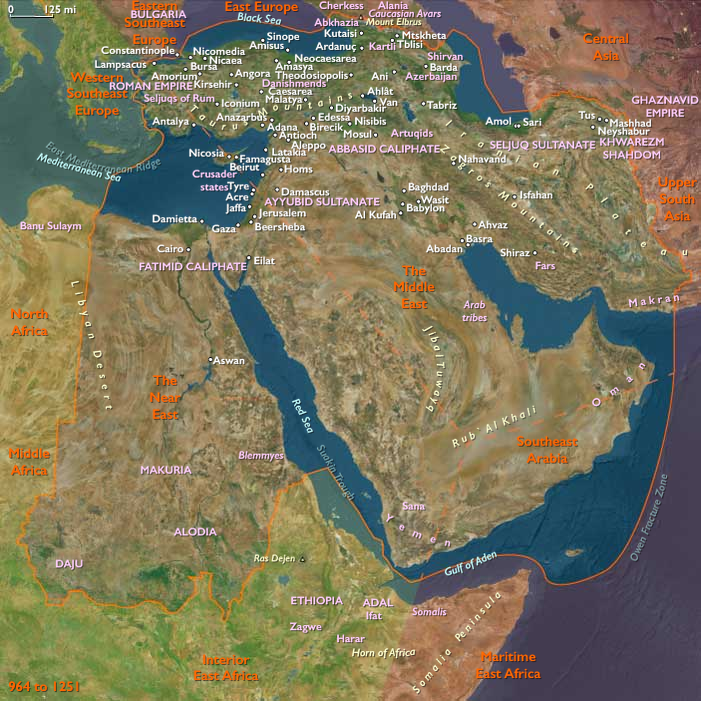
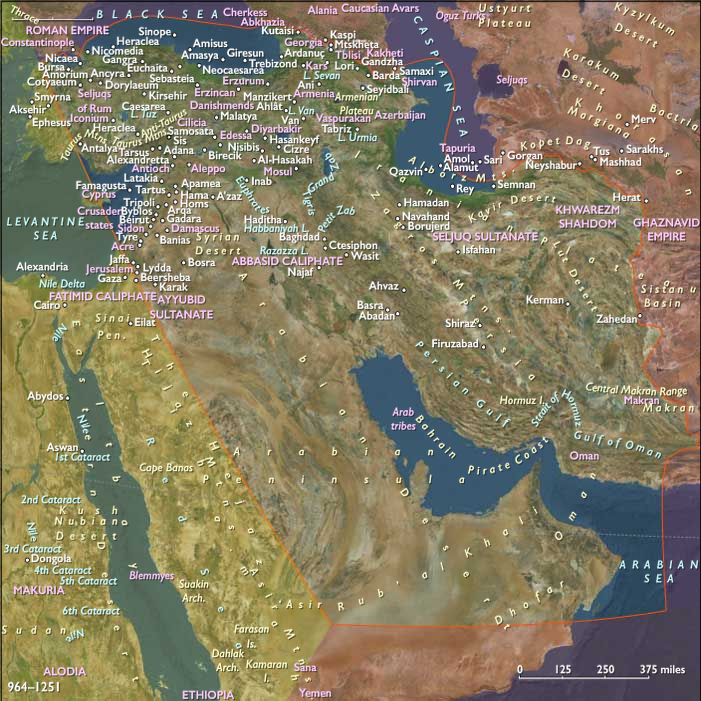
Split by dissension among the tribes, one branch of the Oguz, led by descendants of Seljuk, had moved west and entered service with the Abbasid caliphs of Baghdad.
The Turkish horsemen, known as ghazis, are organized into tribal bands to defend the frontiers of the caliphate, often against their own kinsmen.
People
Groups
- Iranian peoples
- Arab people
- Khorasan, Greater
- Daylamites
- Oghuz Turks
- Muslims, Sunni
- Muslims, Shi'a
- Turkmen, Iraqi
- Abbasid Caliphate (Baghdad)
- Buyid dynasty
- Seljuq Empire (Neyshabur)
- Seljuq Empire (Rayy)
- Seljuq Empire (Isfahan)
Topics
Commodoties
Subjects
Regions
Subregions
Related Events
Showing 9 events out of 9 total
Years: 964 - 1107
People
Groups
- Iranian peoples
- Arab people
- Khorasan, Greater
- Daylamites
- Oghuz Turks
- Muslims, Sunni
- Muslims, Shi'a
- Turkmen, Iraqi
- Abbasid Caliphate (Baghdad)
- Buyid dynasty
- Seljuq Empire (Neyshabur)
- Seljuq Empire (Rayy)
- Seljuq Empire (Isfahan)
Topics
Commodoties
Subjects
Regions
Subregions