The Cape government proclaims Dutch sovereignty over …
Years: 1779 - 1779
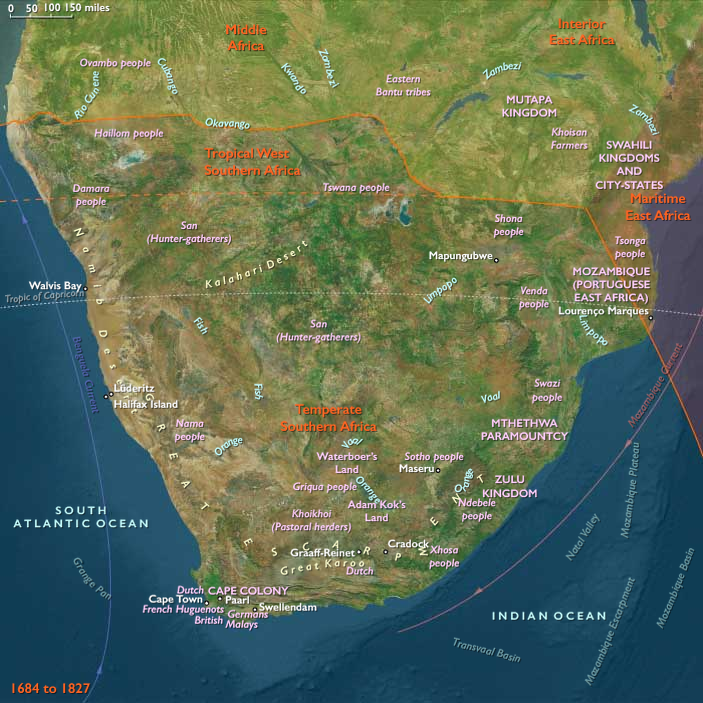
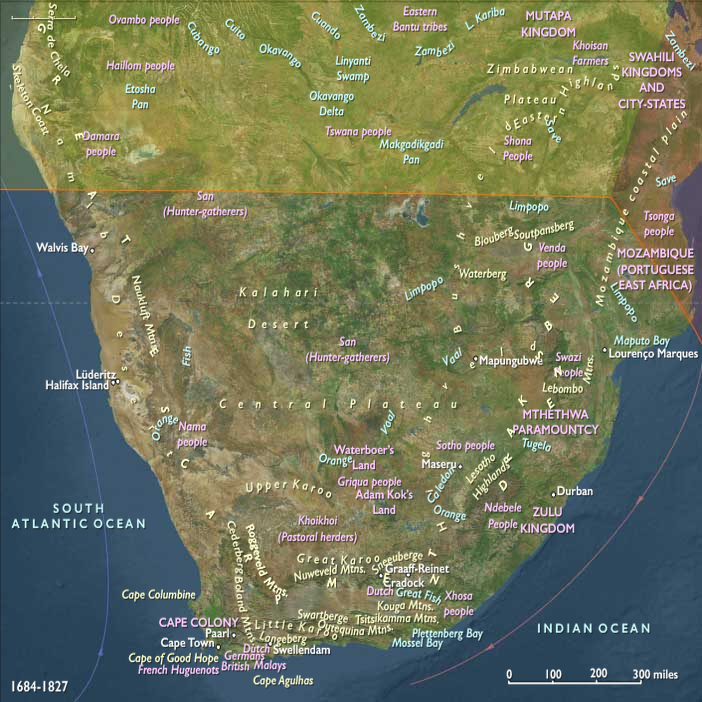
The Cape government proclaims Dutch sovereignty over southwest Africa’s Angra Pequina (modern Lüderitz), ...
Locations
Groups
Subjects
Regions
Subregions
Related Events
Filter results
Showing 10 events out of 25214 total
José de Gálvez, the future Minister of the Indies, had established the province of Alta California, to which he had dispatched five separate expeditions in 1769, just as the Krenitsyn-Levashev expedition was concluding.
Spanish exploration voyages to the far north have been launched from there in 1774 and 1775; a third is launched in 1779.
Tampere, located in southern Finland between two lakes, Näsijärvi and Pyhäjärvi, and founded as a market place on the banks of the Tammerkoski channel in 1775 by Gustav III of Sweden, is granted full township status in 1779.
The two lakes differ in level by eighteen meters, and the rapids linking them, Tammerkoski, are to be an important power source throughout the town’s history.
Scheele discovers in 1779 that graphite, now known to be a form of carbon, forms carbon dioxide when burned in air, and thus distinguishes between molybdenite and graphite.
Adam Weishaupt begins working towards incorporating his system of Illuminism with that of Masonry, with the aim of creating a New World Order, which means the abolition of all monarchical governments and religions.
He had begun his formal education at age seven in Bavaria at a school controlled by the Jesuits, had later enrolled at the University of Ingolstadt and graduated in 1768 at age twenty with a doctorate of law, becoming a professor in 1772.
Following Pope Clement XIV’s suppression of the Society of Jesus the following year, Weishaupt had become a professor of canon law, a position that heretofore held exclusively by the Jesuits.
Weishaupt had been introduced in 1775 to the empirical philosophy of Johann Georg Heinrich Feder of the University of Göttingen.
Both Feder and Weishaupt will later become opponents of Kantian idealism.
Weishaupt had formed the "Order of Perfectibilists", which will later be known as the Illuminati, on May 1, 1776.
He has adopted the name of "Brother Spartacus" within the order.
The Order is neither egalitarian nor democratic.
The actual character of the society is modeled on one of its traditionalist enemies, the Jesuits, and is an elaborate network of spies and counterspies.
Each isolated cell of initiates reports to a superior, whom they do not know, a party structure that will effectively be adopted by some later groups.
Initiated into the Masonic Lodge "Theodor zum guten Rath" (Theodore of Good Counsel), at Munich in 1777, Weishaupt’s project of "illumination, enlightening the understanding by the sun of reason, which will dispel the clouds of superstition and of prejudice" is an unwelcome reform.
He had soon developed Gnostic mysteries of his own, however, with the goal of "perfecting human" nature through reeducation to achieve a communal state with nature, freed of government and organized religion.

...Halifax Island and ...
...Walvis Bay.
The French need these supplies for their naval construction, but are prevented from obtaining those themselves, due to the blockade of the Royal Navy (France being the weaker naval power in the conflict).
The Dutch are privileged by a concession obtained after their victory in the Second Anglo-Dutch War, known as the principle of "free ship, free goods" which had been enshrined in the Anglo-Dutch Commercial Treaty of 1668 (reconfirmed in the Treaty of Westminster (1674)).
This early formulation of the principle of Freedom of Navigation exempts all but narrowly defined "contraband" goods, carried in Dutch ships, from confiscation by the British prize courts, in wars in which the Dutch remain neutral.
According to the treaty naval stores (including ship's timbers, masts, spars, canvas, tar, rope, and pitch) are not contraband and the Dutch therefore are free to continue their trade with France in these goods.
Because of the still-important role of the Dutch in the European carrying trade this opens up a large loophole in the British embargo.
The British have therefore unilaterally declared naval stores to be contraband and enforce their embargo by arresting Dutch (and other neutral) ships on the high seas.
This leads to strong protests by the affected Dutch merchants, who demand institution of convoys escorted by the Dutch navy, to protect them against the Royal Navy and British privateers.
According to customary international law, such convoys are (and still are) exempt from the right of Visit and Search by belligerents.
Initially the stadtholder had managed to prevent this, but strong diplomatic pressure by France, that selectively applies economic sanctions to Dutch cities supporting the stadtholder in this policy, had forced his hand in November 1779.
The States General now order him to provide the escorts and the first convoy, under command of rear-admiral Lodewijk van Bylandt, sails in December 1779.
This leads to the humiliating Affair of Fielding and Bylandt on December 31, 1779, which enrages Dutch public opinion and further undermines the position of the stadtholder.
Lavoisier, who in the latter half of the 1770s first recognizes the combustion-supporting gas in air as an element, coins the name oxygen in 1779.
He explains combustion as a union of oxygen with the burning material, in opposition to the popular but erroneous phlogiston theory,
The element's name combines Greek oxy, sharp, with gen, bearing or forming, from his incorrect belief that oxygen forms acids.
The mysterious personage known as the Count of St. Germain arrives in 1779 in Altona in Schleswig, where he makes an acquaintance with Prince Charles of Hesse-Kassel, who also has an interest in mysticism and is a member of several secret societies.
The Count shows the Prince several of his gems and persuades him that he has invented a new method of coloring cloth.
The Prince, impressed, installs the Count in an abandoned factory at Eckernförde he acquires especially for the Count, and supplies him with the materials and cloths that St. Germain needs to proceed with the project.
The two will meet frequently in the following years, and the Prince outfits a laboratory for alchemistic experiments in his nearby summer residence Louisenlund, where they, among other things, cooperate in creating gemstones and jewelry.
The Prince will late recounts in a letter that he is the only person in whom the Count truly confided.
The Count tells the Prince that he is the son of the Transylvanian Prince Francis II Rákóczi, and that he was eighty-eight years of age when he arrived in Schleswig.
Johann Peter Frank’s methodology for public health deals with such subjects as public sanitation, water supply issues, sexual hygiene, maternal and child welfare, food safety, and prostitution, to name a few; it is first published in 1779.
A native of Rodalben, Frank had studied medicine at the Universities of Strasbourg and Heidelberg, and earned his medical doctorate in 1766.
An important figure in the early history of social medicine and public health, for much of his career he will work on the System einer vollständigen medicinischen Polizey (A Complete System of Medical Policy), which, when finally completed in 1827, six years after Frank's death, will be a comprehensive nine-volume treatise on all aspects of hygiene and public health.