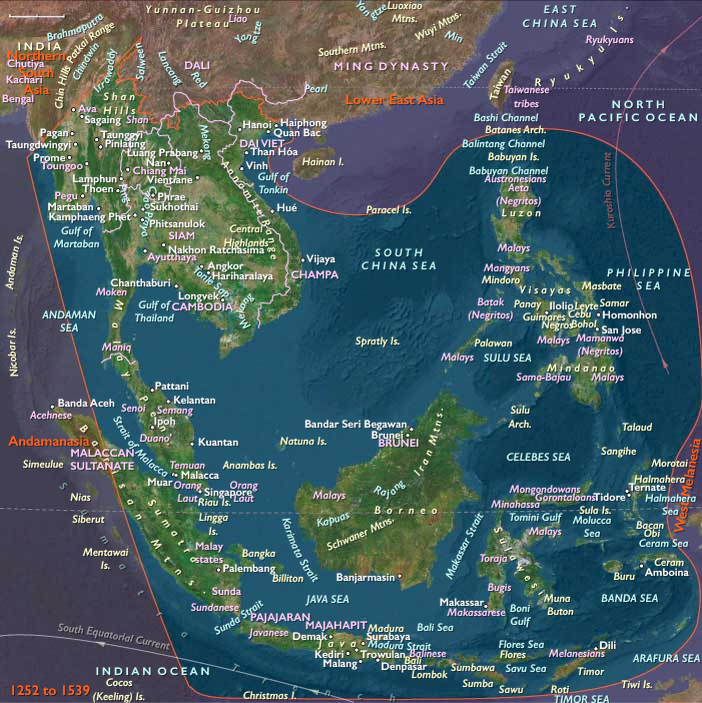
The Chinese diplomat Zhou Daguan, having spent …
Years: 1297 - 1297
The Chinese diplomat Zhou Daguan, having spent a year at the court of the Khmer King Indravarman III at Angkor, sets forth his observations in a personal journal.
Locations
People
Groups
Subjects
Regions
Subregions
Related Events
Filter results
Showing 10 events out of 38 total
The first Gonzaga family members of historical importance are known to have collaborated in the Guelph faction alongside the monks of the Polirone Abbey.
Beginning in the twelfth century, they have become an important family in Mantua, and had grown richer when their allies, the Bonacolsi, defeated the traditional familiar enemy, the Casalodi.
In 1328, however, Ludovico I Gonzaga overthrows the Bonacolsi lordship over the city with the help of the Scaliger family, and enters the Ghibelline party as capitano del popolo ("people's captain") of Mantua and imperial vicar of emperor Louis IV.
Pope Pius II, after allying himself with Ferdinand, the Aragonese claimant to the throne of Naples, convenes a congress of the representatives of Christian princes at Mantua for joint action against the Turks.
He had on September 26, 1459, called for a new crusade against the Ottomans, and on January 14, 1460, proclaims the official crusade: it is to last for three years.
Alberti has meanwhile been commissioned by Ludovico II Gonzaga, Marquis of Mantua, to redesign the exterior of the church of San Sebastian here.
The plan, which is considered one of the earliest and most significant examples of Renaissance centrally planned churches, is in the shape of a Greek cross, with three identical arms centering apses, under a central cross-vaulted space without any interior partitions.
Mantegna works in Mantua for the ruling Gonzaga family from 1459.
The Marquis Ludovico II Gonzaga of Mantua had for some time been pressing Mantegna to enter his service, and Mantegna had been appointed court artist in 1460.
He resided at first from time to time at Goito, but from December 1466 onward he had moved with his family to Mantua.
His engagement is for a salary of seventy-five lire a month, a sum so large for that period as to mark conspicuously the high regard in which his art is held.
He is in fact the first painter of any eminence ever domiciled in Mantua.
His Mantuan masterpiece is painted in the apartment of the Castle of the city, today known as Camera degli Sposi (literally, "Wedding Chamber"): a series of full compositions in fresco including various portraits of the Gonzaga family and some figures of genii.
Leon Battista Alberti had begun his design for the Church of Sant' Andrea in Mantua, commissioned by Ludovico III Gonzaga, in 1462, employing his characteristic classical correctness, use of monumental mass, and emphasis on geometric relationships.
The building, however, will be finished only three hundred and twenty-eight years later.
Though later changes and expansions will alter Alberti's design, the church is still considered to be one of Alberti's most complete works.
He dies on April 25, 1472.
Andrea Mantegna, as artist in residence at the Gonzaga's ducal palace in Mantua, decorates the “Camera degli Sposi,” completed in 1474 with frescoes that display another bold experiment in perspective illusion.
Mantegna portrays the Gonzaga family and their court sitting or standing about the walls of the room as though they occupy a high loggia that logically extends the space of the chamber.
On the ceiling he paints a circular "opening" to a "sky" surrounded by a balustrade, over which laughing women peer down and along which nude boys play.
Poliziano writes “Orfeo,” a lyrical drama performed at Mantua with musical accompanimen, and published in 1475, when he is twenty-one.
Perugino creates a fresco, Combat of Love and Chastity, commissioned for the studiolo (cabinet) of Isabella d'Este, Marchesa of Mantua, in the Castello di San Giorgio, after the two canvasses by Andrea Mantegna, the Parnassus and the Triumph of the Virtues.
The paintings will be completed by Lorenzo Costa the Elder's Coronation of Isabella d'Este.
The subject had been suggested by Isabella's court poet, Paride da Ceresara, documented by the correspondence between Isabella and Perugino, who is at this time active in Florence.
The notary contract includes all the details about the literary theme, as well as a drawing on which the work has to be based.
For example, when Perugino painted a naked Venus, rather than dressed, the marchesa had protested vigorously.
When the painting is delivered in 1505, the marchesa is not entirely satisfied.
She declares that she prefers it would have been painted in oil, instead of the tempera used under her directives in order to follow Mantegna's style.
Perugino, who probably is not at ease with the small format of the painting, receives one hundred ducats for the work.

Mantegna had been commissioned after 1497 by Isabella d'Este to translate the mythological themes written by the court poet Paride Ceresara into paintings for her private apartment (studiolo) in the Palazzo Ducale.
These paintings will be dispersed in the following years: one of them, the legend of the God Comus, is left unfinished by Mantegna and will completed by his successor as court painter in Mantua, Lorenzo Costa.
After the death of his wife, Mantegna became at an advanced age the father of a natural son, Giovanni Andrea; and at the last, although he has continued launching out into various expenses and schemes, he has serious tribulations, such as the banishment from Mantua of his son Francesco, who had incurred the marquis' displeasure.
Perhaps the aged master and connoisseur regarded as barely less trying the hard necessity of parting with a beloved antique bust of Faustina.
Very soon after this transaction he dies in Mantua, on September 13, 1506, still at work on several complex mythological allegories for Isabella.
The members of the League meet in late August at Mantua to discuss the situation in Italy (particularly the partition of territory acquired from the French).
They quickly come to an agreement regarding Florence, which had angered Julius by allowing Louis to convene the Council of Pisa in its territory.
…especially Mantua, the second largest Jewish community in Italy after Venice.