
Rebellion flares increasingly in Tang China, particularly …
Years: 820 - 963
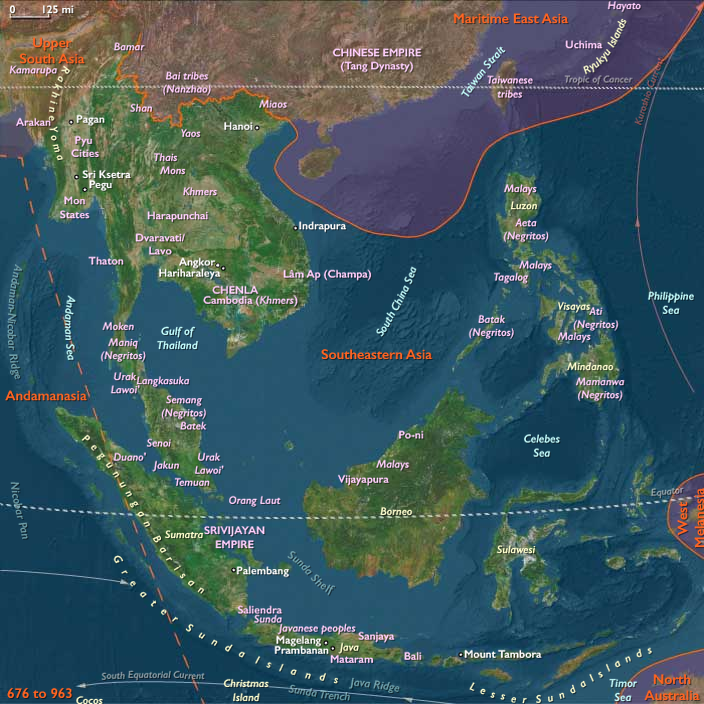
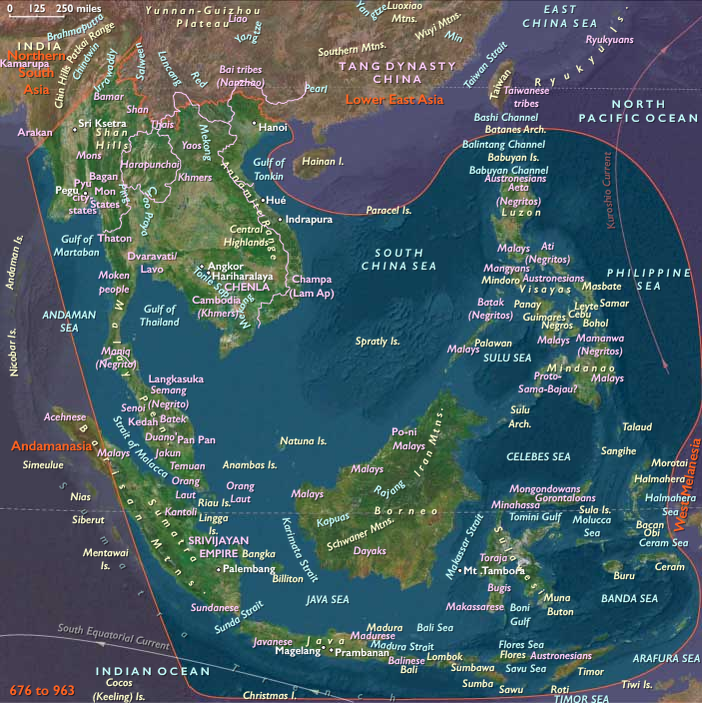
Rebellion flares increasingly in Tang China, particularly among the minority peoples in the mountain and border regions, as imperial power becomes more corrupt and oppressive during the latter part of the dynasty.
The Viet culture of Giao Chau Province, as it develops under Tang hegemony, depends upon Chinese administration to maintain order, but there is growing cultural resistance to the Tang in the border regions.
A revolt among the Muong people, who are closely related to the central Vietnamese, breaks out in the early eighth century.
The rebels occupied the capital at Tong Binh (Hanoi), driving out the Tang governor and garrison, before being defeated by reinforcements from China.
Some scholars mark this as the period of final separation of the Muong peoples from the central Vietnamese, which linguistic evidence indicates took place near the end of the Tang dynasty.
In the mid-ninth century, Tai minority rebels in the border regions recruit the assistance of Nanzhao, a Tai mountain kingdom in the southern Chinese province of Yunnan, which seizea control of Annam in 862.
Although the Tang succeed in defeating the Nanzhao forces and restoring Chinese administration, the dynasty is in decline and no longer able to dominate the increasingly autonomous Vietnamese.
The Tang finally collapse in 907 and by 939 Ngo Quyen, a Vietnamese general, has established himself as king of an independent Vietnam.
Locations
People
Groups
- Vietnamese people
- Tai peoples, or Thais
- Muong people
- Chinese (Han) people
- Chinese Empire, Tang Dynasty
- Annam, Chinese province of
- Nanzhao, or Nanchao, Bai Kingdom of
Topics
Commodoties
Subjects
Regions
Subregions
Years: 820 - 963
Locations
People
Groups
- Vietnamese people
- Tai peoples, or Thais
- Muong people
- Chinese (Han) people
- Chinese Empire, Tang Dynasty
- Annam, Chinese province of
- Nanzhao, or Nanchao, Bai Kingdom of
Topics
Commodoties
Subjects
Regions
Subregions