The city of Cyzicus was said to …
Years: 549BCE - 538BCE
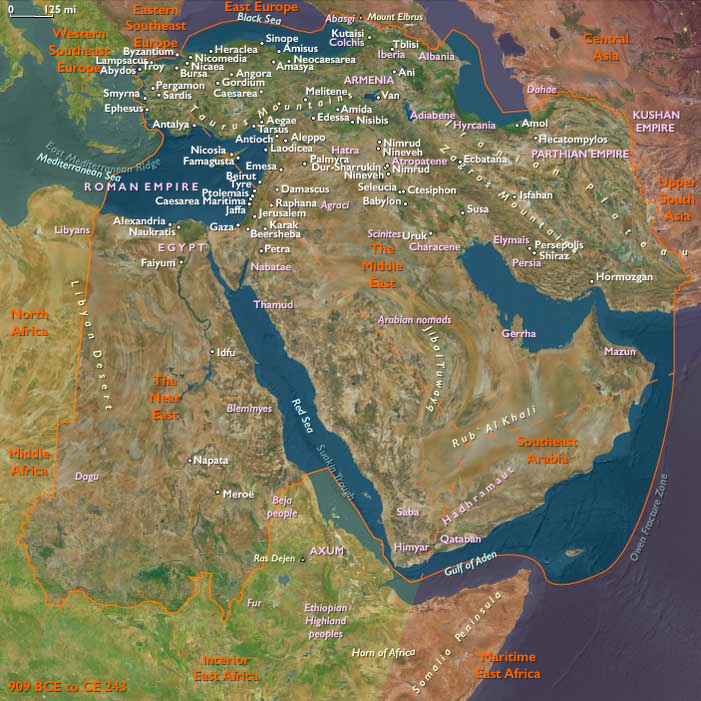
The city of Cyzicus was said to have been founded by Pelasgians from Thessaly, according to tradition, at the coming of the Argonauts; later it received many colonies from Miletus, allegedly in 756 BCE.
An ancient town of Mysia in Anatolia in the current Balikesir Province of Turkey, it is located on the shoreward side of the present Kapidağ Peninsula (the classical Arctonnesus), a tombolo which is said to have originally been an island in the Sea of Marmara only to be connected to the mainland in historic times either by artificial means or an earthquake.
With the collapse of Lydia around 544, Cyzicus comes under Persian rule, as does ...
Locations
People
Groups
- Polytheism (“paganism”)
- Pelasgians
- Lydia, Kingdom of
- Miletus (Ionian Greek) city-state of
- Greece, classical
- Phocaea (Ionian Greek) city-state of
- Achaemenid Empire
Topics
Subjects
Regions
Subregions
Related Events
Filter results
Showing 10 events out of 65828 total
An early version of the game of go, called Yi, is mentioned in the entry corresponding to the year 546 in China’s “Zuo Zhuan” (“Tso Chuan”) chronology.
The Middle East: 549–538 BCE
Cyrus the Great and the Persian Ascendancy
By 549 BCE, Cyrus the Great has firmly established his rule, officially assuming the title "King of Persia." Having previously dismantled the Median Empire and consolidated power by capturing the Median capital of Ecbatana, Cyrus continues to expand the burgeoning Achaemenid Persian Empire. He incorporates Media seamlessly into his empire, forming a lasting union of the Persians and Medes, and unites the twin kingdoms of Parsa and Anshan into the heartland of Persia proper.
Conquest of Lydia and Anatolian Expansion
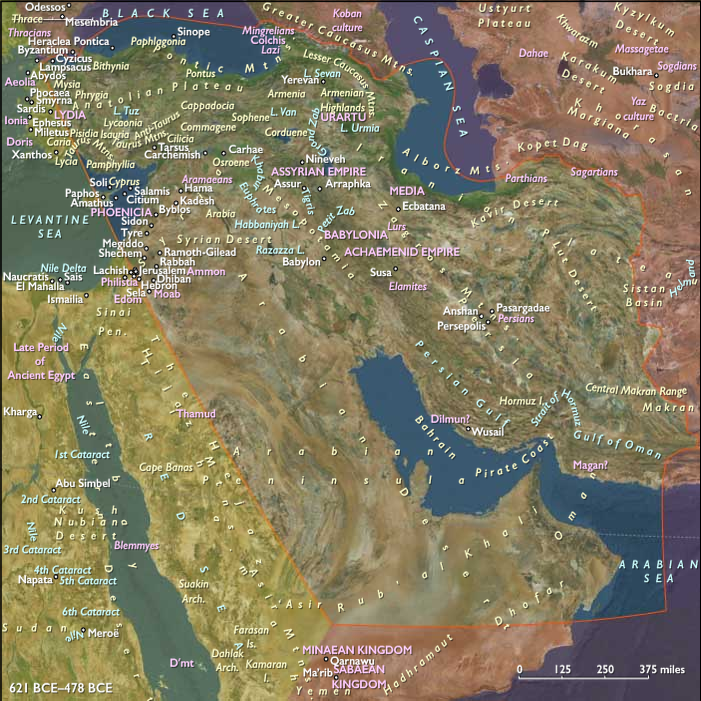
Cyrus’s ambitious westward expansion places him in conflict with the wealthy kingdom of Lydia, ruled by Croesus. Initially engaging in an indecisive battle at Pteria in Cappadocia, Cyrus decisively defeats Croesus at the subsequent Battle of Thymbra. The Lydian capital, Sardis, soon falls after a brief siege around 546 BCE, leading to Persian dominance over Lydia and its Greek colonies, including cities like Ephesos and Cyzicus. This marks the beginning of Persia's profound influence over Anatolia and its Greek-speaking communities.
Persian Consolidation and the Fall of Babylon
After securing Lydia and the Ionian Greek cities along the Aegean coast, Cyrus turns his attention to Babylonia, exploiting internal unrest and dissatisfaction under King Nabonidus and his co-regent son, Belshazzar. In 539 BCE, Persian forces engage Babylonian armies at the strategic location of Opis along the Tigris River. Cyrus swiftly secures victory, leading to the rapid surrender of major Babylonian centers including Babylon, Sippar, and Ur.
Babylon's conquest is notably recorded on the famous Cyrus Cylinder, an inscription where Cyrus proclaims himself "king of Babylon, king of Sumer and Akkad, king of the four corners of the world," emphasizing his policy of restoring religious sanctuaries and repatriating displaced peoples. This conquest signals a definitive shift, positioning Persia as the dominant power across Mesopotamia and the wider Near East.
Thus, between 549 and 538 BCE, the Middle East undergoes dramatic geopolitical transformations, spearheaded by Cyrus's Persian Empire. His rapid and effective consolidation of power from Anatolia through Mesopotamia sets the stage for a new era of Persian ascendancy, profoundly reshaping the political and cultural landscape of the ancient world.
Cyrus the Great had already succeeded to the Persian throne in 559 BCE though his father lived for another eight years; however, Cyrus was not yet an independent ruler.
Like his predecessors, Cyrus had to recognize Median overlordship.
The Median Empire during Astyages's reign, may have ruled over the majority of the Ancient Near East, from the Lydian frontier in the west to the Parthians and Persians in the east.
In Herodotus's version, the Median general Harpagus, seeking vengeance, persuaded Cyrus to rally the Persian people to revolt against their feudal lords, the Medes.
It is likely, however, that both Harpagus and Cyrus rebelled due to their dissatisfaction with Astyages's policies.
From the start of the revolt in summer 553 BCE, with his first battles taking place from early 552 BCE, Harpagus, with Cyrus, led his armies against the Medes until the capture of Ecbatana in 549 BCE, effectively conquering the Median Empire.
While Cyrus the Great seems to have accepted the crown of Media, by 546 BCE, he officially assumes the title "King of Persia" instead.
With Astyages out of power, all of his vassals (including many of Cyrus's relatives) are now under his command.
His uncle Arsames, who had been the king of the city-state of Parsa under the Medes, therefore would have had to give up his throne.
However, this transfer of power within the family seems to have been smooth, and it is likely that Arsames was still the nominal governor of Parsa, under Cyrus's authority—more of a Prince or a Grand Duke than a King.
His son, Hystaspes, who was also Cyrus's second cousin, was then made satrap of Parthia and Phrygia.
Cyrus the Great thus united the twin Achaemenid kingdoms of Parsa and Anshan into Persia proper.
Arsames would live to see his grandson become Darius the Great, Shahanshah of Persia, after the deaths of both of Cyrus's sons.
Cyrus makes Media a province in his new empire, forming a lasting union of the Persians and the Medes.
His conquest of Media is merely the start of his wars.
The exact dates of the Lydian conquest are unknown, but it must have taken place between Cyrus's overthrow of the Median kingdom (550 BCE) and his conquest of Babylon (539 BCE).
It was common in the past to give 547 BCE as the year of the conquest due to some interpretations of the Nabonidus Chronicle, but this position is currently not much held.
The Lydians first attack the Achaemenid Empire's city of Pteria in Cappadocia.
(Herodotus mentions Pteria as near Sinop on the Black Sea.)
Croesus besieges and captures the city, enslaving its inhabitants.
Meanwhile, the Persians invite the citizens of Ionia who are part of the Lydian kingdom to revolt against their ruler.
The offer is rebuffed, and thus Cyrus levies an army and marches against the Lydians, increasing his numbers while passing through nations in his way.
The Battle of Pteria is effectively a stalemate, with both sides suffering heavy casualties by nightfall.
Croesus retreats to Sardis the following morning.
Cyrus captures Cilicia to control supply routes to the Lydian kingdom.
…Lampsacus, which has become famous for its wines, and has remained the chief seat of the worship of Priapus, a god of procreation and fertility.
Originally known as Pityusa or Pityussa, Lampsacus, strategically located on the eastern side of the Hellespont in the northern Troad, was colonized from Phocaea and Miletus.
Cyrus conquers the Iranians who oppose him, bringing the entire plateau under the sway of the Achaemenid Empire.
Cyrus, after incorporating Lydia and such Ionian dependencies as Ephesos to his Persian kingdom in 546, consolidates his rule over Ionian Greek cities on the coast of the Aegean Sea, then turns to Babylonia, where the people’s dissatisfaction with the rule of Nabonidus and his son provide Cyrus with a pretext for invasion.
Persia is the leading power in the Near East at the time of the Battle of Opis.
Its power has grown enormously under its king, who has conquered a huge swath of territory to create an empire that covers an area corresponding to the modern countries of Turkey, Armenia, Azerbaijan, Iran, Kyrgyzstan and Afghanistan.
The only remaining significant unconquered power in the Near East is the Neo-Babylonian Empire, which controls Mesopotamia and subject kingdoms such as Syria, Judea, Phoenicia and parts of Arabia.
It had been closely linked with Cyrus's enemies elsewhere.
The empire was previously an ally of Croesus of Lydia, whose kingdom had been overrun by the Persians a few years earlier.
During a great banquet, Belshazzar, according to Biblical sources (Daniel 5), sees the “handwriting on the wall” that only the prophet Daniel can interpret: a message spelling the end of the Chaldean dynasty.
The dynasty indeed ends when Babylon, Sippar, Ur and other Neo-Babylonian centers surrender to Cyrus in 539 BCE.
Both Belshazzar and his father Nabonidus will die soon after.
The site of the final battle is at the city of Opis on the river Tigris, located about fifty miles (eighty kilometers) north of modern Baghdad.
The city is thought to have been a preferred point to cross the river; Xenophon describes a bridge there.
The timing of the invasion may have been determined by the ebb of the Mesopotamian rivers, which are at their lowest levels—and therefore are easiest to cross—in the early autumn.
Opis is a place of considerable strategic importance; apart from the river crossing, it is at one end of the Median Wall, a fortified defensive barrier north of Babylon that had been built several decades earlier by Nebuchadnezzar II.
Control of Opis will enable Cyrus to break through the Median Wall and open the road to the capital.
The main contemporary source of information on Cyrus's Mesopotamian campaign of 539 BCE is the Nabonidus Chronicle, one of a series of clay tablets collectively known as the Babylonian Chronicles that record the history of ancient Babylonia.
Some additional detail is provided by one of the few documents to have survived from Cyrus's lifetime, the Cyrus Cylinder.
Further information on Cyrus's campaign is provided by the later ancient Greek writers Herodotus and Xenophon, though neither mention the battle at Opis and their accounts of the campaign differ considerably from the Persian and Babylonian sources.
Most scholars prefer to use the Nabonidus Chronicle as the main source on the battle, as it is a contemporaneous source.
Although much of the Nabonidus Chronicle is fragmentary, the section relating to the last year of Nabonidus's reign—539 BCE—is mostly intact.
It provides very little information about Cyrus's activities in the years immediately preceding the battle.
The chronicler focuses on events of immediate relevance to Babylonia and its rulers, only occasionally records events outside Babylonia and does not provide much detail other than a bare outline of key incidents.
There is almost no information for the period 547-539.
Most of the chronicle's text for this period is illegible, making it impossible to assess the significance of the few words that can be read.
By the time of the battle, Babylonia is in an unpromising geopolitical situation; the Persian empire borders it to the north, east and west.
It has also been suffering severe economic problems exacerbated by plague and famine, and its king Nabonidus was said to be unpopular among many of his subjects for his unconventional religious policies.
Cyrus was said to have persuaded a Babylonian provincial governor named Gobryas (and a supposed Gadates) to defect to his side.
Gutium, the territory governed by Gobryas, is a frontier region of considerable size and strategic importance, which Cyrus was said to have used as the starting point for his invasion.
The Nabonidus Chronicle records that prior to the battle, Nabonidus had ordered cult statues from outlying Babylonian cities to be brought into the capital, suggesting that the conflict had begun possibly in the winter of 540 BCE.
In a fragmentary section of the chronicle which is presumed to cover 540/39 BCE, there is a possible reference to fighting, a mention of Ishtar and Uruk, and a possible reference to Persia The Battle of Opis is thus probably only the final stage in an ongoing series of clashes between the two empires.
After taking Babylon, Cyrus proclaims himself "king of Babylon, king of Sumer and Akkad, king of the four corners of the world" in the famous Cyrus cylinder, an inscription deposited in the foundations of the Esagila temple dedicated to the chief Babylonian god, Marduk.
The text of the cylinder denounces Nabonidus as impious and portrays the victorious Cyrus pleasing the god Marduk.
It describes how Cyrus had improved the lives of the citizens of Babylonia, repatriated displaced peoples and restored temples and cult sanctuaries.
Although some have asserted that the cylinder represents a form of human rights charter, historians generally portray it in the context of a long-standing Mesopotamian tradition of new rulers beginning their reigns with declarations of reforms.

The Lydians and Medes had formerly arranged that the natural boundary between the two empires would be the Halys River.
Croesus, learning of the sudden Persian uprising and defeat of his longtime rivals, the Medes, attempts to opportunistically use these set of events to expand his borders upon the eastern frontier of Lydia.
He makes an alliance with Chaldea, Egypt and Sparta.
Croesus may have intended reinstating his brother-in-law, Astyages, on the Median throne.
It is also possible that he was trying to pre-empt a Persian invasion of Lydia.
Cyrus advances to halt the Lydian invasion.
The winter battle appears to have been fierce, but indecisive.
Croesus withdraws across the Halys.
As Herodotus refers to how the Lydians fell short in defeating the Persians, it seems clear that partly because of the battle, and having fewer troops than the Persians, it was enough for Croesus to retreat.
The Persians reclaim the land of the Medes in their name.
In this respect, the battle might be regarded as a strategic victory for the Persians, in that it helps to secure Cappadocia as part of the newly formed Achaemenid Empire.
Among historians, the outcome of the battle remains debatable and unclear.
Before all of this, and prior to his invasion, Croesus had asked the Oracle of Delphi for advice.
The Oracle had suggested vaguely that, "if King Croesus crosses the Halys River, a great empire will be destroyed."
Croesus received these words with delight, instigating a war that will ironically and eventually end not the Persian Empire but his own.
Cyrus's plan is to catch the Lydian king unprepared for battle, but at Thymbra, Croesus has more than twice as many men as Cyrus.
The Lydians march out to meet Cyrus and quickly arm all the reserves there, before their allies are to arrive, which they never do.
According to Xenophon, Cyrus had one hundred and ninety-six thousand men in total, which was composed of from thirty thousand to around seventy thousand Persians.
This consisted of twenty thousand infantry which may have included archers and slingers, ten thousand elite infantry/cavalry, which may have been the Persian Immortals, plus twenty thousand peltasts and twenty thousand pikemen.
All except the archers and slingers are known to have carried small to large shields.
The others were: forty-two thousand Arabians; Armenians; and Medians, which amounted to one hundred and twenty-six thousand infantry.
There were also three hundred camel cavalry, three hundred chariots, and five to six siege towers, which were known to hold twenty men each.
It all amounted to over a thousand men men, partly because there was one citizen, and one soldier on each chariot.
Xenophon tells us that Croesus had an army of four hundred and twenty thousand men, which was composed of sixty thousand Babylonians, Lydians, and Phrygians, also Cappadocians, plus nations of the Hellespont.
This amounted to three hundred thousand men which included sixty thousand cavalry.
There were also one hundred and twenty thousand Egyptians, plus three hundred chariots, which may have been at least five hundred men.
The numbers of the battle given by Xenophon, even if untrue, are considered within the realm of possibility, but less than half may have engaged in the actual battle.
Cyrus deploys his troops with flanks withdrawn in a square formation.
The flanks are covered by chariots, cavalry, and his best infantry and a newly organized camel corps.
This improvised camel corps is formed by camels taken from the baggage train, and its sole purpose is to disrupt the Lydian cavalry.
As Cyrus expected, the wings of the Lydian army wheel inward to envelop this novel formation.
As the Lydian flanks swing in, gaps appear at the hinges of the wheeling wings.
Disorder is increased by the effective overhead fire of the Persian archers and mobile towers, stationed within the square.
Cyrus now gives the order to attack, his flank units smashing into Croesus' disorganized wings.
Herodotus gives an account of the battle but does not give any numbers.
His account of the battle's progress and outcome, however, confirms that which Xenophon gives later.
After the battle, all the Lydian lands are annexed by the Persian empire, including the Greek cities of Ionia and Aeolis, which lead to conflict between Greece and Persia.
The surviving troops hole up in the nearby city of Ephesus and Sardis, which is captured after a short siege.
According to the Greek author Herodotus, Cyrus treats Croesus well and with respect after the battle, but this is contradicted by the Nabonidus Chronicle, one of the Babylonian Chronicles (although whether or not the text refers to Lydia's king or prince is unclear).
Byblos and other Phoenician cities fall to Persian control.
Years: 549BCE - 538BCE
Locations
People
Groups
- Polytheism (“paganism”)
- Pelasgians
- Lydia, Kingdom of
- Miletus (Ionian Greek) city-state of
- Greece, classical
- Phocaea (Ionian Greek) city-state of
- Achaemenid Empire