
The classical style of Islamic music develops …
Years: 714 - 714
The classical style of Islamic music develops further under the Umayyad caliphate.
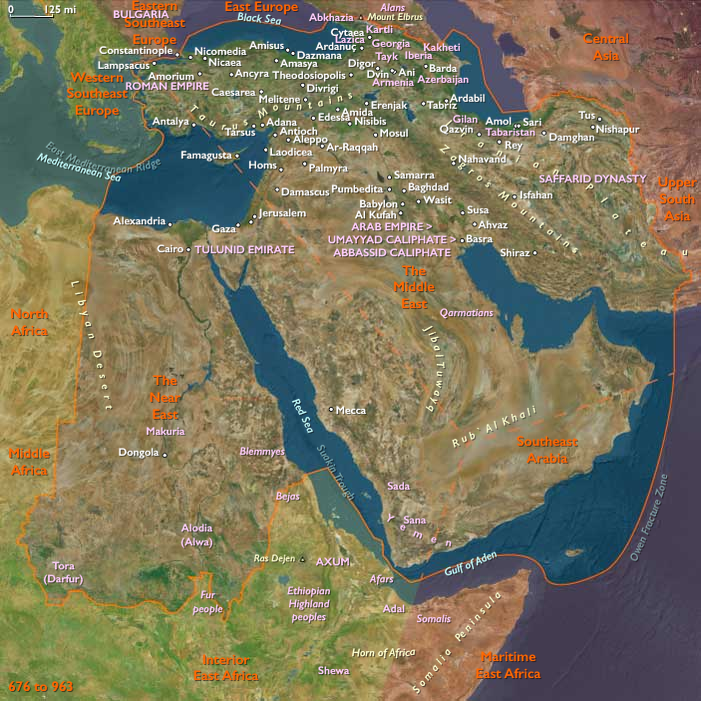
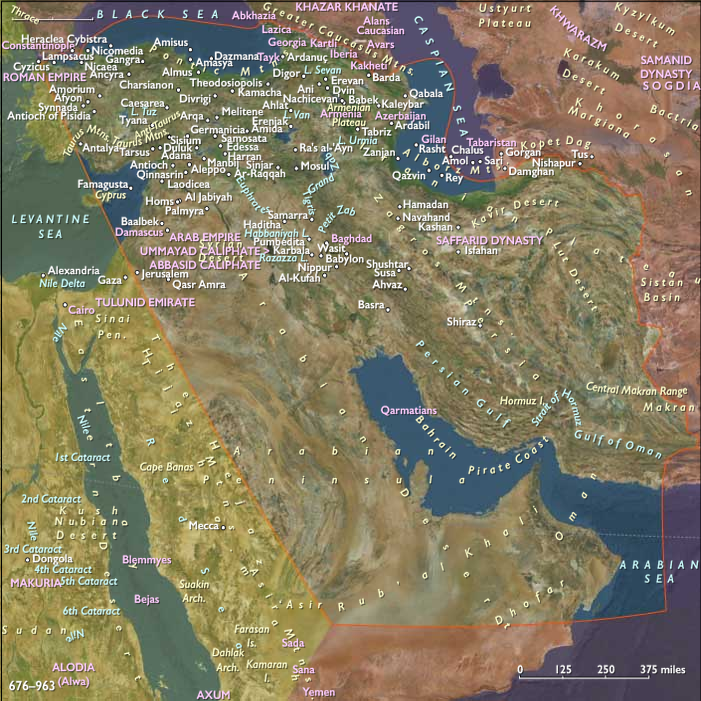
Male and female musicians, who form a class apart, throng the courts of the capital, Damascus.
Many prominent musicians are Arab by birth or acculturation, but the alien element continues to play a predominant role in Islamic music.
As foreign musical influence from the Muslim-held territories of Syria, Egypt, and Persia begins to influence Arabia, the tuning of the 'ud is altered to afford it the range of the Persian lute.
Works on musical theory, drawing upon Syrian and Persian practices, begin to appear.
In one such, written by Ibn Misjah, a musical theorist and a skilled singer and lute player, who dies around 715, the author describes eight melodic modes (“asabi”) and six rhythmic patterns (“iqaat”).
The first and the greatest musician of the Umayyad era, Ibn Misjah, is often honored as the father of Islamic music.
Born in Mecca of a Persian family, Ibn Misjah had traveled to Syria and Persia, learning the theory and practice of Byzantine and Persian music and incorporating much of his acquired knowledge into the Arabian art song.
Although he has adopted new elements such as foreign musical modes, he has rejected other musical traits as unsuitable to Arabian music.
The system of modal theory that he has devised will last throughout the golden age under the first Abbasid caliphs.
(Knowledge of his contributions is contained in the tenth-century Kitab al-Aghani, or “Book of Songs,” by Abu al-Faraj al-Isbahani, the most important source of information about music and musical life in the first three centuries of Islam.)
Locations
People
Groups
Subjects
Regions
Subregions
Years: 714 - 714
Locations
People
Groups
Subjects
Regions
Subregions