The covenant of the League of Arab …
Years: 1945 - 1945
March
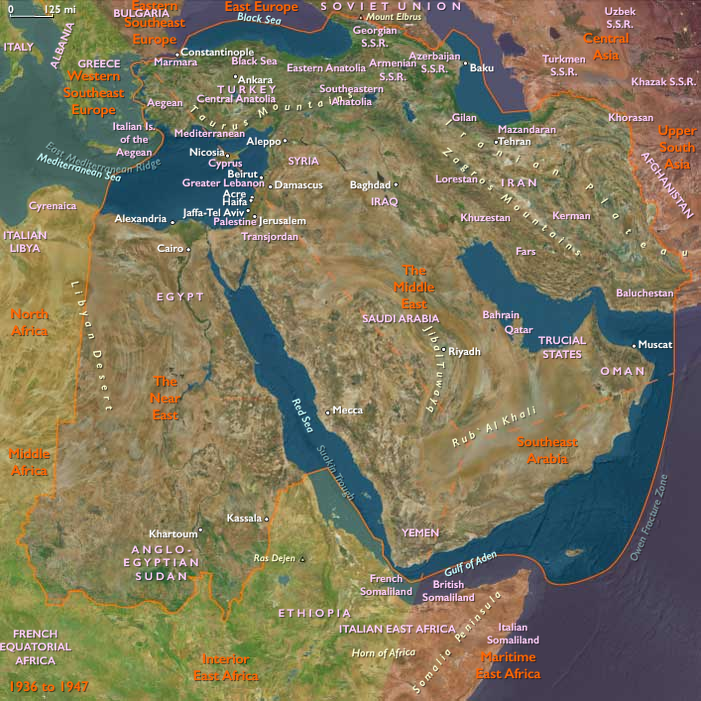
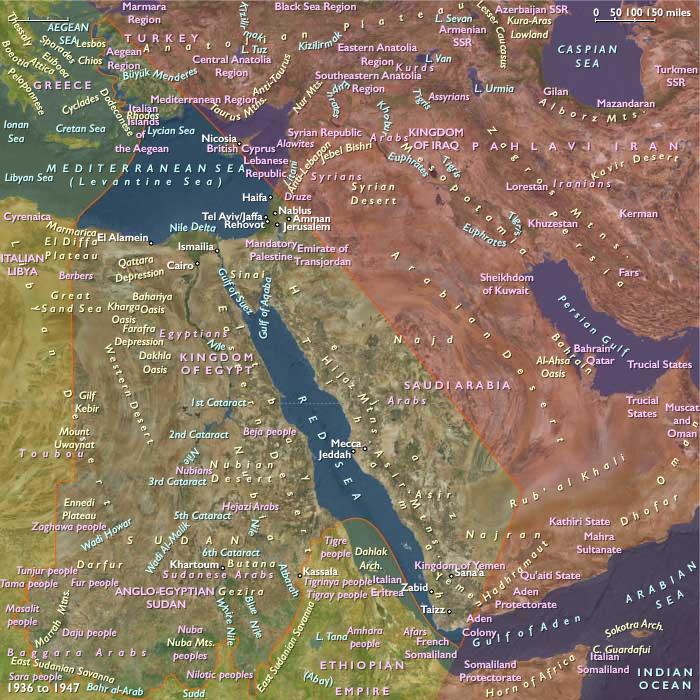
The covenant of the League of Arab States, or Arab League, formed in March 22, 1945, contains an annex emphasizing the Arab character of Palestine and proclaiming its intent to defend it.
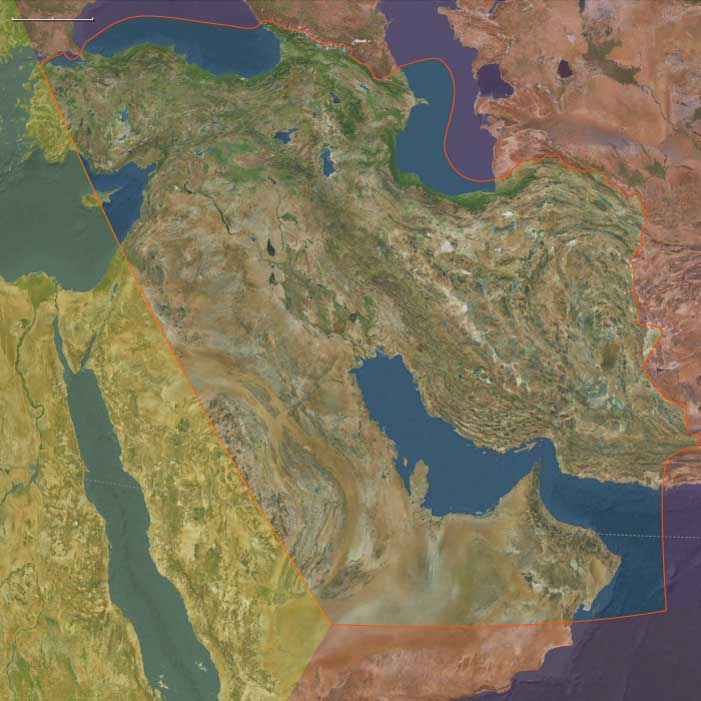
The founding member states are Egypt, Syria, Lebanon, Iraq, Transjordan, Saudi Arabia, and Yemen.
The aims of the league in 1945 are to strengthen and coordinate the political, cultural, economic, and social programs of its members and to mediate disputes among them or between them and third parties.
Locations
Groups
- Arab people
- Arab nationalism
- Yemen, Mutawakkilite Kingdom of (North Yemen)
- Syria, French Mandate of
- Transjordan, Emirate of
- Iraq, Hashemite Kingdom of
- Egypt, Kingdom of (British Protectorate)
- Saudi Arabia, Kingdom of
- Lebanon, Republic of
- Arab League, or League of Arab States
Subjects
Regions
Subregions
Related Events
Filter results
Showing 10 events out of 5226 total
Australian medical scientist Howard Walter Florey, who collaborated with Ernest Boris Chain to purify and test penicillin, shares the 1945 Nobel Prize for physiology of medicine with Chain and penicillin’s discoverer, Alexander Fleming.
Curtin dies in office on July 5, 1945 and is replaced by Francis M. Forde.
In the general elections held later in the year, Labor retains power under prime minister Ben Chifley.
The Americans recover Manila within four weeks, completely clearing the city by March 4, 1945.
The Allied forces in Burma capture Mandlay in March 1945.
Rangoon fall to the Allies on May 3, 1945.
The Japanese forces fall back to the Thai border.
Japan, by early 1945, is near collapse; its supply lines drastically overextended, its raw materials cut off, its air fleet seriously crippled, its merchant fleet decimated, and its navy reduced by 19 aircraft carriers, 11 battleships, 34 cruisers, almost 150 submarines, and dozens of other combat vessels.
Approximately 1.5 million troops remain to defend the home islands; another 3 million fight in China, Manchuria and the Pacific.
Following the capture of Iwo Jima in mid-March, Allied strategist plan the capture of the main island of the southern Ryuku Archipelago, Okinawa, whose airfields lie within about 350 miles (560 kilometers) of Japan.
On April 1, in the Pacific Theater’s largest operation, the US tenth Army begins landing the first of its 172,000 troops.
The Americans, in the face of stiff resistance and 1,500 individual Kamikaze attacks, capture four-fifth of the island within three weeks.
By the time organized Japanese resistance ends on June 17, 12,000 American soldiers are dead or missing and 100,000 Japanese arter dead, many by suicide in avoidance of capture.
In the spring and summer of 1945, the Chinese Nationalists, trained and led by US advisors, launch their first major offensive against the weakened Japanese forces on the Chinese mainland, capturing several major airfields.
As Japan’s military domination crumbles, the increasing political and military contest between China’s Nationalists and Communists becomes entrenched.
By July 5, The Allied reconquest of the Philippines is officially complete.
Japan has lost the supply lines and 400,000 of her finest troops.
Intensive Allied strategic bombing has destroyed almost half of Tokyo by the end of July 1945.
Japanese refusal to surrender to the July 26, 1945 ultimatum issued from Potsdam spurs Truman to order the dropping of an atomic bomb on Hiroshima, population 300,000.
On August 6, the bomb explodes at ground level with a force in excess of 20,000 US tons of TNT, killing at least 78,000 instantly, permanently “disappearing” another 10,000, injuring over 70,000 and destroying over two-thirds of the city.
The USSR declares war on Japan on August 8, 1945, two days after Hiroshima.
On August 9, the Americans drop a second atomic bomb on Nagasaki, population 250,000.
40,000 people die; another 40,000 are injured.
Japan sues for peace the following day, stipulating that the emperor’s position of sovereign ruler be maintained.
On August 11, the Allies reply that that the vivctors will decide the emperor’s status.
The emperor urges unconditional surrender, and an imperial conference accepts the Allied terms on August 14; a cease fire commences the following day.
Indonesia proclaims its independence from the Netherlands on August 17, 1945; her Dutch masters will recognize the new state four years later.
At the end of the Second World War on August 15, 1945, Thailand’s new government, under prime minister Khuang Abhaiwong, issues a proclamation explaining that the 1942 declaration of war is null and void as it had been issued against the wishes of the Thai people.
Japanese representatives formally surrender on September 2, 1945 aboard the US battleship Missouri anchored in Tokyo Bay.
Under the conditions of the Japanese surrender in 1945, all conquered territories are forfeit.
The Japanese return Formosa to China (as Taiwan) as well as Manchuria.
Korea’s independence is re-confirmed, but the Potsdam Conference held by the Allies on August 2 results in the partition of the country along the 38th parallel, mandating a US-dominated sphere of influence in the North and a Soviet sphere in the South.
Indonesian Nationalist Party founder Sukarno proclaims Indonesia’s independence on August 17, 1945.
Vietnam’s Ho pressures Bao Dai to abdicate and proclaims the independence of the Democratic republic of Vietnam on September 2 and becomes the country’s first president.
Laotian nationalist forces oppose the resumption of French control in Laos.
The French begin to establish a semi-independent Laotian state.

On February 19, 1945, 30,000 US Marines land on the battered fortress island of Iwo Jima and wage four days of some of the war’s bloodiest fighting, planting the American flag on the peak of Mt.
Suribachi on February 23.
When the US forces finally secure the island in mid-March, they do so with only 200 Japanese prisoners; the rest of the defenders lie dead.
The Americans prepare to move on Okinawa.
In February 1945, an Air Force plane's engines fail over Iwo Jima as mysterious balls of fire called “foo-fighters” maneuver around it.
Several pilots in the Pacific Theater of War report usually harmless encounters with the so-called foo-fighters, loosely named after the Chinese “foo dog” statues deployed to protect buildings in a manner similar to European gargoyles.
Saudi Arabia finally declares war on Germany in 1945, thus enabling the kingdom to enter the United Nations.
Ibn Sa'ud also joins the Arab League, but does not play a leading part in it since the religious and conservative element in Saudi Arabia opposes cooperation with other Arab states, even when Saudis share common views, as in opposition to Zionism. (In the Arab-Israeli War of 1948, Saudi Arabia will contribute only a token battalion.)
The Ras Tanura refinery opens in 1945.
The viceroy meets with Indian leaders in Simla in 1945 to decide what form of interim government will be acceptable.
No agreement is reached.
New elections to the provincial and central legislatures are ordered, and a three-man team comes from Britain to discuss plans for self-government.
The Cabinet Mission Plan, proposed by Cripps, represents Britain's last, desperate attempt to transfer the power it retains over India to a single union.
The mission puts forward a three-tier federal form of government in which the central government will be limited to power over defense, foreign relations, currency, and communications; significant other power will be delegated to the provinces.
The plan also prescribes the zones that will be created.
Northeastern Bengal and Assam will be joined to form a zone with a slight Muslim majority; in the northwest, Punjab, Sindh, North-West Frontier Province, and Balochistan will be joined for a clear Muslim majority; and the remainder of the country will be the third zone, with a clear Hindu majority.
The approximation of the boundaries of a new Pakistan is clear from the delineation of the zones.
The mission also suggests the right of veto on legislation by communities that see their interests adversely affected.
Finally, the mission proposes the immediate establishment of an interim government and the holding of new elections.
The red-haired fictional character Pippi Longstocking, a strangely dressed girl living alone with her horse and ape, having great wealth and enormous physical strength, is introduced to the world in 1945 by Astrid Lindgren (1907-2002), an influential Swedish writer of children's stories.
An incarnation of every child's dream of freedom and power, Pippi stands totally apart from the conformist demands of everyday life.
Pippi Långstrump (”Pippi Longstocking”), is the first of three books with Pippi as its main character.
Allied troops reach the concentration camps during their April, 1945 push towards Berlin, liberating Buchenwald, Belsen and the extermination center, Dachau.
At Belsen, the Allies find 40,000 emaciated, barely-living inmates amid 10,000 unburied corpses.
On April 12, 1945, American troops reach the Elbe at a crossing only 60 miles (96 kilometers) from Berlin, at which point Eisenhower informs Stalin that he is leaving the German capital to the Red Army.
The Luftwaffe, with no intact airfields, few pilots, and virtually no fuel, is unable to protect the city from systematic pounding by England-based Allied bombing runs and Soviet artillery that turn Berlin’s buildings into ruined shells.
Zhukov launches his final assault on Berlin on April 16, 1945.
The Red Army penetrates to the city’s center as westward-fleeing German soldiers and civilians rush to surrender to the Americans and British in hopes of receiving better treatment from them than from the presumably vengeful Soviets.
The Red Army, now encircling Berlin meets the Americans at Torgau on the Elbe on April 25, 1945.
Hitler appoints Admiral Karl Doenitz as his successor, marries his long-time paramour Eva Braun, and reportedly commits suicide in his Berlin bunker on April 30, 1945.
By some accounts, Hitler allegedly escapes from Berlin after arranging for the fake suicide cover story.
The Allies anounce Hitler's death.
Nazi leader Martin Bormann escapes without a trace from Berlin after supervising Hitler's suicide.
Admiral Doenitz takes command; submarines U-530, U-977 and others begin a secret journey from Norway soon after Quisling allegedly refuses Hitler's offer to take him aboard a submarine to a safe refuge.
General Gehlen, the head of Nazi Intelligence, is captured by the US Army and flown to Washington in 1945.
The Soviets liberate Prague in May 1945, returning Benes to the presidency.
Doenitz orders the surrender of the Third Reich on May 7, 1945.
The Berlin government issues its formal statement of unconditional surrender the following day.
Two months after Germany surrenders, submarines U-530 and U-977 give themselves up in Mar del Plata, Argentina, after allegedly being lost from the submarine convoy taking Hitler and others to their hideout in Antarctica.
From July 17 to August 2, 1945, the Allies hold the Potsdam Conference, in which Stalin, Truman (who has replaced the late Roosevelt) and Churchill, replaced as prime minister during the conference by Clement Atlee, confirm the Yalta plan and agree on plans for Germany’s de-Nazification, demilitarization and democratization.
A mechanism is established to try Nazi leaders and their supporters for war crimes or atrocities.Truman tells Stalin that the atomic bomb recently tested by the US could be used against Japan.
On July 26, Truman, Churchill and Jiang Jeishei call for the unconditional surrender of Japan without mentioning the bomb; Japan does not surrender.
The US and Britain refuse to recognize Poland’s Soviet-installed provisional government as they do not consider it to be based in democatic principles.
The two allies also reject the pro-Soviet puppet regimes in Bulgaria, Hungary and Romania and call for free elections; Stalin demands that the Western Allies recognize the regimes as legitimate governments.
The Allies also disagree over German war reparations and other matters.
The USSR declares war on Japan on August 8, 1945, two days after the atomic bombing of Hiroshima.
Beginning in November 1945, the Allies prosecute war criminals in the Nuremburg Trials at the site of the Nazi party rallies.
Twenty-eight year old Henry Ford II, Edsel’s son, is released from the navy and made executive vice-president, then president of Ford Motor Company in 1945.
He begins to effect a sweeping reorganization of the shaky automotive giant.
Years: 1945 - 1945
March
Locations
Groups
- Arab people
- Arab nationalism
- Yemen, Mutawakkilite Kingdom of (North Yemen)
- Syria, French Mandate of
- Transjordan, Emirate of
- Iraq, Hashemite Kingdom of
- Egypt, Kingdom of (British Protectorate)
- Saudi Arabia, Kingdom of
- Lebanon, Republic of
- Arab League, or League of Arab States