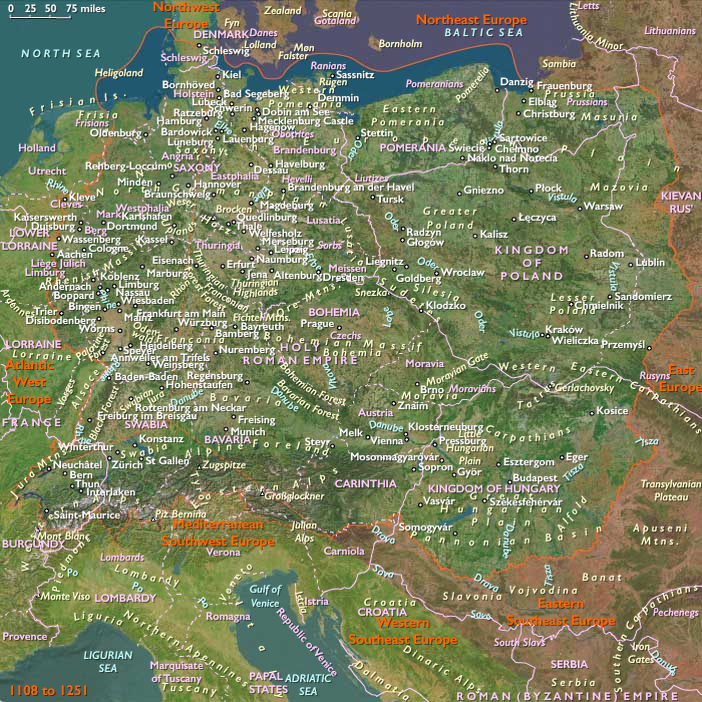
The death of Duke Henry, who had …
Years: 1242 - 1242
The death of Duke Henry, who had been close to unifying the Polish lands and reversing their fragmentation, has set back the unification of Poland, and also means the loss of Silesia, which will drift outside the Polish sphere of influence until the unification takes place in the fourteenth century.
Locations
Groups
- Poles (West Slavs)
- Mongols
- Poland during the period of fragmentation, Kingdom of
- Silesia, Duchy of
- Seniorate Province (Duchy of Kraków)
- Mongol Empire
Topics
Commodoties
Subjects
Regions
Subregions
Related Events
Filter results
Showing 10 events out of 46787 total
The Mongol invaders have reached the Austrian borders and the Adriatic shores in Dalmatia.
At this time, Croatia is part of Hungary, since it had been conquered by the Kingdom of Hungary in 1091.
The Mongols appoint a darughachi in Hungary and mint coins in the name of the Khagan.
The country of Béla is assigned to Orda by Batu as an appanage.
At least twenty to fort percent of the population has died by slaughter or epidemic.
But while the Mongols claim control of Hungary, they cannot occupy fortified cities such as Fehérvár, Esztergom, Veszprém, Tihany, Győr, Pannonhalma, Moson, Sopron, Vasvár, Újhely, Zala, Lockenhaus, Bratislava, Nitra, Komárom, Fiľakovo and Abaújvár.
The Hungarians having learned from this lesson, fortresses will come to play a significant role in Hungary.
The Mongols regain impetus in the spring of 1242 and extend their control into Austria and Dalmatia and Moravia.
Ögedei Khan had granted permission to invade the remainder of Europe, all the way to the "Great Sea", the Atlantic Ocean, and it may only be his only his death in December 1241 that prevents the possible invasions of Austria, Germany, Italy, France, and Spain, and the remaining small European principalities.
Indeed, Mongol forces are moving on Vienna, launching a fierce winter campaign against Austria and Germany in the first wave into Western Europe, when news of Ögedei’s death of reaches the western Mongol army.
Bowing to the rules of succession promulgated by Genghis Khan, the Mongols recall all their forces and prepare to return to the Mongol capital, Karakorum, to participate in the election of a new Great Khan.
Batu, who is one of the contenders to the imperial throne, returns at once with his armies to Asia, leaving the whole of Eastern Europe depopulated and in ruins.
Before withdrawal, Batu orders the wholesale execution of prisoners, but because of his withdrawal, Western Europe escapes unscathed from the Mongol invasion.

The kingdom of Hungary does not exist for a year. (So nearly complete is the country's destruction that future Hungarians, when referring to total calamity, will use the word tatárjárás, meaning Tatar invasion.)
Had the Great Khan not died, much of Europe might have suffered a similar fate.
Batu Khan had told Subutai to plan to conquer all the way to "the great sea," (the Atlantic), and they had been putting the final touches on a plan to begin that conquest with an attack on Austria and Germany the following winter.
The Mongols prefer to fight in winter, using frozen lakes and rivers as highways to move at a pace that will see not equal until Germany's blitzkreig that opens the Second World War, whereas the heavily armored European knights can barely fight at all in winter weather.
The Bulgarians are forced to pay tribute to the Mongol following the Mongol invasion of 1242.
The neighboring regions of present Moldavia and Wallachia come under the direct control of the Mongol Golden Horde.
Kaykhusraw finally corners and defeats the rebels near Kirsehir, probably in 1242 or early 1243.
Simon of Saint-Quentin credits the victory to a large number of Frankish mercenaries employed by the sultan.
Emperor John III of Nicaea launches another attack on the Despotate of Epirus in 1242, greatly reducing Epirus' territory.
The property of Guglielmo II of Adelardi, the last of the House of Adelardi, had passed, at his death in 1146, as the dowry of his niece the Marchesella, to Obizzo I of Este.
There had been considerable hostility between the newly entered Este family and the prominent Salinguerra family, but after considerable struggles Azzo VII of Este is nominated perpetual podestà in 1242.
The Burning of the Talmud in Paris (1242): A Tragic Episode of Religious Persecution
In 1242, Christian zealots in Paris burned twenty-four cartloads of Talmud manuscripts, marking one of the most devastating acts of cultural and religious suppression against the Jewish community in medieval France. This event was part of a larger campaign of anti-Jewish persecution fueled by papal and royal policies.
Background: The Anti-Talmud Campaign
- In 1239, Pope Gregory IX issued a decree calling for an investigation of the Talmud, following accusations that it contained blasphemous statements against Christianity.
- The accusations originated from converted Jews, particularly Nicholas Donin, a former Jewish scholar who had joined the Franciscan Order and became a leading anti-Talmud advocate.
- Gregory’s decree led to mass confiscations of Talmudic manuscripts across Europe, especially in France.
The Trial of the Talmud and the Mass Burning (1240–1242)
-
The Paris Disputation (1240)
- At the order of King Louis IX (Saint Louis), a public disputation was held in Paris in 1240 between:
- Nicholas Donin, representing Christian authorities.
- Four of France’s leading rabbis, including Rabbi Yechiel of Paris.
- The trial was highly biased, and the rabbis were unable to defend the Talmud adequately in the face of predetermined accusations.
- At the order of King Louis IX (Saint Louis), a public disputation was held in Paris in 1240 between:
-
The Verdict and the Burning of the Talmud (1242)
- The Talmud was declared heretical, and King Louis IX ordered all copies seized.
- In 1242, twenty-four cartloads of handwritten Talmud manuscripts—representing centuries of Jewish scholarship—were publicly burned in Paris’ central marketplace (Place de Grève).
Consequences of the Talmud Burning
-
A Devastating Loss for Jewish Learning
- The destruction of thousands of manuscript pages was a cultural catastrophe, eliminating irreplaceable religious and scholarly texts.
-
Increased Persecution of Jews in France
- The event marked a new phase of anti-Jewish policies in France, culminating in the expulsion of Jews under Philip IV in 1306.
-
Louis IX’s Role in Anti-Jewish Legislation
- King Louis IX (Saint Louis) was known for his deep hostility toward Jews and later told Christians to dispute with Jews only by "thrusting a sword into them".
-
A Precedent for Later Censorship
- The 1242 burning of the Talmud set a precedent for future censorship of Jewish texts, influencing later papal restrictions and Inquisition policies.
Legacy
The burning of the Talmud in Paris in 1242 remains one of the most infamous acts of medieval anti-Semitism, symbolizing the intellectual repression and religious intolerance faced by Jewish communities in Christian Europe. It was a harbinger of future persecutions, as Jewish scholars struggled to preserve their sacred texts and traditions in the face of systematic suppression.
Simon de Montfort and Henry III’s Failed Invasion of France (1242): The Capetian Victory at Taillebourg and Saintes
Simon de Montfort, a French noble by birth, went to England in 1229 to claim family lands and the earldom of Leicester. By 1238, he had joined the court of Henry III and strengthened his position by marrying Eleanor of England, the king’s sister.
When Henry III invaded France in 1242, de Montfort joined the campaign, despite his past conflicts and reconciliations with Henry. However, the campaign ended in disaster for the English, as Louis IX decisively defeated them at the Battles of Taillebourg and Saintes, securing Capetian dominance over Poitou.
Henry III’s Attempt to Reclaim Poitou
- Henry III allied with rebellious vassals in southern France, hoping to restore Plantagenet influence in Poitou.
- His invasion was poorly coordinated, facing the well-organized and disciplined forces of Louis IX of France.
- Simon de Montfort accompanied Henry, despite their prior disputes.
The French Victory at Taillebourg and Saintes (July 1242)
- Louis IX met Henry III’s army at Taillebourg on July 21, 1242.
- The French forces, better prepared and numerically superior, overwhelmed the English and their allies.
- After a crushing defeat, Henry retreated to Saintes, but Louis pursued him, forcing a final confrontation.
- The Battle of Saintes (July 24–26, 1242) further demoralized Henry’s Poitevin allies, leading to their collapse.
Aftermath: Henry III’s Retreat and Truce at Bordeaux
- Henry III, realizing the war was lost, was forced to seek a truce.
- In Bordeaux, a peace agreement was arranged, effectively ending Plantagenet ambitions in Poitou.
- The southern French lords abandoned their rebellion, leaving Louis IX’s authority unchallenged in the region.
Impact on Simon de Montfort
- The failed campaign further strained de Montfort’s relationship with Henry III.
- De Montfort would later turn against the king, becoming a leader of the English baronial opposition and a key figure in the Second Barons’ War (1264–1267).
The French victories at Taillebourg and Saintes in 1242 were a decisive moment in the Capetian-Plantagenet struggle, securing Capetian control over western France and further weakening English claims on the Continent.
Walram I, Count of Nassau, had received the area around Wiesbaden as a fiefdom in the 1170s.
When Franconia fragmented in the early thirteenth century, Nassau had emerged as an independent state as part of the Holy Roman Empire.
Wiesbaden had in 1232 become a reichsstadt, an imperial city, of the Holy Roman Empire I.
However, the Archbishop of Mainz, Siegfried III, orders the city's destruction in 1242 during the war of Emperor Frederick II against the Pope.
The Mongols' pursuit of Béla IV has continued from Zagreb through Pannonia to Dalmatia.
The Mongols have chased Béla IV from town to town in Dalmatia, while Croatian nobility and Dalmatian towns such as Trogir and …
Years: 1242 - 1242
Locations
Groups
- Poles (West Slavs)
- Mongols
- Poland during the period of fragmentation, Kingdom of
- Silesia, Duchy of
- Seniorate Province (Duchy of Kraków)
- Mongol Empire