
The Dutch stadtholder Frederick Henry had given …
Years: 1650 - 1650
November
The Dutch stadtholder Frederick Henry had given major financial support during the English Civil War to Charles I, to whom he had close family ties, and had often been on the brink of intervening with his powerful army.
When Charles was beheaded, the Dutch were outraged by the regicide.
Oliver Cromwell therefore considers the Dutch Republic as an enemy.
Nevertheless the Commonwealth and The Republic have many things in common: they are both republican and Protestant.
When after the death of Frederick Henry in 1647 his son, stadtholder William II, Prince of Orange, had tried to fulfill the monarchical aspirations his late father had always fostered by establishing a military dictatorship, the States of Holland had made overtures to Cromwell, seeking his support against William, suggesting vaguely that the province of Holland might join the Commonwealth.
William suddenly dies of smallpox in 1650, however, so there is no longer any need for Cromwell's support against him.
Eight days later, William Henry of Orange, born in The Hague in the Dutch Republic on November 14, 1650, is the only child of stadtholder William II, and Mary, Princess Royal.
Mary is the eldest daughter of King Charles I of England, Scotland and Ireland, and sister of King Charles II and King James II.
Thus, William is the Sovereign Prince of Orange from the moment of his birth.
Immediately a conflict ensues between the Princess Royal and William II's mother, Amalia of Solms-Braunfels, over the name to be given to the infant.
Mary wants to name him Charles after her brother, but her mother-in-law insists on giving him the name William or Willem to bolster his prospects of becoming stadtholder.
William II had appointed his wife as his son's guardian in his will; however the document remained unsigned at William II's death and is void.
At William's father's death, the provinces had suspended the office of stadtholder; thus, the United Provinces now become a true republic.
However, rivalry between the two main factions in Dutch society, the Staatsgezinden (Republicans) and the Prinsgezinden (Royalists or Orangists) will sap the strength and unity of the country in the the long term.
Locations
People
Groups
Subjects
Regions
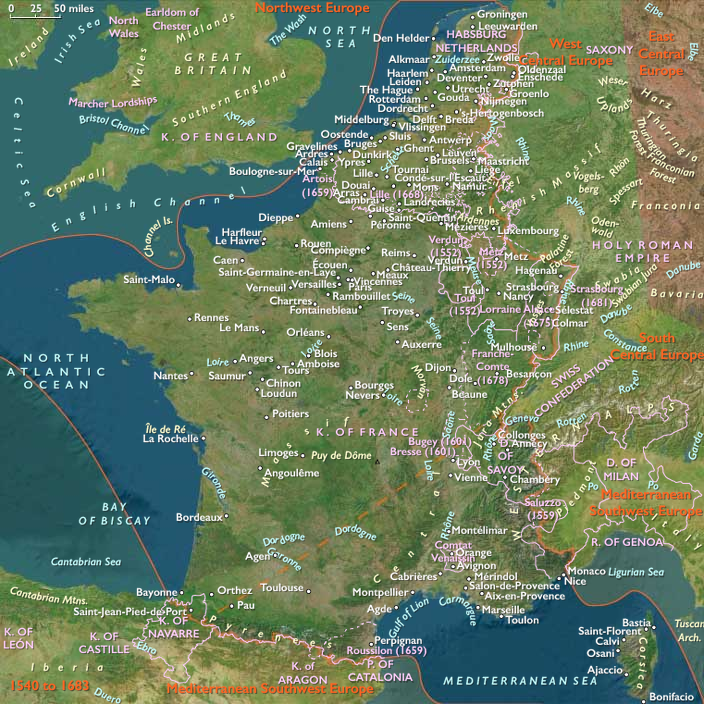
Subregions
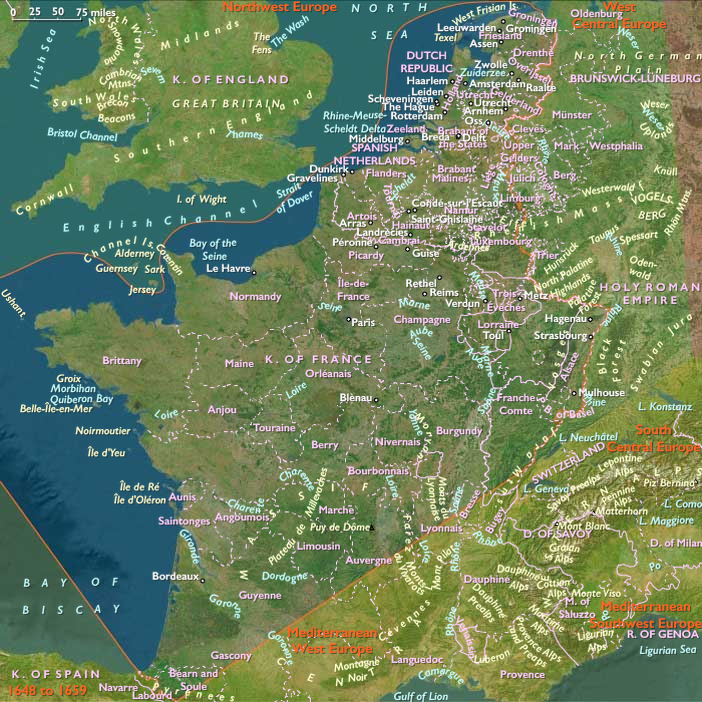
Related Events
Showing 10 events out of 31777 total
Years: 1650 - 1650
November
Locations
People
Groups
Subjects
Regions
Subregions