
The Persians were led during the seventh …
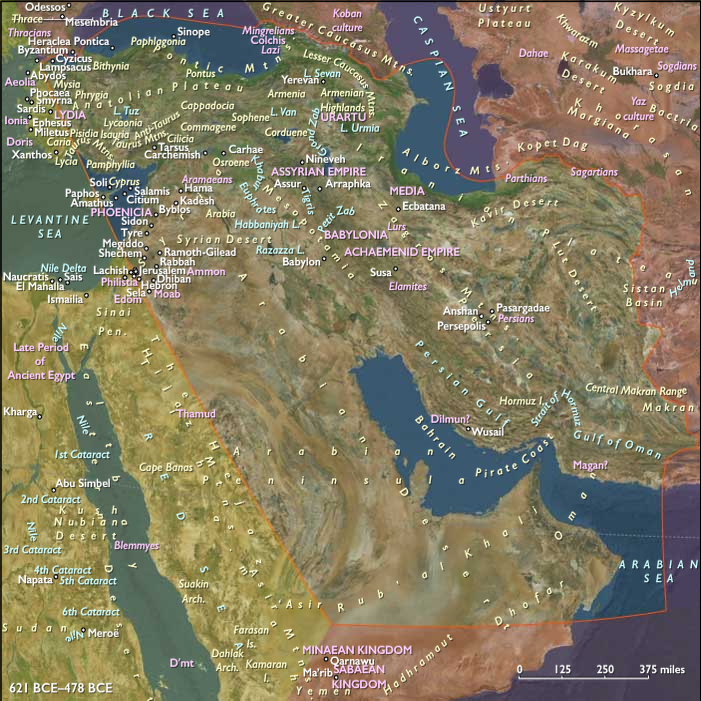
Years: 621BCE - 478BCE
A descendant, Cyrus II (also known as Cyrus the Great or Cyrus the Elder), leads the combined forces of the Medes and the Persians to establish the most extensive empire known in the ancient world.
Cyrus defeats Croesus, the Lydian king of fabled wealth, by 546 BCE and secures control of the Aegean coast of Asia Minor, Armenia, and the Greek colonies along the Levant.
Moving east, he takes Parthia (land of the Arsacids, not to be confused with Parsa, which is to the southwest), Chorasmia (Khwarezm), and Bactria.
He besieges and captures Babylon in 539 BCE and releases the Judahites who had been held captive there, thus earning his immortalization in the Book of Isaiah.
When Cyrus dies in 529 BCE, his kingdom extends as far east as the Hindu Kush in present-day Afghanistan.
Cyrus's successors are less successful.
His unstable son, Cambyses II, conquers Egypt in 525 BCE but later commits suicide during a revolt led by a priest, Gaumata, who holds the throne until 522 BCE, when he is overthrown by a member of a lateral branch of the Achaemenian family, Darius I (also known as Darayarahush and Darius the Great).
Darius attacks the Greek mainland, which has supported rebellious Greek colonies under his aegis, but his defeat at the Battle of Marathon in 490 BCE forces him to retract the limits of the empire to Asia Minor.
The Achaemenians hereafter consolidated areas firmly under their control.
It is Cyrus and Darius who, by sound and farsighted administrative planning, brilliant military maneuvering, and a humanistic worldview, establish the greatness of the Achaemenians, raising them in less than thirty years from an obscure tribe to a world power.
The quality of the Achaemenians as rulers begins to disintegrate, however, after the death of Darius in 486 BCE.
His son and successor, Xerxes, chiefly occupies himself with suppressing revolts in Egypt and Babylonia.
He also attempts to conquer the Greek Peloponnesus, but, encouraged by a victory at Thermopylae, he overextends his forces and suffers overwhelming defeats at Salamis and Plataea.
People
Groups
- Medes
- Lydia, Kingdom of
- Persian people
- Greeks, Classical
- Judahites
- Achaemenid Empire
- Achaemenid, or First Persian, Empire
Topics
- Iron Age, Near and Middle East
- Babylonian Captivity
- Persian Conquests of 559-509 BCE
- Persian Revolt
- Persian-Lydian War of 547-546 BCE
- Persian Civil War of 522-521 BCE
- Ionian Revolt
- Persian Invasion of Greece, First
- Marathon, Battle of
- Salamis, Battle of
- Persian Invasion of Greece, Second
- Thermopylae, Battle of
Subjects
Regions
Subregions
Years: 621BCE - 478BCE
People
Groups
- Medes
- Lydia, Kingdom of
- Persian people
- Greeks, Classical
- Judahites
- Achaemenid Empire
- Achaemenid, or First Persian, Empire
Topics
- Iron Age, Near and Middle East
- Babylonian Captivity
- Persian Conquests of 559-509 BCE
- Persian Revolt
- Persian-Lydian War of 547-546 BCE
- Persian Civil War of 522-521 BCE
- Ionian Revolt
- Persian Invasion of Greece, First
- Marathon, Battle of
- Salamis, Battle of
- Persian Invasion of Greece, Second
- Thermopylae, Battle of
Subjects
Regions
Subregions