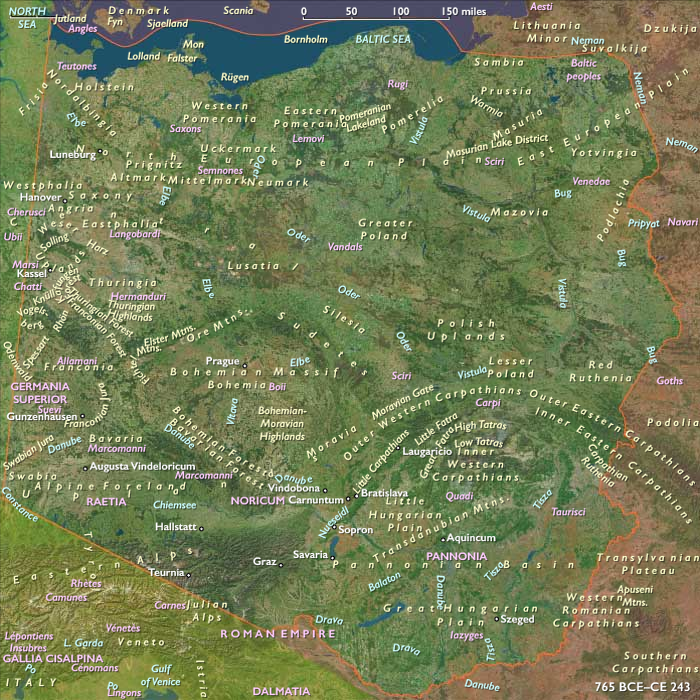
The emperor arrives at Carnuntum in August …
Years: 178 - 178
The emperor arrives at Carnuntum in August 178, and sets out to quell the rebellion in a repeat of his first campaign, moving first against the Marcomanni.
Locations
People
Groups
- Sarmatians
- Iazyges, or Iazygians
- Costoboci
- Lacringi
- Hasdingi
- Marcomanni (Germanic tribe)
- Lombards (West Germanic tribe)
- Roman Empire (Rome): Nerva-Antonine dynasty
- Dacia, Roman
- Pannonia Superior (Roman province)
Topics
Subjects
Regions
Subregions
Related Events
Filter results
Showing 10 events out of 60931 total
Emperor Ling's wife Empress Song, whom he had made empress in 171 but has never favored, falls victim to the eunuchs in 178.
Her aunt, Lady Song, is Prince Kui's wife, and the eunuchs have been concerned that if she were to become powerful, she would avenge her aunt.
In alliance with the imperial consorts who wish to replace Empress Song, the eunuchs falsely accused her of using witchcraft to curse the emperor.
Emperor Ling believes them and deposes Empress Song, who, imprisoned, dies in despair.
Her father Song Feng and her brothers are executed.
Emperor Ling carries out a plan in 178 that greatly damages the authority of the imperial government and harms the people even more by selling offices of all kinds.
The people who purchases these offices then become extremely corrupt while in office—this, in fact, is according to the Emperor’s plan, for he allows people without the necessary resources to set up installment payment plans after they are placed in office.
The Montanist movement, which originated in Asia Minor, has made its way to Rome and Gaul in the second half of the second century, around the reign of Eleuterus.
Its nature does not diverge so much from the orthodoxy of the time for it to initially be labeled heresy.
During the violent persecution at Lyon, in 177, local confessors had written from their prison concerning the new movement to the Asiatic and Phrygian communities, and also to Pope Eleuterus.
The bearer of their letter to the pope is the presbyter Irenaeus, soon to become Bishop of Lyon.
It appears from statements of Eusebius concerning these letters that the Christians of Lyon, though opposed to the Montanist movement, advocated patience and pleaded for the preservation of ecclesiastical unity.
Exactly when the Roman Catholic Church takes its definite stand against Montanism is not known with any certainty.
It would seem from Tertullian's account (adv. Praxeam, I) that a Roman bishop did send some conciliatory letters to the Montanists, but these letters, says Tertullian, were subsequently recalled.
He probably refers to Pope Eleuterus, who long hesitated, but after a conscientious and thorough study of the situation, is supposed to have declared against the Montanists.
At Rome, the Gnostics and Marcionites continue to preach against the orthodox church.
The Liber Pontificalis ascribes to Pope Eleutherius a decree that no kind of food should be despised by Christians (Et hoc iterum firmavit ut nulla esca a Christianis repudiaretur, maxime fidelibus, quod Deus creavit, quæ tamen rationalis et humana est).
Possibly he did issue such an edict against the Gnostics and Montanists; it is also possible that on his own responsibility, the writer of the Liber Pontificalis attributed to this pope a similar decree current about the year 500.
Emperor Ling creates Consort He as the new empress and makes her brother He Jin a key official in his government in 180.
(According to legends, she had initially been selected as an imperial consort because her family had bribed the eunuchs.)
She receives the empress position because she has given birth to Emperor Ling's son Liu Bian.
During the past few years, Emperor Ling has become interested in heavy spending to build imperial gardens, and to finance them he has ordered the prefectures and principalities to offer tributes to him personally.
This in turn has created pressures for officials to become corrupt.
However, he also listens to good advice at times, but does not follow his advisors consistently.
For the more honest of his officials, it has become a frustrating exercise to try to persuade Emperor Ling on points that are beneficial to the people—because he can in fact sometimes be persuaded, but not usually.
Evidence of Han-era mechanical engineering comes largely from the choice observational writings of sometimes disinterested Confucian scholars.
Professional artisan-engineers do not leave behind detailed records of their work.
Han scholars, who often have little or no expertise in mechanical engineering, sometimes provide insufficient information on the various technologies they describe.
Nevertheless, some Han literary sources provide crucial information.
For example, in 15 BCE the philosopher Yang Xiong described the invention of the belt drive for a quilling machine, which was of great importance to early textile manufacturing.
The inventions of the artisan-engineer Ding Huan are mentioned in the Miscellaneous Notes on the Western Capital.
Around 180 CE, Ding creates a manually operated rotary fan used for air conditioning within palace buildings.
Ding also uses gimbals as pivotal supports for one of his incense burners and invented the world's first known zoetrope lamp.
(Needham, Joseph.
[1986c].
Science and Civilisation in China: Volume 4, Physics and Physical Technology; Part 2, Mechanical Engineering.
Taipei: Caves Books Ltd) Modern archaeology has led to the discovery of Han artwork portraying inventions which are otherwise absent in Han literary sources.
As observed in Han miniature tomb models, but not in literary sources, the crank handle is used to operate the fans of winnowing machines that separate grain from chaff.
The odometer cart, invented during Han times, measures journey lengths, using mechanical figures banging drums and gongs to indicate each distance traveled.
This invention is depicted in Han artwork by the second century CE, yet detailed written descriptions are not offered until the third century CE.
Modern archaeologists have also unearthed specimens of devices used during the Han Dynasty, for example a pair of sliding metal calipers used by craftsmen for making minute measurements.
These calipers contain inscriptions of the exact day and year they were manufactured.
These tools are not mentioned in any Han literary sources.

Marcus Aurelius, a philosopher emperor, has lowered taxes and displayed charity toward the less fortunate.
He keeps, even during his campaigns against the Germans, a "spiritual diary," later known as the Meditations, which document his internal struggle to reconcile his Stoic philosophy of virtue and self-sacrifice with his role as a warrior-sovereign.
Marcus' Meditations offer a window on his inner life, but are largely undatable, and make few specific references to worldly affairs.
Marcus Aurelius has written the twelve books of the Meditations in Koine Greek as a source for his own guidance and self-improvement.
It is possible that large portions of the work were written at Sirmium, where he spends much time planning military campaigns from 170 to 180.
Some of it was written while he was positioned at Aquincum on campaign in Pannonia, because internal notes tell us that the second book was written when he was campaigning against the Quadi on the river Granova (modern-day Hron) and the third book was written at Carnuntum.
It is not clear that he ever intended the writings to be published, so the title Meditations is but one of several commonly assigned to the collection.
These writings take the form of quotations varying in length from one sentence to long paragraphs.
His stoic ideas often involve avoiding indulgence in sensory affections, a skill which, he says, will free a man from the pains and pleasures of the material world.
He claims that the only way a man can be harmed by others is to allow his reaction to overpower him.
An order or logos permeates existence.
Rationality and clearmindedness allow one to live in harmony with the logos.
This allows one to rise above faulty perceptions of "good" and "bad".
Having acquired the reputation of a philosopher king within his lifetime, the title will remain his after death; both Dio Cassius and the biographer call him "the philosopher".
Christians—Justin Martyr, Athenagoras, Melito—give him the title as well.
The emperor is immediately deified and his ashes are returned to Rome, and rest in Hadrian's mausoleum (modern Castel Sant'Angelo) until the Visigoth sack of the city in 410.
His campaigns against Germans and Sarmatians will also be commemorated by a column and a temple built in Rome.
Commodus has little interest in pursuing the war.
Against the advice of his senior generals, after negotiating a peace treaty with the Marcomanni and the Quadi, he leaves for Rome in early autumn 180, where he celebrates a triumph for the conclusion of the wars on October 22.
Marcus moves against the Quadi in 179-180, chasing them westwards, deeper into Greater Germania, where the praetorian prefect Tarutenius Paternus later achieves another decisive victory against them.
The inhabitants of Pannonia have retained their own culture into the second century CE, but Romanization has proceeded rapidly, especially in the west.
Pannonia Superior is the focal point of the Roman wars with the Marcomanni in the reign of Marcus Aurelius, who is determined to pass from defense to offense and to an expansionist redrawing of Rome's northern boundaries.
His determination seems to be winning success when, on March 17, 180, he dies at his military headquarters at Vindobona (modern Vienna), having just had time to commend to the regime's chief advisers to his son Commodus, who quickly comes to terms with the Germans.
The Romans, under the command of Marcus Valerius Maximianus, fight and prevail against the Quadi in a decisive battle at Laugaricio (near modern Trenčín, Slovakia).
After the decisive victory in 178, the plan to annex Bohemia seems poised for success.
The death of Marcus Aurelius from plague while campaigning in 180, has left his son and heir Commodus with the unwinnable Danubian war and a treasury that has been seriously depleted by Marcus's wars and benevolences.
In a move that many Romans consider treasonable, Commodus abandons his father's military campaign against the German tribes and returns to Rome to ascend the imperial throne.
Marcus’s choice of Commodus as his successor, putting an end to the series of "adoptive emperors", will be highly criticized by later historians since Commodus was a political and military outsider, as well as an extreme egotist with neurotic problems.
Commodus devalues the Roman currency upon his accession, reducing the weight of the denarius from ninety-six per Roman pound to one hundred and five (3.85 grams to 3.35 grams).
He also reduces the silver purity from seventy-nine percent to seventy-six percent—the silver weight dropping from 2.57 grams to 2.34 grams.
Unlike the preceding Emperors Trajan, Hadrian, Antoninus Pius and Marcus Aurelius, Commodus seems to have had little interest in the business of administration and will tend throughout his reign to leave the practical running of the state to a succession of favorites, beginning at this time with Saoterus, a freedman from Nicomedia who had become his chamberlain.
Years: 178 - 178
Locations
People
Groups
- Sarmatians
- Iazyges, or Iazygians
- Costoboci
- Lacringi
- Hasdingi
- Marcomanni (Germanic tribe)
- Lombards (West Germanic tribe)
- Roman Empire (Rome): Nerva-Antonine dynasty
- Dacia, Roman
- Pannonia Superior (Roman province)